

Legs: where the front-pairing run starts
Content version · · Sources & references
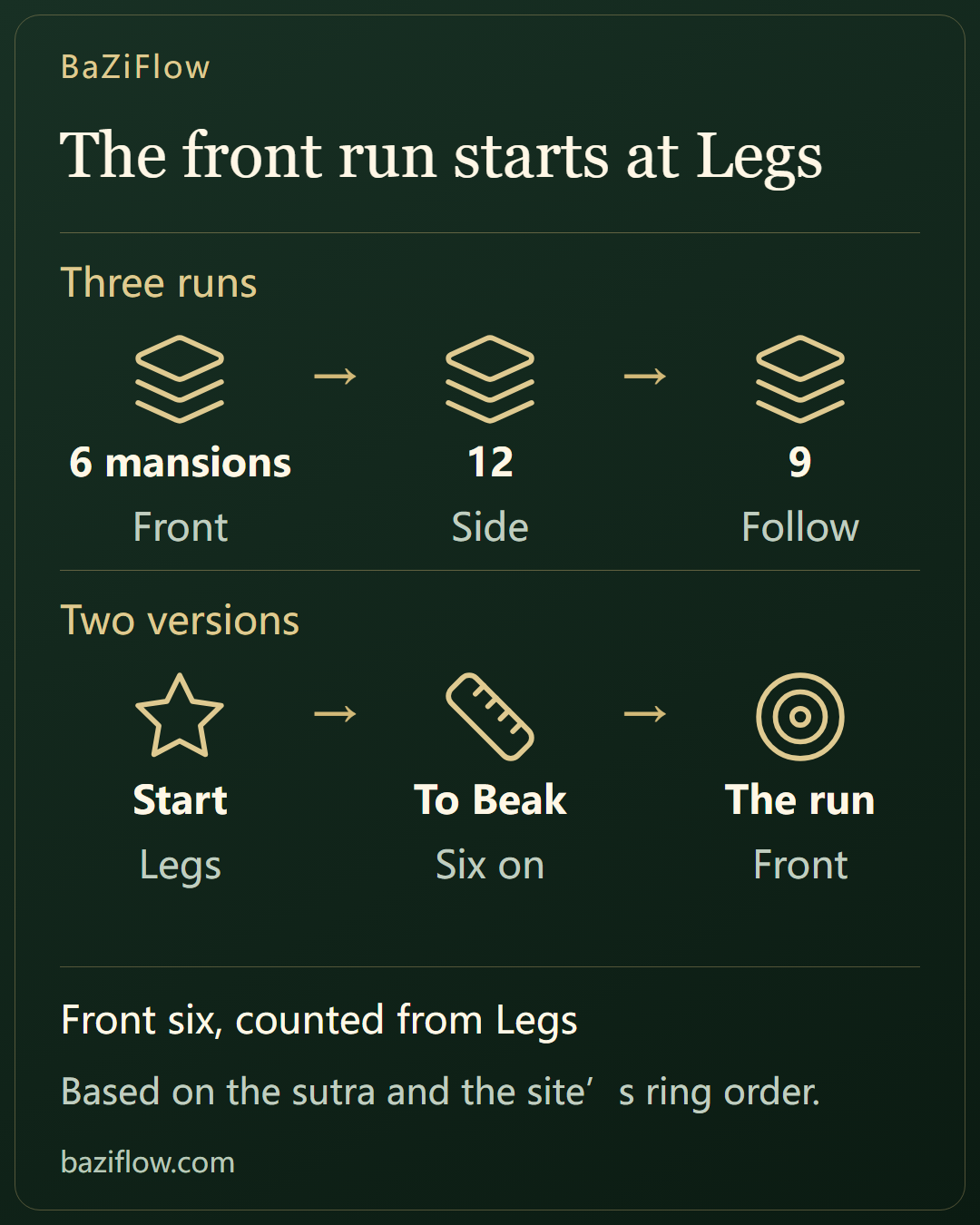
Legs (奎) is position 25 on the 27-mansion ring. By the Moon’s position against each mansion the sutra splits the 27 into six front, twelve side-by-side and nine following mansions, and the front run is counted from Legs.
The short version6 min read
Legs (奎, Kei in Japanese) is position 25 on the site’s ring. By the Moon’s position against each mansion the sutra splits the 27 into front, side-by-side and following pairings, and the front run is counted from Legs.
- The three pairings hold 6, 12 and 9 mansions, 27 in all. The front six are Legs, Bond, Stomach, Hairy Head, Net and Turtle Beak, with Legs first, which fits the verse’s "count from Legs".
- The same verse appears once in each fascicle with different wording: the first fascicle ends with the Legs mansion being on duty, and the second ends "count from the Legs mansion".
- The Legs picture gives thirty-two stars shaped like a small boat, while Jingfeng’s note counts sixteen in Chinese astronomy, exactly half the picture’s number and the only picture count above six.
Read first
What is Sukuyō astrology? How a birth mansion is found ↗
Sukuyō 27 mansions vs the 28 lunar mansions: what is the difference? ↗
Three ways the Moon can meet a mansion
In the sutra the 27 mansions are an even scale, four feet each. In the sky, though, mansions are broad or narrow and the Moon covers different distances on different days, so the two sets of numbers do not line up everywhere. Someone in the sutra raises exactly this:
The twenty-seven mansions are broad or narrow but are divided evenly by four feet; the Moon runs ahead or behind, and checking the sky disagrees with the rule.
The answer sorts the meetings between Moon and mansion into three kinds:
There are three ways a mansion and the Moon can meet: the front pairing, the following pairing and the side-by-side pairing.
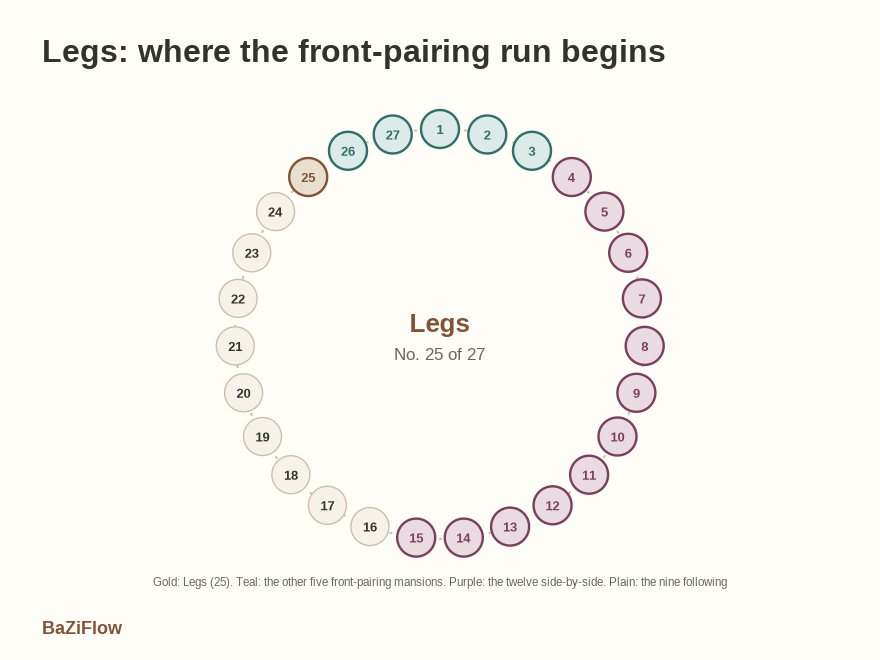
The ring lists the 27 mansions in the sutra’s order with even spacing, which says nothing about their widths in the sky; the three runs come from one question and answer in the first fascicle.
Gold marks Legs (奎), teal marks the other five front-pairing mansions, purple marks the twelve side-by-side ones, and the plain circles are the nine following mansions. The front run starts at Legs, and the seam falls between Wall (壁) and Legs.
The sutra draws the three kinds like this:
Enlarge diagram · scroll sideways to read
On which way is "front", Jingfeng’s note says one line:
By the rule of the heavens, west is front and east is back.
The second fascicle describes the front six as "the Moon has not yet reached the mansion, and then the Moon is said to be on duty in that mansion". The two descriptions of "front" appear to point in opposite directions, and the text at hand does not reconcile them. This article records both side by side and offers no guess that would smooth them over.
Six, twelve and nine: the three lists
On the ring the three lists are three unbroken stretches. Cut the ring open at Legs, call Legs position 0, and the stretches run 6, 12 and 9:
Enlarge diagram · scroll sideways to read
In the site’s ring order the front run is positions 25 to 27 and 1 to 3, the side-by-side run is positions 4 to 15, and the following run is positions 16 to 24. The front six are the seven western mansions less the last one, Three Stars (参), and the following run ends at Wall, one step before Legs, which closes the circle.
One verse, written twice
The three pairings are packed into a four-line verse, which appears in the first fascicle and again in the second. The second line is the same in both; the other three differ:
Enlarge diagram · scroll sideways to read
The last line deserves attention. The first fascicle says the Legs mansion is on duty, and the second says "count from the Legs mansion", which names the starting point more clearly. The second fascicle then unpacks the verse line by line:
Six not yet arrived are the front pairing: from Legs, Bond, Stomach, Hairy Head, Net and Turtle Beak; for these six, when the Moon has not yet reached the mansion, the Moon is said to be on duty in that mansion.
So the list "Legs, Bond, Stomach, Hairy Head, Net, Turtle Beak" and "count from Legs" say one thing: the list is written in exactly that order. Cite the fascicle when quoting the verse, because the two versions are not interchangeable.
The Legs picture: thirty-two stars or sixteen
The Legs picture opens:
Legs has thirty-two stars, shaped like a small boat.
At the end of the entry Jingfeng gives the Chinese count:
In Chinese astronomy, Legs has sixteen stars.
Thirty-two is exactly twice sixteen. Only ten of the 27 mansions have the same count in both layers, and Legs is not one of them. Picture counts are mostly single digits, topping out at six for Hairy Head, Willow and Star, so thirty-two is the one exception. The full comparison is in the article on Rooftop.
In the site’s month table (Japanese old calendar, new moon fixed by Tokyo time) Legs opens month 2, and it falls on these old-calendar days: month 1, days 3 and 30; month 2, days 1 and 28; month 3, day 26; month 4, day 24; month 5, day 22; month 6, day 20; month 7, day 17; month 8, day 14; month 9, day 12; month 10, day 10; month 11, day 7; month 12, day 5.
When month 1 has 30 days, its day 30 and day 1 of month 2 are both Legs, as in 2025:
Enlarge diagram · scroll sideways to read
Two exercises
Counting from Legs, which is the fourth front-pairing mansion?
Legs, Bond, Stomach, Hairy Head: the fourth is Hairy Head, position 1, reached by wrapping past position 27, Stomach.
Which mansion is day 26 of old month 3?
Month 3 opens on Stomach, position 27; 25 steps on gives 27 + 25 = 52, minus 27 is 25, which is Legs.
Just before Legs on the ring is Wall and just after it is Bond; another weekday pairing table is in the article on Room.
Questions readers ask next
Do the three pairings describe where the Moon really is?
They address a mismatch between real positions and a scale: mansions are broad or narrow in the sky and the Moon speeds up and slows down, while the sutra divides the mansions into four feet each. The pairings decide which mansion is on duty. The site’s table steps through old-calendar days and contains no such rule.
Why does one verse have two versions?
It appears once in each fascicle with slightly different wording, and the transcription at hand gives no reason. Cite the fascicle every time and never splice the two versions into one.
Why does the Legs picture carry both 32 and 16 stars?
The two numbers come from two layers of one entry: the picture says thirty-two stars and Jingfeng’s note says sixteen for Chinese astronomy, exactly half. The text offers no explanation, so cite the layers separately.
Was this article helpful?
Sources & references
Continue reading
Wall (壁): Last of the Northern Mansions and the One Paired with Mars Day ↗
Bond (娄): Where the Ram House Starts, and Where the Equinox and a Full Moon Meet It ↗