

Traveling Horse: only four branches
Content version · · Sources & references
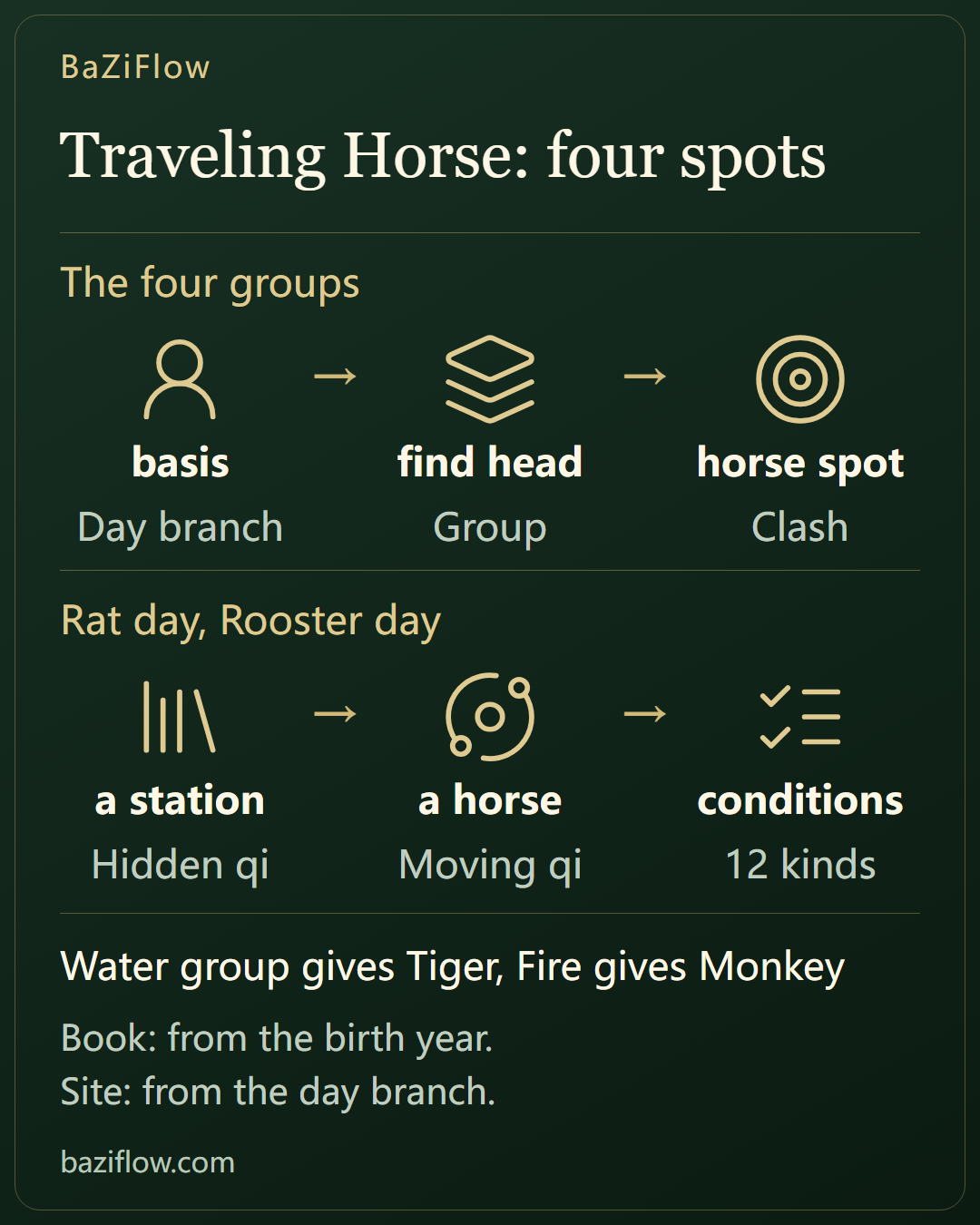
The Traveling Horse starts from the day branch: find its Three Harmony group, take the head, then the clashing branch. It lands only on Tiger, Monkey, Snake or Pig. Set against the twelve horses of the Sanming Tonghui.
The short version6 min read
The basis of the Traveling Horse is the day branch: find the head of its Three Harmony group, take the branch opposite it, and look for that branch in the year, month and hour pillars. It always lands on Tiger, Monkey, Snake or Pig.
- The twelve day branches fall into four Three Harmony groups, each with one landing spot: Monkey-Rat-Dragon gives Tiger, Tiger-Horse-Dog gives Monkey, Snake-Rooster-Ox gives Pig, Pig-Rabbit-Goat gives Snake. The day branch itself is never the horse.
- The Sanming Tonghui says qi hidden is a relay station and qi moving is a horse: Water hides inside the Fire group and is released at Monkey, where Water is born. Applied to all four groups, that is the clash of the head.
- The book sorts the horse into twelve kinds that turn on voids, emolument and the conception month, and its examples start from the birth year. The site look-up says only whether a horse exists and in which pillar.
Read first
Symbolic Stars in BaZi: Check the Reference and Rule Before the Meaning ↗
Twelve day branches, only four landing spots
On this site the Traveling Horse (驿马) is found from the day branch. Work out which Three Harmony (三合) group that branch is in, take the first branch of the group, and the branch opposite it is where the "horse" lands. You look for it in the year, month and hour pillars.
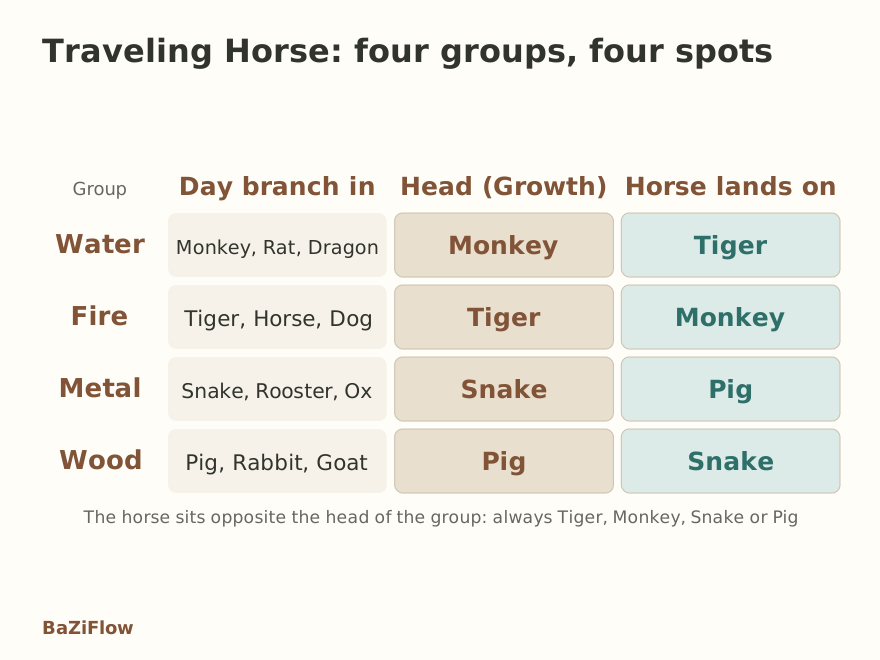
Look-up sketch: the left column is the Three Harmony group of the day branch, the middle column is the head of the group (the Growth spot of its element), and the right column is the horse landing spot given by the site engine's table.
The four rows in the picture are the whole rule. The Water group is Monkey, Rat and Dragon: its head is Monkey and the horse lands on Tiger. The Fire group is Tiger, Horse and Dog: head Tiger, horse on Monkey. The Metal group is Snake, Rooster and Ox: head Snake, horse on Pig. The Wood group is Pig, Rabbit and Goat: head Pig, horse on Snake. So whatever the day branch is, the horse sits among Tiger, Monkey, Snake and Pig. The day branch is never the horse itself, which is why the day pillar is not part of the search.
Why the clash: the "relay station" and the "horse" in the book
The "On the Traveling Horse" chapter of the Sanming Tonghui (三命通会, a Ming-dynasty compendium) treats the horse as a kind of qi held in reserve, and compares it to the post stations of old:
When the qi is hidden, it is like a relay station; when the qi moves, it is like a horse.
It then gives the Fire group as an example:
Tiger, Horse and Dog belong to Fire, with Water hidden inside; at the Monkey place, where Water is born, it is released.
Tiger, Horse and Dog form the Fire group, and Fire holds Water inside; Water is born at Monkey, and there the hidden qi is set moving, so that place is the horse. The Water group works the same way: Fire is hidden inside Monkey, Rat and Dragon and is released at Tiger. Put this over all four groups and each time the result is the clash of the head:
Enlarge diagram · scroll sideways to read
The site's table fixes this rule into twelve rows, and a check confirms it: head Monkey, clash Tiger; head Tiger, clash Monkey; head Snake, clash Pig; head Pig, clash Snake. It matches the table exactly.
Pulling out one horse: two charts
Take a chart whose day branch is Rat: Rat belongs to the Water group, whose head is Monkey, and the branch opposite Monkey is Tiger. The four branches read Tiger, Ox, Rat, Dragon, so the year pillar's Tiger is the horse. Now take a day branch of Rooster: Rooster belongs to the Metal group, with Snake as head and Pig opposite; the four branches read Horse, Pig, Rooster, Pig, and the month and hour pillars each hold a Pig, so both are horses.
Enlarge diagram · scroll sideways to read
Finding the horse is only the start: twelve kinds in the book
The same chapter goes on to sort the horse into twelve kinds, each one the horse plus another condition. The book puts it plainly:
These twelve Traveling Horses are to be weighed with judgment.
Four of them show what the book cares about:
Four of the twelve horses
The horse meets a void
The chart carries a Traveling Horse, but the day pillar falls into a void.
The emolument is void
A horse is present, but the emolument it travels with falls into a void.
The horse overcomes the hour
The horse overcomes the element of the birth hour, for instance a Metal horse with Wood in the hour.
Horse and emolument together
The conception month and the birth day both carry emolument and horse.
The conditions in these four, which are voids, emolument, the conception month and element control, are not judged by the site. The site look-up says only whether a horse exists and in which pillar.
The site's wording against the book's
The site describes the Traveling Horse as "much moving and change, suited to mobile work or travel". The closest line in the same chapter of the Sanming Tonghui follows a quotation from Luo Lu Zi and opens with "it is also said": when the major or minor luck or the passing year reaches the horse, it brings official posts and transfers. Set side by side:
Enlarge diagram · scroll sideways to read
Another day-branch Symbolic Star worked out from a Three Harmony group is the Peach Blossom: it takes the branch right after the head (the Bath spot), which is not one of the group's three branches. How much weight a horse carries in a full reading is covered in where Symbolic Stars sit in a BaZi reading.
Questions readers ask next
My day branch is Rat, yet the horse is on Tiger. Why not Ox or Pig, next to Rat?
The site does not search by distance. It goes by group: Rat belongs to Monkey-Rat-Dragon, whose head is Monkey, and the branch opposite Monkey is Tiger. There is no idea of neighboring branches here.
My year pillar has a Tiger branch. Do I have a Traveling Horse?
That depends on the starting point. With a Rat, Dragon or Monkey day branch, the year's Tiger is the horse; with another day branch it is not. The book's examples start from the birth year, so different tools find a horse in some charts and miss it in others.
Does the Traveling Horse mean I will move house or travel a lot?
The site's wording, "much moving and change", is a modern summary of the position. The book's phrase is that a year meeting the horse brings "official posts and transfers", which is about career moves. It is only a clue, and real travel depends on actual plans.
Was this article helpful?
Sources & references
Continue reading
Peach Blossom: Count One Step Past Growth to Bath, Which the Book Calls Xian Chi ↗