

Chariot: a hand of five and a skipped day
Content version · · Sources & references
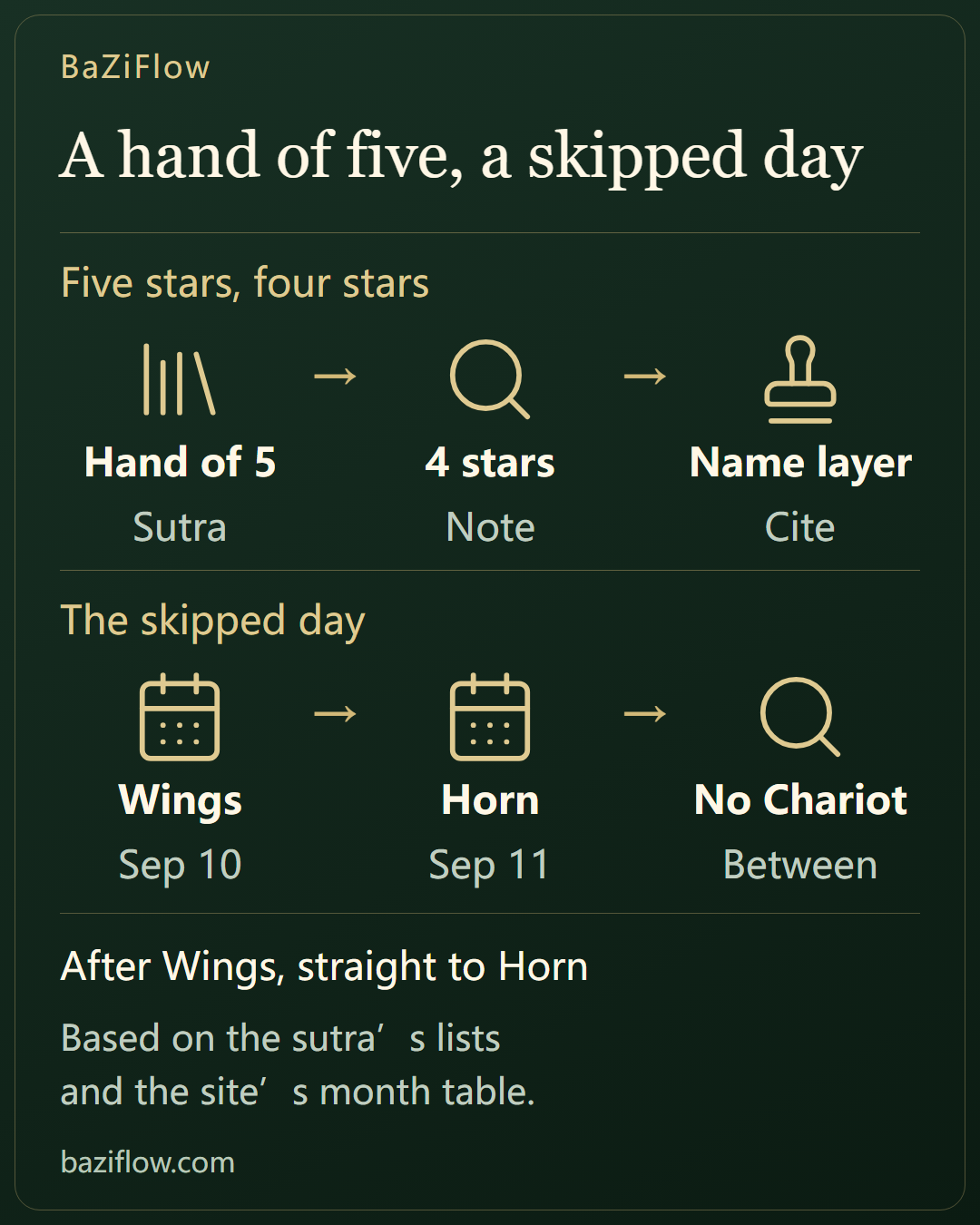
Chariot (轸) is position 11 on the site’s 27-mansion ring, last of the seven southern mansions. Five stars like a hand against four, its character in the class lists, and the one day the month table skips it.
The short version7 min read
Chariot (轸) is position 11 on the site’s 27-mansion ring, between Wings and Horn. The Sukuyō Sutra draws it as a hand of five stars, and the site’s month table skips it on one day in September 2026.
- The sutra’s picture gives Chariot five stars shaped like a hand, while the note says four in Chinese astronomy and “in charge of carriages”. Chariot is the last of its group of seven southern mansions, and Horn after it starts the east.
- The sutra sorts the mansions into seven classes by the character of their days. Chariot belongs to the Swift class, whose members differ a little between fascicles; in fascicle 2 the heading of the Light class is also miswritten as “Chariot”.
- The month table, on the Japanese old calendar (new moon fixed by Tokyo time), resets each month. When month 7 has only 29 days, the day after Wings is day 1 of month 8, Horn: Sept 11, 2026 has no Chariot, while Sept 21, 2025 (month 7, day 30) does.
Read first
What is Sukuyō astrology? How a birth mansion is found ↗
Sukuyō 27 mansions vs the 28 lunar mansions: what is the difference? ↗
Position 11 on the ring, last of the seven southern mansions
In 2026 the seventh old-calendar month had only 29 days, so the site’s month table went straight from Wings (翼) to Horn (角), and the one mansion skipped that year was Chariot (轸). On the ring of 27 mansions Chariot takes position 11, right between those two.
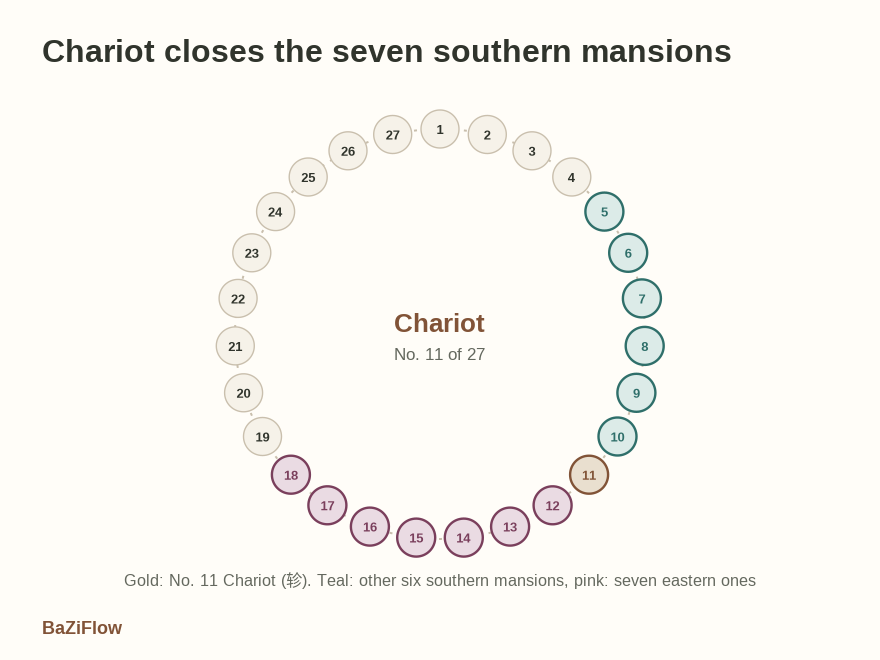
Gold Chariot closes Jingfeng’s “mansions of the south” (teal); the next position, Horn, opens his “mansions of the east” (pink).
Gold marks Chariot. The six teal ones are Well (井), Ghost (鬼), Willow (柳), Star (星), Extended Net (张) and Wings, which the commentator Yang Jingfeng also calls mansions of the south; the seven pink ones, Horn, Neck (亢), Root (氐), Room (房), Heart (心), Tail (尾) and Winnowing Basket (箕), he calls mansions of the east. Chariot sits at the end of the southern stretch, and the next place, Horn, already belongs to the east.
A hand of five stars, and four in the note
In the sutra’s second chapter the Chariot picture opens like this:
Chariot has five stars, shaped like a hand. It is the god Pipodali (毗婆怛利).
Five stars make the shape of a hand. After the picture Jingfeng records the Chinese count: four stars, in charge of carriages and riding, a mansion of the south. The site’s own Chariot page uses a four-star box, laid out like a carriage frame, which is closer to the note’s number; the sutra paints a different picture, the hand.
Enlarge diagram · scroll sideways to read
The hand turns up once more in the sutra, used quite differently. The chapter of miscellaneous divinations records a test for someone who cannot remember their mansion: when the person comes to ask, watch which part of the body they touch first, then look it up in a list that runs roughly from head to foot. One line reads “if the hand is touched, it is the Chariot mansion”, so Chariot and the hand match. The entries around it are:
Enlarge diagram · scroll sideways to read
After that passage Jingfeng notes that the method is for people who do not know their birth date, and that the teacher treated it as a secret method. The site does not use it: a birth mansion is always worked out from the birth date and the month-start table.
One character, three appearances in the class lists
Seven classes, grouped by what kind of day each mansion governs, are written out twice in the sutra, once in fascicle 1 and again in fascicle 2. Chariot is a member in two places and a miswritten character in a third.
Enlarge diagram · scroll sideways to read
The two lists differ in only two mansions. Fascicle 2 counts 28 mansions, so Ox (牛) joins the Swift class and Stomach (胃) moves over to the Fierce class, which grows from 4 members to 5. Chariot stays in the Swift class in both.
Every group in fascicle 2 is written in the pattern “heading. members. these N are the X mansions”. The Light group reads:
Chariot. Well, Neck, Girl, Emptiness, Rooftop. These five are the Light mansions, also called traveling mansions.
The heading slot says “Chariot”, yet the members are only Well, Neck, Girl, Emptiness and Rooftop, and the line ends “these five are the Light mansions”, so by the pattern the heading should be “Light”. The e-text has the character as it is, and a count of any list should read heading and members apart: the “Chariot” here is not a member of the Light class.
September 2026: the one mansion that was skipped
The site’s month table resets once each old-calendar month, so between the end of one month and the start of the next it sometimes skips a mansion and sometimes repeats one. In all of 2026 it skips exactly once, and the one skipped is Chariot.
Month 7 opens on Extended Net and month 8 on Horn, three places apart. If month 7 has only 29 days it ends on Wings, and the next day, day 1 of month 8, is Horn; Chariot in between gets no day. With 30 days, day 30 is exactly Chariot and it runs into Horn.
Enlarge diagram · scroll sideways to read
The result is that only 13 days of 2026 fall on Chariot, where the neighboring mansions have 14. Two successive Chariot days are usually 27 or 28 days apart, but from August 15 to October 7 the gap is 53 days, with no Chariot day in September at all. The same mechanism can skip Star at the end of month 6 or Winnowing Basket at the end of month 10, in years when those months are short.
Citing Chariot: what to write straight, what needs a source
Write directly
- Position 11, Wings before and Horn after
- Sutra picture: five stars, shaped like a hand
- Note: four stars, carriages, southern mansion
Add a source
- Swift-class members: say fascicle 1 or 2
- Star count: say sutra text or note
- “No Chariot day in Sept 2026”: say it is the site’s table
Easy to get wrong
- Treating the heading “Chariot” in fascicle 2 as a member
- Reading a skip in the table as Chariot “vanishing”
- Taking the touch test as the site’s method
Before it is Wings and after it Horn. For checking which calendar a table follows, see reading a Sukuyō calendar, and for the 28 versus 27 lists see 27 versus 28 mansions.
Questions readers ask next
Does Chariot have five stars or four?
The sutra’s picture says five, shaped like a hand, and Yang Jingfeng’s note says four by Chinese astronomy. Both numbers come from one entry in two layers of text, so a citation should name its layer. The site’s own Chariot page uses a four-star box shape, a different picture from the sutra’s hand.
Why is there no Chariot day in September 2026 on the site’s table?
The site lays days out from fixed first-day mansions, month by month. Old-calendar month 7 of 2026 has 29 days, so it ends on Wings and the next day, month 8 day 1, is Horn; Chariot, which sits between them, never gets a day. In a year when month 7 has 30 days, day 30 is Chariot.
What is the “touch a hand and it is Chariot” test, and does the site use it?
It is a question from the sutra for someone who does not remember their mansion: note which part of the body the person touches first on arriving, then look it up. The site does not use it; a birth mansion is always worked out from the birth date and the month-start table.
Was this article helpful?
Sources & references
Continue reading
Wings (翼): Two Stars or Twenty-Two, Among the Side-by-Side Mansions ↗
Horn (角): One of the Sutra’s Several “Firsts”, the Horn Month and a Matching Star Count ↗