

Evidence for a career reading
Content version · · Sources & references
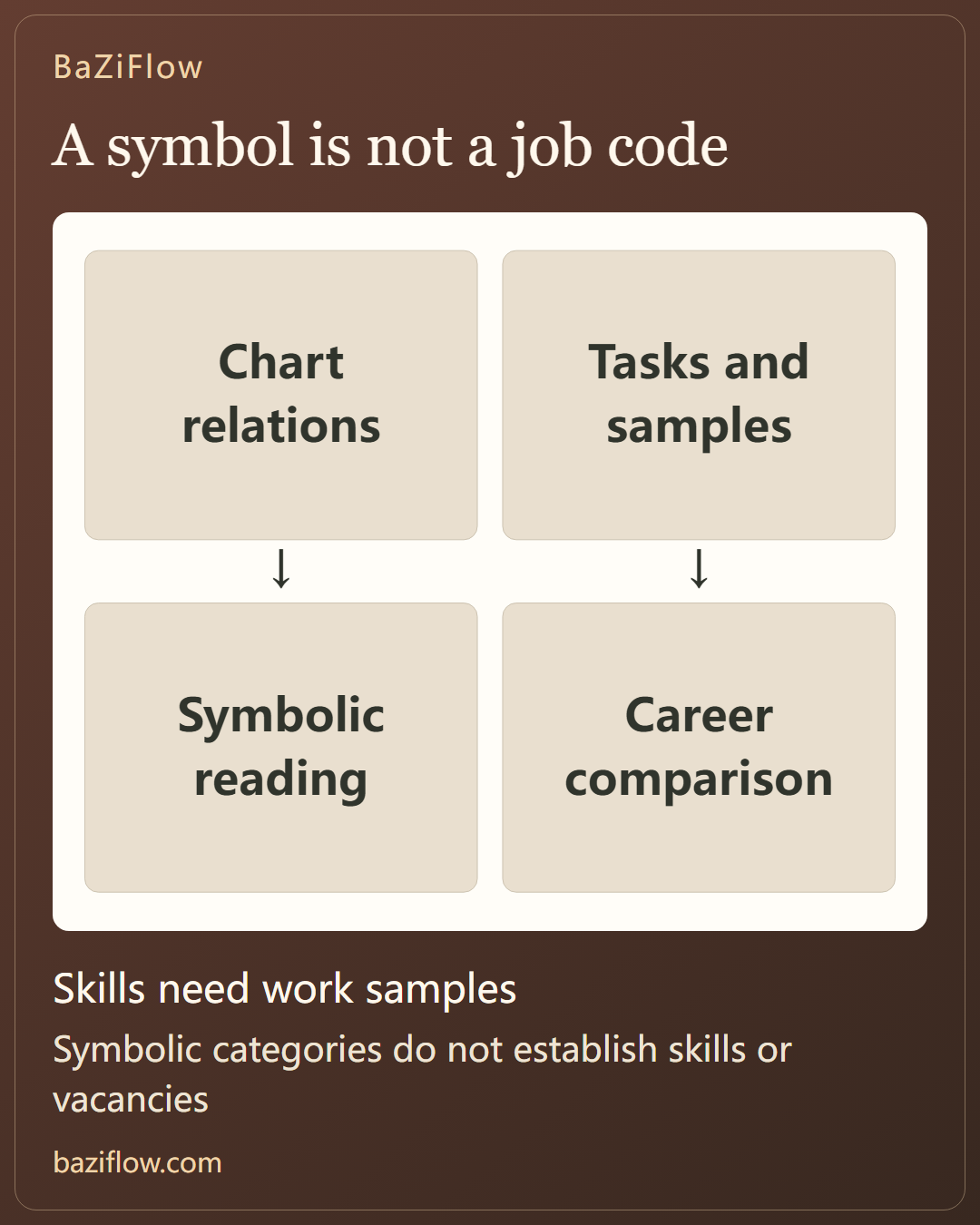
Ten-God names are not job codes. Separate traditional chart reasoning from skills, tasks, qualifications and actual opportunities before turning a career reading into action.
The short version5 min read
A theme of expression does not yet identify a career. Comparing internal training with technical writing makes the missing evidence visible: tasks, work samples and personal preferences must be checked separately.
- Ten Gods classify relations to a Day Master; historical language about rank does not establish modern hiring outcomes.
- Training and technical writing both involve communication but call for different evidence about tasks and performance.
- A favorable period does not create a vacancy; requirements, deadlines and preparation remain independent facts.
Read first
Output Generates Wealth and Officer Generates Resource: Chains and Conditions ↗
Natal, Luck, Annual and Monthly Layers: How to Read Them Together ↗
A career database asks more than one question
The O*NET Content Model separates information about workers, work and the labor market. Abilities, skills, knowledge, experience, tasks and work context answer different questions. Someone's interest in a task is not the same fact as demonstrated proficiency, and neither establishes that a suitable vacancy is available.
That distinction helps define the limits of a BaZi career discussion. A chart supplies none of those real-world facts merely by naming a Ten God. O*NET is cited here as an example of occupational information structure, not as evidence for BaZi. It describes a U.S. occupational setting; credentials and opportunities elsewhere need local checking.
Worker
- Skills and experience
- Interests
Job
- Tasks and context
- Requirements
Try a question that could change with new evidence
Suppose a cultural interpretation suggests a theme of expression. Instead of translating that into a job title, ask what kind of communication the reader has actually practised. Delivering a lesson, writing a technical explanation and discussing a customer's concern require different evidence. A work sample may answer one question while leaving another open.
For a teaching comparison, consider internal training and technical writing. Lesson planning and answering live questions may matter to one; organizing documentation and maintaining technical accuracy may matter to the other. Verify the actual duties rather than treating these short descriptions as complete job specifications. Neither option is assigned to a particular Ten God, and no personal career recommendation has been calculated.
If no relevant experience is supplied, retain that as a learning or information gap. A favorable symbolic description cannot fill it. If the reader does have work demonstrating a skill, an unfavorable chart label cannot erase that evidence either. This makes the comparison capable of changing when new information arrives.
Training
- Lesson planning
- Live questions
Technical writing
- Document structure
- Technical accuracy
What belongs on the traditional side of the page?
A traditional interpretation still needs its own traceable inputs: verified pillars, the Day Master, month context, visible and hidden stems, and the relevant positions. A question about a particular period also needs the specified luck and annual layers. These inputs explain how a symbolic argument was constructed; they do not perform a skills assessment.
| Question to check | Evidence that can address it |
|---|---|
| Why was a Ten God named? | The specified stem or branch relationship to the Day Master |
| Has the person demonstrated a skill? | Relevant work, experience and observed performance |
| Which traditional period is being discussed? | The stated timing layer, pair and calculation convention |
| Is this role currently available and suitable to explore? | Actual duties, requirements, location, goals and resources |
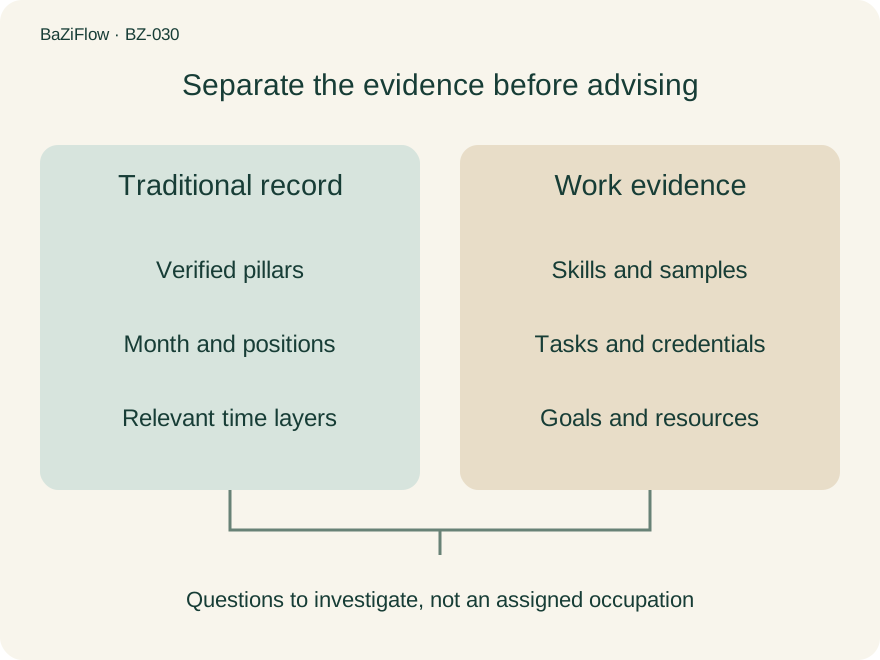
Original BaZiFlow evidence map. It does not map a chart symbol directly to a modern occupation.
Keep the two evidence records distinct. A report may explain a symbolic relation accurately and still have no basis to say that the reader already possesses the associated ability. Conversely, useful occupational information does not validate the symbolic argument placed beside it.
Chart record
- Pillars and positions
- Specified time layer
Work record
- Samples and experience
- Role requirements
Read “Officer” in its historical argument
Ziping Zhenquan's Direct Officer chapter considers Wealth and Resource together with placement and other conditions. It does not end its argument at the discovery of an Officer label. Its social language about office and rank also belongs to its historical setting; contemporary civil-service entry, company hierarchy and hiring probability are different subjects.
Direct Officer, Eating God and Indirect Wealth are relationships to a Day Master, not codes for civil service, art and entrepreneurship. Replacing a traditional term with a modern job name loses both the old argument's conditions and the modern role's requirements. The conditions around Ten-God combinations help distinguish naming a relation from interpreting a configuration.
A forecast does not create a vacancy
The same book's discussion of luck relates the period's stems and branches to the natal configuration. If a report concerns a year, it should identify the year and the relationship being discussed. An annual branch must not be rewritten as a birth placement; the separate timing layers retain that distinction.
Employers, qualifications, organizational needs and preparation remain independent facts. A period described as favorable does not guarantee an offer. A period described as unfavorable is not a reason to stop ordinary learning or applications. A traditional timing statement cannot replace the actual schedule or requirements of a role.
Leave a question that the reader can revise
A bounded conclusion might identify the chart relation being discussed, state that the relevant skill has not yet been demonstrated, and suggest checking the duties of the roles under consideration. This says what is known and what could change the comparison. It is more useful than turning a symbolic theme into a permanent occupational identity.
Collect only material relevant to the question. Terminology study needs no complete résumé; comparing tasks needs no company secrets or unrelated family details. More private information does not automatically improve reasoning.
Leaving employment, purchasing expensive training or abandoning an opportunity should not rest solely on a chart interpretation. Cultural reading and practical investigation can remain separate parts of the conversation. The reasons for action should still make sense when checked against the actual work, the person's evidence and the available choices.
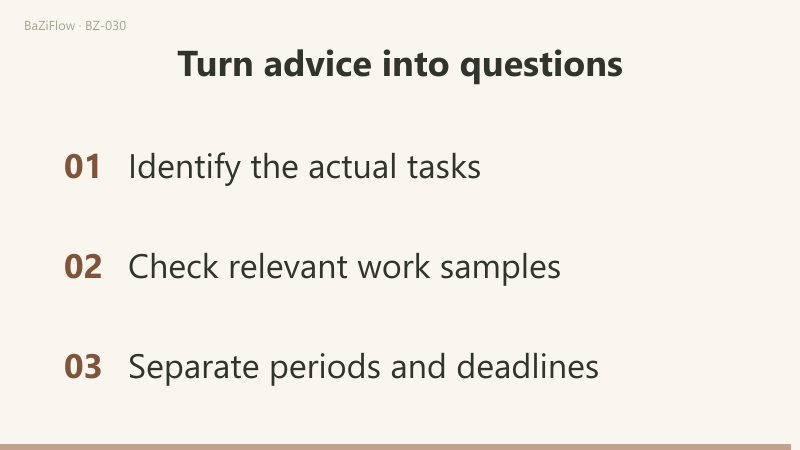
Name one real task
For example, identify live question handling in a training role rather than use only the broad word communication.
Find relevant evidence
Inspect a lesson, document or recorded experience; if none exists, retain the need for learning or investigation.
Compare requirements and preferences
Check local requirements, resources and the person’s own preferences before deciding what to investigate next.
Questions readers ask next
Does Direct Officer identify a civil-service career?
No. It classifies a relation to the Day Master. Current eligibility, examinations and recruitment procedures require local evidence.
Why compare tasks when both roles involve expression?
Live questions during training and accurate technical documentation require different work samples. A broad theme establishes neither experience nor preference.
Can a favorable year justify leaving a job?
Not by itself. Opportunities, eligibility, resources and personal preferences need independent checking; a timing label guarantees no offer or income.
Was this article helpful?
Theme: Career & learning
Sources & references
Continue reading
Bazi pattern formation: follow the conditions and assistance ↗
Same day pillar, different readings: what the shared pair does not supply ↗