

Wings: two stars or twenty-two
Content version · · Sources & references
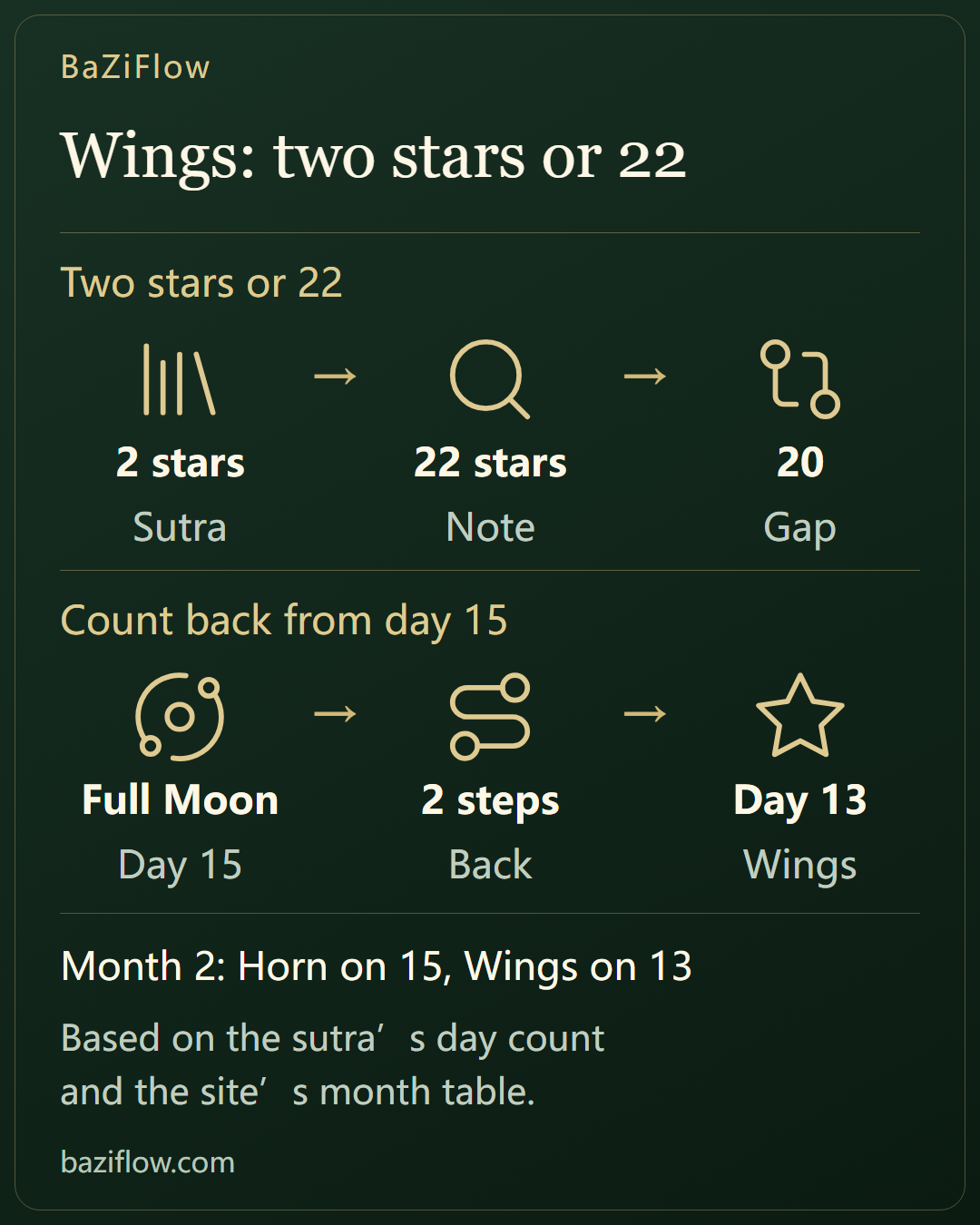
Wings (翼) is position 10 on the site’s 27-mansion ring. Two stars in the sutra, twenty-two in the note, its place among three ways of meeting the Moon, and counting back from the day-15 full-Moon mansion.
The short version6 min read
Wings (翼) is position 10 on the site’s 27-mansion ring, between Extended Net and Chariot. The Sukuyō Sutra draws it with two stars, the note says twenty-two, and it is one of the twelve side-by-side mansions.
- The sutra’s picture gives Wings two stars shaped like a seated cross-legged pose, and the note gives twenty-two in Chinese astronomy. Subtracting entry by entry, the gap of 20 is the widest of all the picture entries.
- The sutra has three ways a mansion meets the Moon: front (6 mansions), side by side (12) and following (9), counted from Legs, summing to 27. Wings is 7th among the twelve.
- The full-Moon mansion on day 15 is the starting point for counting days. The book’s example is Horn on day 15, Chariot on day 14 and Wings on day 13 of month 2, and the site’s month table gives Wings on day 13 as well.
Read first
What is Sukuyō astrology? How a birth mansion is found ↗
Sukuyō 27 mansions vs the 28 lunar mansions: what is the difference? ↗
Position 10 on the ring, in the middle of the side-by-side twelve
The sutra draws Wings (翼) with two stars, while the commentator’s note gives twenty-two, the widest gap in any of the mansion entries. On the site’s ring Wings is position 10, with Extended Net (张) before it and Chariot (轸) after it.
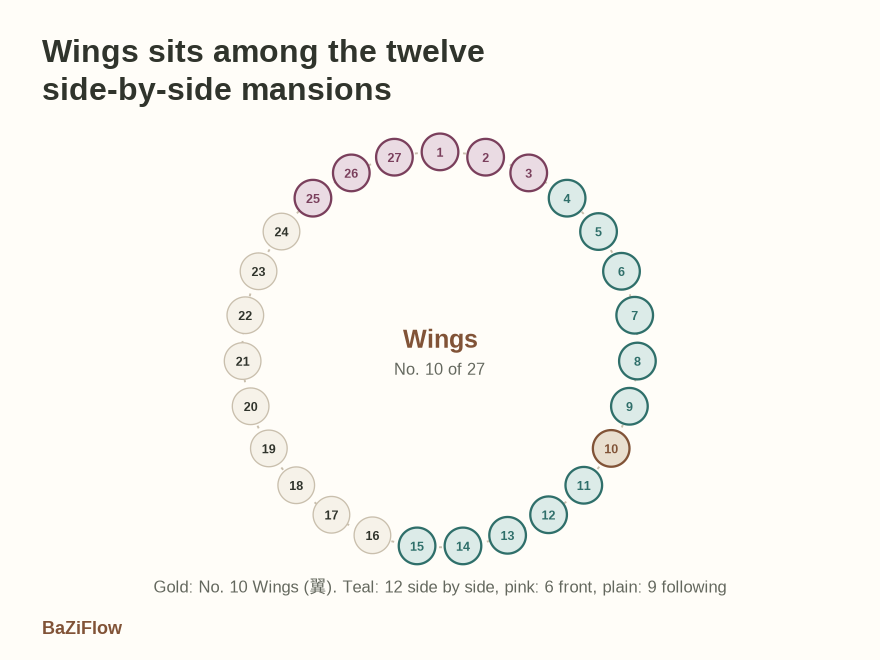
Gold Wings sits inside the twelve side-by-side mansions (teal); pink marks the six front mansions and the uncolored nine are the following ones, the three ways of meeting from the start of fascicle 1.
Gold marks Wings. The opening of the Sukuyō Sutra (宿曜经) also sorts the 27 mansions into three groups by how they meet the Moon: the twelve teal ones are “side by side”, the six pink ones are “front”, and the nine plain ones are “following”. Wings is 7th among the twelve, just past the middle.
Two stars or twenty-two: the widest gap of any entry
In the sutra’s second chapter the Wings picture opens with:
Wings has two stars, shaped like a seated cross-legged pose.
“Seated cross-legged” is the meditation posture, a body position borrowed to picture how the stars are laid out. At the end of the entry the commentator Yang Jingfeng adds the Chinese count:
In Chinese astronomy, Wings has twenty-two stars and has charge of prefecture and county affairs; it lies in the south.
Enlarge diagram · scroll sideways to read
Jingfeng adds a Chinese star count to every mansion. Subtracting entry by entry, Wings differs by 20, the widest of all twenty-eight entries, Ox included. Next is Legs (奎), with 32 stars in the sutra text and 16 in the note, a gap of 16, and then Three Stars (参), with 1 and 10, a gap of 9. Twenty-two is also the largest number in all of Jingfeng’s notes, with Legs’ sixteen second.
Three ways of meeting: front, side by side, following
The first chapter of fascicle 1 contains a question and answer. An immortal remarks that the mansions differ in width across the sky and the Moon runs now ahead, now behind, so that checking the heavens never quite matches the book; how, then, is a day’s mansion to be fixed? The reply is that the Moon and a mansion can meet in three ways.
Enlarge diagram · scroll sideways to read
The sutra gives each a one-sentence definition. In a front meeting the mansion lies ahead and the Moon trails it. In a side-by-side meeting the two move abreast. In a following meeting the Moon leads and the mansion comes after, which the sutra likens to a calf behind its mother. Jingfeng fixes the direction by the rule “west is front and east is back”. A verse turns the three group sizes into a rhyme:
Six mansions not yet reached are called front; twelve mansions, the Moon meets them on either side; nine mansions are like a calf following its mother; the day of the Legs mansion should be understood.
Fascicle 2 repeats the verse with a last line that reads “count from the Legs mansion”, so the three groups are counted from Legs: Legs, Bond, Stomach, Hairy Head, Net and Turtle Beak first, then the twelve from Three Stars to Room, and last the nine from Heart to Wall.
Counting back from the full-Moon mansion on day 15
The sutra’s way of counting days is to learn first which mansion holds the full Moon on day 15 of the month, then count back from it for days 1 to 15 and forward for days 16 to 30. The book gives its own example: on day 15 of month 2 it is Horn, on day 14 Chariot and on day 13 Wings; on day 16 it is Neck and on day 17 Root.
Enlarge diagram · scroll sideways to read
This count is the same thing as the site’s month table (built on Japan’s old calendar, new moon fixed by Tokyo time): first-day mansion plus day minus one equals counting back or forward from the day-15 mansion. Listing the full-Moon mansions of months 1 to 6 shows where Wings falls:
Enlarge diagram · scroll sideways to read
The six full-Moon mansions are exactly the sutra’s month names: the Wings month, Horn month, Root month, Heart month, Basket month and Girl month. From month 7 the day-15 mansion has already passed Wings, and it takes 14 steps forward from day 15 to reach it: day 29 in month 7, where day 2 is also Wings. The names of the second half of the year are in Hairy Head.
Counting back once yourself
Find the full-Moon mansion
Look up the mansion of day 15, which is the sutra’s month name: month 5 is the Basket month, so day 15 is Winnowing Basket.
Count the steps
Go back from Winnowing Basket to Wings: Basket, Tail, Heart, Room, Root, Neck, Horn, Chariot, Wings, 8 steps back.
Read off the date
Fifteen minus 8 is day 7 of month 5. In the site’s table, month 5 begins at Three Stars and six steps later is also Wings.
Before it is Extended Net and after it Chariot; how the feet of Wings are shared between houses is in Star.
Questions readers ask next
Does Wings really have two stars or twenty-two?
The two numbers belong to two layers of text on one page: the sutra’s picture says two, and Yang Jingfeng’s note says twenty-two by Chinese astronomy. A citation should name the layer it uses. This site does not rule between them and keeps the layers apart.
Do front, side-by-side and following meetings change my birth mansion?
No. They are the sutra’s three descriptions of how the Moon and a mansion sit relative to each other, offered to explain how a day’s mansion is fixed. The site’s birth mansion comes from the month-start table and the old-calendar day, and does not use this grouping.
How can I get the mansion of any day from the mansion of day 15?
Count back from the full-Moon mansion for days 1 to 15 and forward for days 16 to 30, one mansion per day. The site’s table does the same thing, first-day mansion plus day minus one, and the two methods give identical results for the same month.
Was this article helpful?
Sources & references
Continue reading
Extended Net (张): Two Stars or Six, and Its Place Among the Vajra Peak Days ↗
Chariot (轸): A Hand of Five Stars, a Stray Heading, and a Skipped Day in 2026 ↗