

Dun: from the tail to the ample retreat
Content version · · Sources & references
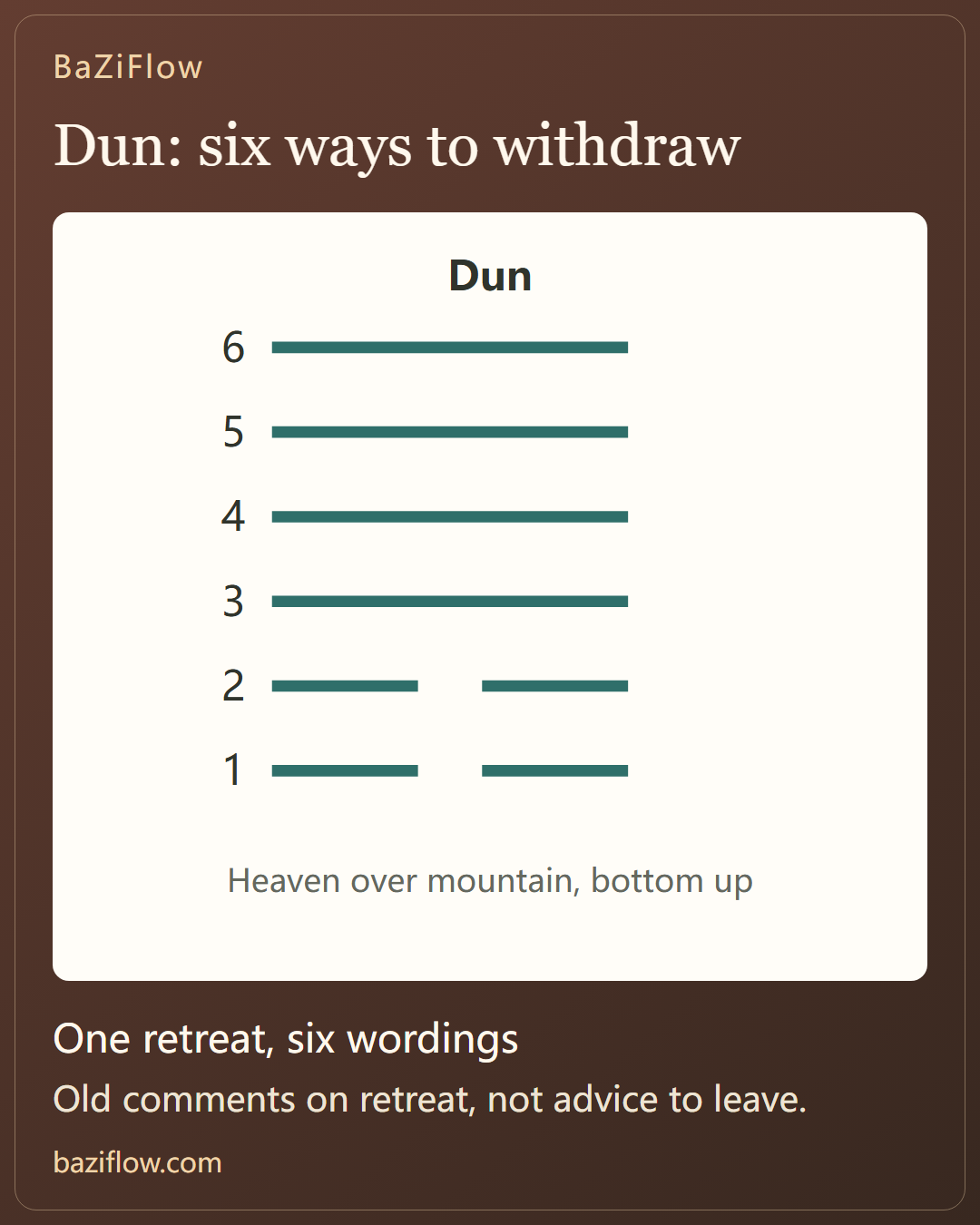
Dun is the 33rd hexagram: Qian (heaven) above Gen (mountain), two yin lines growing from the bottom. Read “moving with the time”, the Great Image on distance, and the changing wording of “retreat” in its six lines.
The short version7 min read
The wording of the retreat changes line by line: tail, held, tied, willing, fine, ample. The text uses that run of words to show one withdrawal at six different positions.
- Dun stacks Qian (heaven) on Gen (mountain), and its two lowest lines are yin. The Commentary on the Judgments says “the small is gradually growing”, which matches those two lines creeping upward.
- The Commentary first says that retreat is what makes it succeed, then that it moves with the time. The Great Image turns this into conduct: keep your distance without hatred, and stay strict with yourself.
- The first three lines are about being held back (tail, strap, tie) and the last three about ease (willing, fine, ample); the last Small Image comment is “no room for doubt”.
Read first
The Sixty-Four Hexagrams: How Upper and Lower Trigrams Form One Figure ↗
Judgment and Line Statements: Whole Hexagram or Single Line? ↗
A mountain under heaven: Qian above, Gen below
Dun (遯) is Qian (heaven) above and Gen (mountain) below. The Shuo Gua gives Qian the word “strength” and Gen the word “stopping”. Counting from the bottom, the first two lines are yin and the other four are yang: two yin lines underfoot, four yang lines standing above them.
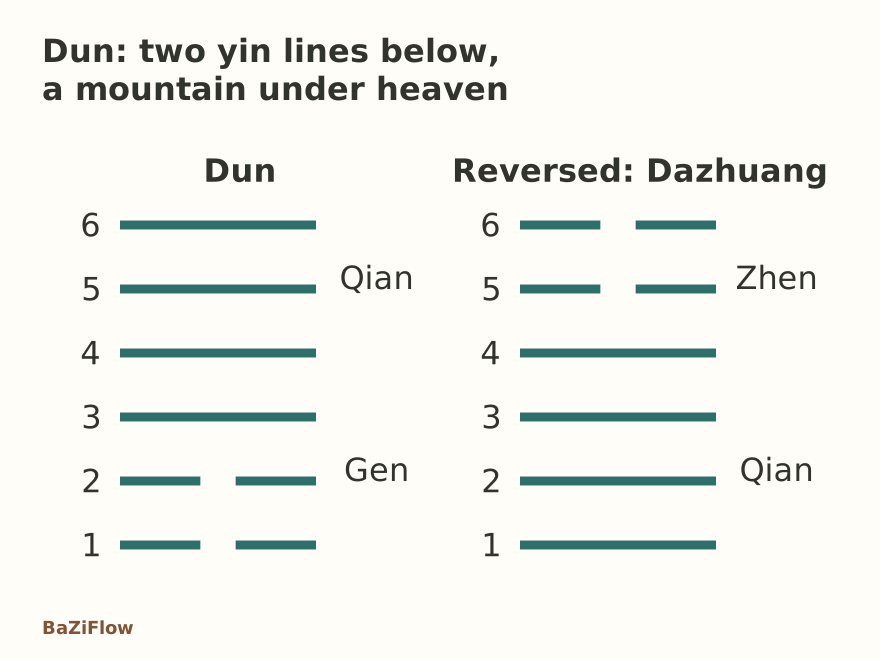
Dun and its reversed hexagram Dazhuang: the two yin lines at the bottom of Dun end up at the top of Dazhuang.
Enlarge diagram · scroll sideways to read
Three words to know first
- Dun
- The old text spells the name with a variant character, and the Xu Gua glosses it directly: Dun means to retreat.
- The small
- The “small” of the judgment’s “a little fitting to stay on course”. The Commentary follows it with “gradually growing”, and tradition usually reads it as the side that is growing, here the two yin lines at the bottom.
- The time
- The Commentary ends by exclaiming over “the time of retreat”, so the weight falls on timing: when to retreat gives retreat its meaning.
The judgment and the Commentary: retreat, moving with the time
The judgment of Dun is very short: success; a little fitting to stay on course. Two phrases, both bare verdicts with no subject or object. The Commentary on the Judgments fills them in one by one.
“Dun: success” means that by retreating one succeeds. The firm holds its proper place and is answered; it moves with the time. “A little fitting to stay on course” means that the small is gradually growing. The meaning of the time of retreat is great indeed!
Enlarge diagram · scroll sideways to read
“By retreating one succeeds” is blunt: retreat itself is what lets things pass. “The firm holds its proper place and is answered” can be checked on the figure. Line 5 is a yang line in the fifth place, a yang place, and line 2 below it is a yin line in the second place, a yin place, so a yang and a yin answer each other. “It moves with the time” then puts all this in terms of timing: retreat is something done as the time allows.
The last two clauses make a contrast. “The small is gradually growing” is about the two yin lines creeping upward, and the exclamation that follows, “the time of retreat is great”, does not say which time it means; read right after “gradually growing”, it brings to mind a time when the yin lines are growing.
The Great Image: keep away, without hatred but strict
The Great Image (大象) of Dun has three phrases: keep away, no hatred, strict.
Beneath heaven there is a mountain: Dun. The noble person keeps petty people at a distance, without hatred but with strictness.
“Beneath heaven there is a mountain”: the mountain lies below heaven. Tradition usually reads it this way: however high the mountain, heaven is still above it and withdraws upward out of reach, and that is the look of retreat. From this the noble person takes a way of acting, to keep petty people at a distance.
Enlarge diagram · scroll sideways to read
The first word, keeping away, is an action, and the two that follow set conditions on it: no hatred means no ill will, and strict means staying dignified oneself. Read together, they describe going far without breaking with anyone and without going slack.
Six lines: the manner of retreat keeps changing
Five of the six statements contain the word “retreat”: tail of the retreat, tied retreat, willing retreat, fine retreat, ample retreat; only line 2 lacks it, and speaks of binding with yellow ox hide.
Enlarge diagram · scroll sideways to read
Line 1 is at the bottom. The “tail of the retreat” is the last place in the retreating line, and the statement calls it dangerous and adds “do not act on having somewhere to go”. The Small Image comment is striking: if he does not go, what disaster is there? Line 2 says: held with a strap of yellow ox hide, and no one can undo it. The Small Image says only that it firms the will. Line 3, the “tied retreat”, brings illness and danger, and then “keeping servants is fortunate”, to which the Small Image adds that great undertakings cannot be done.
At line 4 the word changes: “willing retreat”, which tradition usually reads as retreating gladly; fortunate for the noble person, not so for the petty one. Line 5 is a “fine retreat”, good if steadfast, and the Small Image says it keeps the will upright. Line 6 is an “ample retreat”, where ample means generous, nothing unfavorable, and the Small Image ends on “no room for doubt”.
The two yin lines sit at the very bottom. The three lines closest to them all describe a retreat that is held back: tail, strap, tie. The three farther away say willing, fine, ample. One way to read it: the nearer to where the yin is growing, the harder it is to get away, and the higher the line, the easier the retreat.
Dazhuang, Lin and Gou: neighbors of Dun and its place after Heng
Turn Dun upside down and you get Dazhuang (大壮), so Dazhuang is the reversed hexagram (综卦) of Dun (see the figure above). The inverse hexagram (错卦) is Lin (臨) and the nuclear hexagram (互卦) is Gou (姤): lines 2 to 4 of Dun are yin, yang, yang (Xun) and lines 3 to 5 are three yang lines (Qian), so they stack as Xun below and Qian above, with only one yin line left at the bottom.
Enlarge diagram · scroll sideways to read
The Xu Gua puts Dun after Heng (恒), and says why:
Things cannot dwell forever in one place, so what follows is Dun; Dun means to withdraw.
Dun’s successor is Dazhuang, and the Xu Gua’s reason is that one cannot keep retreating without end. The two are each other’s reversed hexagram: in one the yin lines grow from the bottom, in the other the yang lines do, and they stand side by side.
Questions readers ask next
Does Dun simply tell you to run away?
The Xu Gua glosses the name as “retreat”, but the Commentary does not count retreat as failure; it says that by retreating one succeeds. The Great Image also keeps a measure: distance, without hatred, and still a straight back.
How should “willing retreat: fortunate for the noble person, not for the petty person” be read?
It is the comment on line 4 alone: the noble person retreats gladly and is fortunate, while the petty person cannot. Tradition usually reads the first word as “gladly”. It holds only within that one line and does not sort people into kinds.
How are Dun and Dazhuang related?
They are each other’s reversed hexagram: turn Dun upside down and you have Dazhuang. Dun has two yin lines at the bottom and Dazhuang has four yang lines at the bottom, and the Xu Gua places them one after the other.
Was this article helpful?
Sources & references
Continue reading
Heng: thunder and wind, and why lasting is not standing still ↗
Dazhuang: thunder in the sky, and where strength is meant to stop ↗
The Sixty-Four Hexagrams: How Upper and Lower Trigrams Form One Figure ↗
Judgment and Line Statements: Whole Hexagram or Single Line? ↗