

The Parents palace: last of twelve, Sun and Moon
Content version · · Sources & references
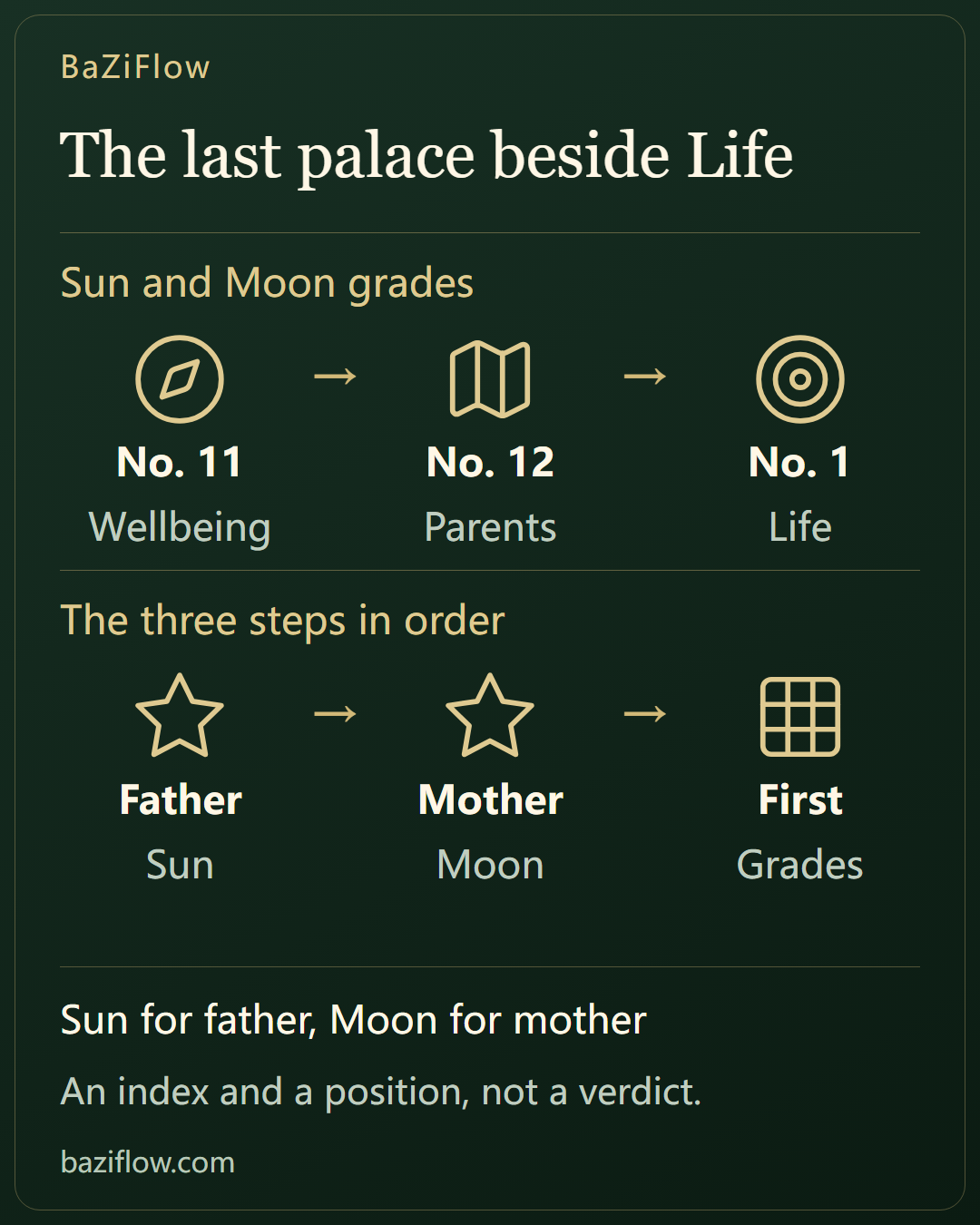
The Parents palace is the twelfth and last, right beside Life. Read how juan 2 indexes it with the Sun as father and the Moon as mother, check both stars in the grade table, and take the book's own closing line.
The short version6 min read
The Parents palace (父母宫) is the last of the twelve, and counting one place further returns to Life; juan 2 of the Zi Wei Dou Shu Quan Shu indexes it with "the Sun is the father, the Moon the mother," checking the grade of the two stars first and then the day or night of birth.
- Parents is no. 12, its opposite is Health (no. 6), its trine palaces are Children (no. 4) and Friends (no. 8), and its neighbors are Wellbeing and Life; on the branches it is the place right after Life.
- The book uses the Sun as a father star and the Moon as a mother star for indexing, and the Sun is also a "father star" in male charts and a "husband's lord" in female ones. One star can play several kin roles, so a star is not a particular person.
- The juan 2 method has three steps: check both grades, look at day or night of birth if both are fallen, then read the other stars and malefics. Its own closing line is "judge by reason," not a formula.
Read first
Twelve counted, and back to Life
The Parents palace is the last stop when the twelve are counted; one place further and you are at the Life palace again.
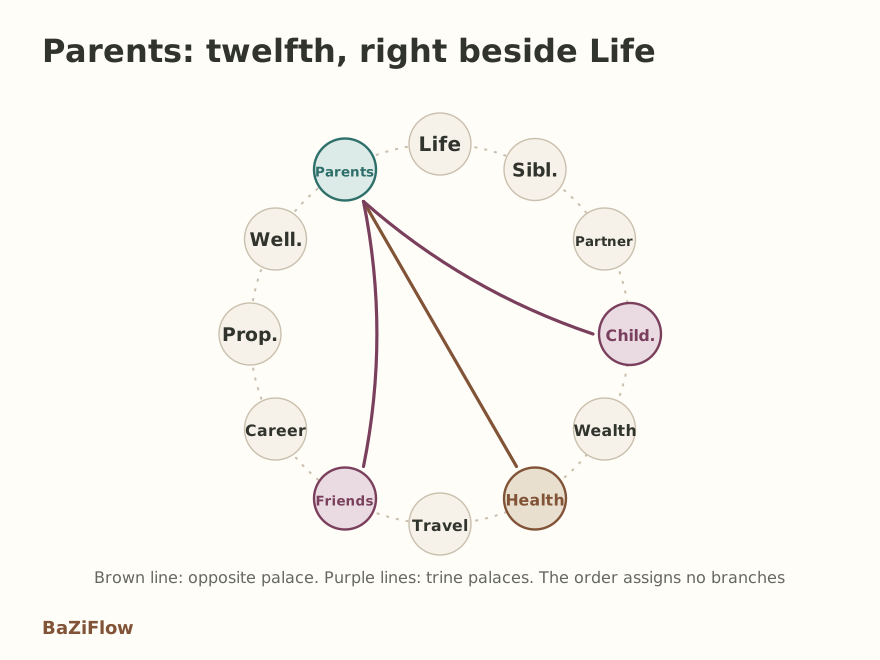
Count round to Parents at no. 12 (green) and the next cell is Life again; Parents faces Health (brown) and has Children and Friends on its trine (purple).
On the ring Parents is no. 12, with the Wellbeing palace (no. 11) on one side and the Life palace (no. 1) on the other. Its opposite is the Health palace (no. 6), and its trine palaces are Children (no. 4) and Friends (no. 8). The four make one set of four directions, counted as in three sides and four directions.
The Sun is the father, the Moon the mother
The juan 2 section on Parents does not begin with the stars one by one. It begins by setting up an index:
To look at the parents, take the Sun as the father star and the Moon as the mother star.
The book lets the two lights stand for "father" and "mother," and another star is also called master of this palace:
Enlarge diagram · scroll sideways to read
Notice the detail: in the book the Sun is a male chart's "father star" and also a female chart's "husband's lord"; the Moon is a "mother star" and also a "wife star." One star holding several kin roles shows that "the Sun is the father" is not a one-to-one identification but an index that uses stars as clues. Reading it directly as "your father is so and so" goes beyond how the book uses it.
The grades of Sun and Moon: check the table first
Once the index is set, the book's first gate is the brightness of the two stars. To find them, open the brightness chart that goes with the book and read both stars across the twelve branches:
Enlarge diagram · scroll sideways to read
The table is by branch and has nothing to do with any particular chart. The Sun is brightest on Rabbit and fallen on Rat and Pig; the Moon is brightest on Rat, Ox and Pig and fallen on Rabbit, Dragon and Snake. Interestingly, the two stars have dark zones that do not overlap: where the Sun is fallen, on Rat and Pig, the Moon is bright. The book words its verdicts on fallen positions very heavily and flatly, and they are not repeated here; only the lookup is recorded: consult the table first, then see on which branch the star falls in the Parents palace.
Three steps, and the book's own reminder
Juan 2 arranges the way of reading the Parents palace as three steps:
Enlarge diagram · scroll sideways to read
After its opening, the section runs to 28 star paragraphs, and the words used most are "punishment" and "harm": "no punishment" 23 times, "harm" 25 times (including "no harm" 4 times), with "both parents complete" 5 times; "two surnames" 8 times and "adopted out" and "taking new parents" 6 times each are the book's words for changed parentage, fostering and living in a wife's family. These are kinship arrangements of the old clan society, to be read as that era's vocabulary and not applied as they stand today.
The book itself says how to use the method:
Weigh it by reason; it rests on one's own insight.
That is: judge according to reason, and rely on the reader's own understanding. The line puts the three steps in their place: they are not a mechanical formula, and the stars, the grades, the malefics and the whole chart have to be read together.
Find Parents, then count its four directions
Parents is no. 12, its opposite is Health, its trine palaces are Children and Friends, and its neighbors are Wellbeing and Life.
Treat "the Sun is the father" as an index
The star is a clue, not an identification of a person, and one star has other roles too.
State the conditions when quoting
Give the grade first, then whether both stars are fallen and whether day or night decides; leave the verdicts out.
Two short checks
Life is on Dog: write down the branch of Parents, then its opposite.
Parents lands on Pig. Across the ring Health takes Snake, and the other two corners of the triangle, Children and Friends, take Goat and Rabbit, each four steps from Pig.
The Moon stands in a Parents palace that sits on Rat. How bright is it, and which branch holds Life?
On Rat the Moon is at its brightest grade; Life is one step back from the Parents branch, on Pig.
To see why the twelve are arranged this way, read what the twelve palaces cover; the palace beside it is Wellbeing.
Questions readers ask next
Can the Parents palace show my parents' health or lifespan?
No. The verdicts in this juan 2 section are heavy and flat, and this article does not repeat them or apply them to anyone. This site reads the palace as parents and related support, with any wider symbolism labeled separately; the palace name is no medical or lifespan judgment.
If the Sun is in my Parents palace, does that mean my father?
No. "The Sun is the father, the Moon the mother" is the book's indexing symbol: pick the star, then look at its grade. The Sun also serves as a male chart's "father star" and a female chart's "husband's lord," so one star plays different roles on different charts. A star is a clue, and tying it to a real person needs other grounds.
Why does the Parents palace sit right beside Life?
The palace order starts at Life, so counting to no. 12, Parents, reaches the end of the circle, and the next place is Life again. Because the order runs backward along the branches, Parents is on the branch right after Life's: Life on Dog puts Parents on Pig.
Was this article helpful?
Sources & references
Continue reading
The Wellbeing Palace in Zi Wei Dou Shu: Toil, Ease, and Five "Look First" Lists ↗