

Meet the Nine Palaces Before Reading a Qimen Chart
Content version · · Sources & references
Learn the numbered grid, its south-up orientation and the distinction between a palace and the symbols placed there. Named classical examples show why the time label alone is not a complete chart.
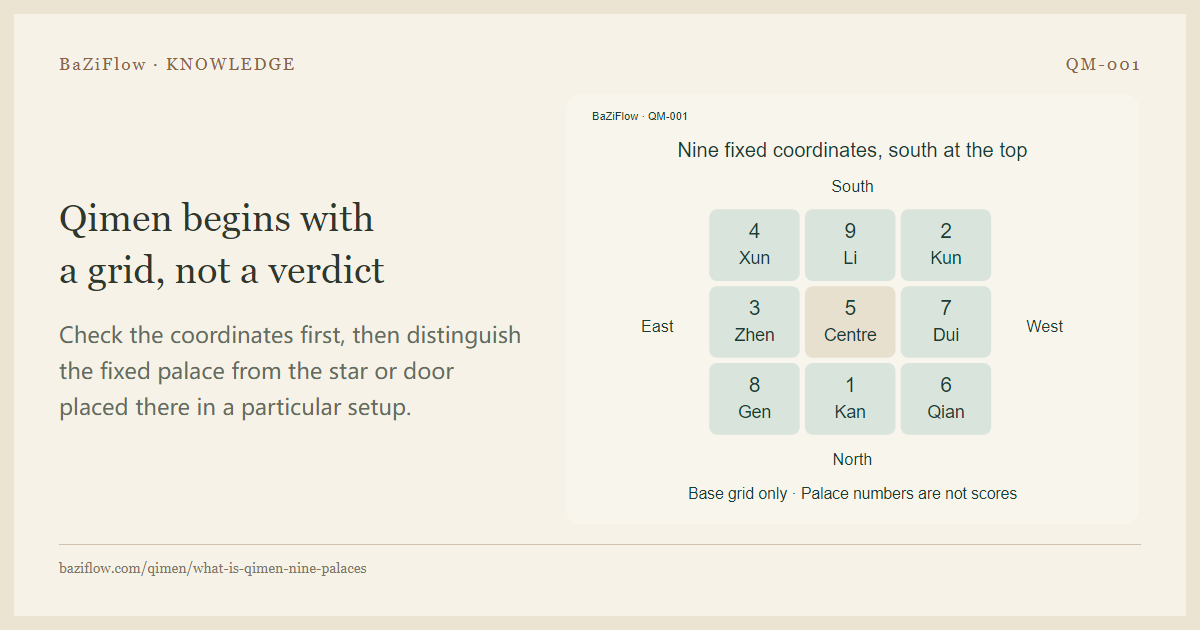
Check the coordinates first, then distinguish the fixed palace from the star or door placed there in a particular setup.
A palace is a location; a door is a different field
When reading a Qimen Dunjia chart, resist treating every word inside a box as another name for the box. A palace identifies a position. A star or door placed there belongs to another layer of the chart. An interpretation of that combination is another step again.
Qimen Dunjia is a traditional divination system that arranges time, direction and several kinds of symbols on a chart. This introduction starts with the nine-palace grid: eight surrounding positions and one centre. It teaches the coordinates needed to read a diagram, rather than turning an isolated symbol into a verdict.
The classical texts cited below document the grid and particular time-chart examples. Their origin legends are part of the textual tradition; they are not used here as verified historical accounts. Likewise, a traditional favourable or unfavourable judgement is not evidence that an event will occur.
Turn the map habit around
This diagram places south at the top and north at the bottom. East is therefore on the left, west on the right. If you habitually read a north-up map, check the direction labels before interpreting any position. The top of a screen is not inherently north.
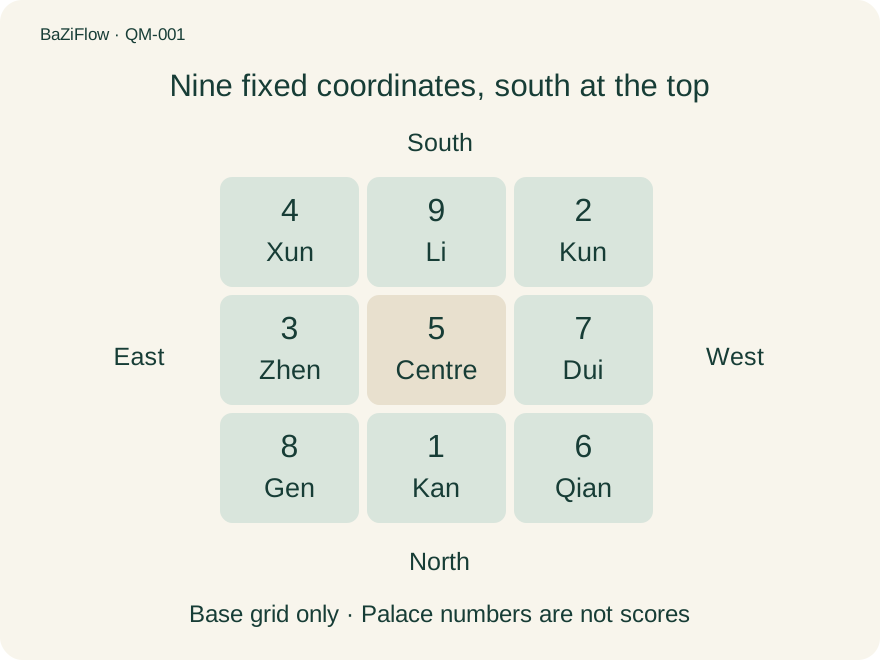
Original BaZiFlow coordinate diagram combining the cited palace numbers and trigram positions. This is a base grid, not a completed time chart.
| Row in this orientation | Left | Middle | Right |
|---|---|---|---|
| Top, toward south | 4 Xun | 9 Li | 2 Kun |
| Middle | 3 Zhen | 5 Centre | 7 Dui |
| Bottom, toward north | 8 Gen | 1 Kan | 6 Qian |
The cited compilation records the number-to-trigram associations. The Shuo Gua text supplies directional associations such as Zhen in the east, Li in the south and Kan in the north. The centre is numbered five; it does not require inventing a ninth trigram. Eight surrounding trigram positions and nine total palaces are compatible counts.
These numbers are identifiers, not a scale of quality. Palace one is not a lower score than palace nine, and the grid is not read by simply scanning the integers in order. First locate the numbered palace, then inspect the layers placed there in the chart being studied.
Check the square without making a prediction
The three row sums are 4 + 9 + 2, 3 + 5 + 7 and 8 + 1 + 6: each is 15. The columns and both diagonals also sum to 15. This is a useful arithmetic check when copying the grid. It tells you nothing by itself about whether a real-world action will succeed.
Even as a copying check, one sum is insufficient. Swap the two and nine in the top row and that row still totals 15, although its arrangement is now wrong. Check each number, trigram and direction, then use the sums as an additional check rather than a substitute for the full layout.
Nine spaces do not mean that every symbolic layer must have nine distinct members. Different layers have their own inventories and placement conventions. An apparently spare central box is not permission to manufacture another door to fill it.
The same time label can appear in different setups
In the Siku edition of Dun Jia Yan Yi, volume one, the Jia-Zi entry in the Yang-one example names Kan, Tian Peng and the Rest Door. Its Jia-Zi entry in the Yin-nine example names Li, Tian Ying and the Scenery Door. These are identified examples in that edition, not universal assignments for every Jia-Zi hour.
The comparison is useful because it separates a time label from the additional setup conditions. Recognizing Jia-Zi, or recognizing Kan palace one, does not supply the whole chart. Yin or Yang mode, the ju number and the relevant time information must be retained. Solar terms and ju numbers develops one part of that setup.
The same volume gives a centre-five lodging convention involving Kun two in its example. Record it with the named source. Do not silently promote one example into the only rule for every school or implementation. Differences in rotating and flying plate settings must be checked before declaring two charts inconsistent.
Read a box as a small record
A useful transcription keeps the palace number and trigram separate from the star, door and other layers actually shown. “Rest Door in Kan” says where a door is placed in this chart. “Kan is the Rest Door” collapses the location and the occupant into one category and loses that distinction.
Retain the time and setup alongside a cropped box so that it can be checked against the complete chart. Only then examine how a named reading method selects the symbols relevant to a question and interprets their combination. The direction on the chart is still a coordinate: identifying Li nine as south does not itself recommend travelling south.
The first milestone is simple but substantial. You can point to what stays fixed as the grid, what was placed for this setup, and what the reader added as interpretation. Those distinctions make the unfamiliar terminology easier to investigate without mistaking it for established facts about your life.
Part of a learning path
Qimen: from the nine palaces to recording a chart · Step 1 of 1 available