

Laozi editions: received and excavated
Content version · · Sources & references
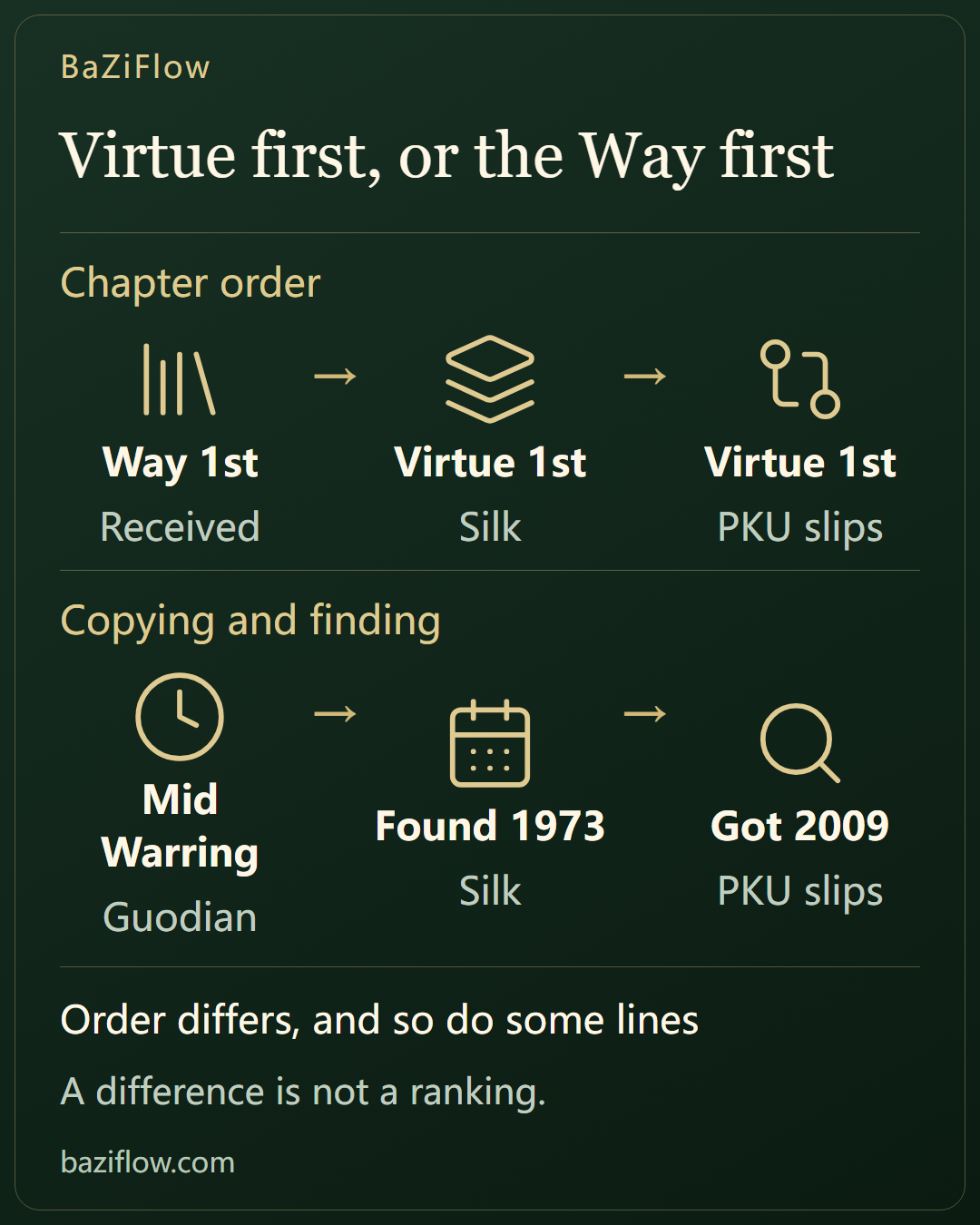
The Laozi survives as a received text, Mawangdui silk and bamboo slips. A chapter-order table, chapter 38 side by side, a few disputed lines and a timeline of copying against finding show where they differ.
The short version9 min read
There is more than one Laozi: the received text opens with the Way and follows with Virtue, the Mawangdui silk reverses them, and the Guodian slips copy only part of the book. Before reading, ask which copy is in hand.
- The received text puts the Way section (chapters 1-37) before the Virtue section (38-81); both Mawangdui copies and the Peking University slips put Virtue first, and the Peking University slips have only 77 chapters.
- In silk Text B chapter 38 lacks the line about lower virtue, chapter 39 lacks the myriad things, and chapter 37 opens with a nameless Way rather than a Way that does not act; most differences are in which lines are present and which characters are used.
- The Guodian slips are the earliest but copy only part of the book; the silk is fuller but has gaps. Disputed readings, such as the great vessel in chapter 41, are marked as disputed, and no copy is ruled the better.
Read first
Daoist Thought and Religious Daoism: Sorting the Books, the Name and the Religion ↗
One book, three kinds of material
Readers of the Laozi usually assume the book in hand has eighty-one chapters and opens with the Way (道) before turning to Virtue (德). In fact at least three kinds of material are in play: the received text handed down through the centuries, the silk manuscripts found in 1973 at Mawangdui, and the bamboo slips that have surfaced since 1993. They differ in chapter order, in wording and in size.
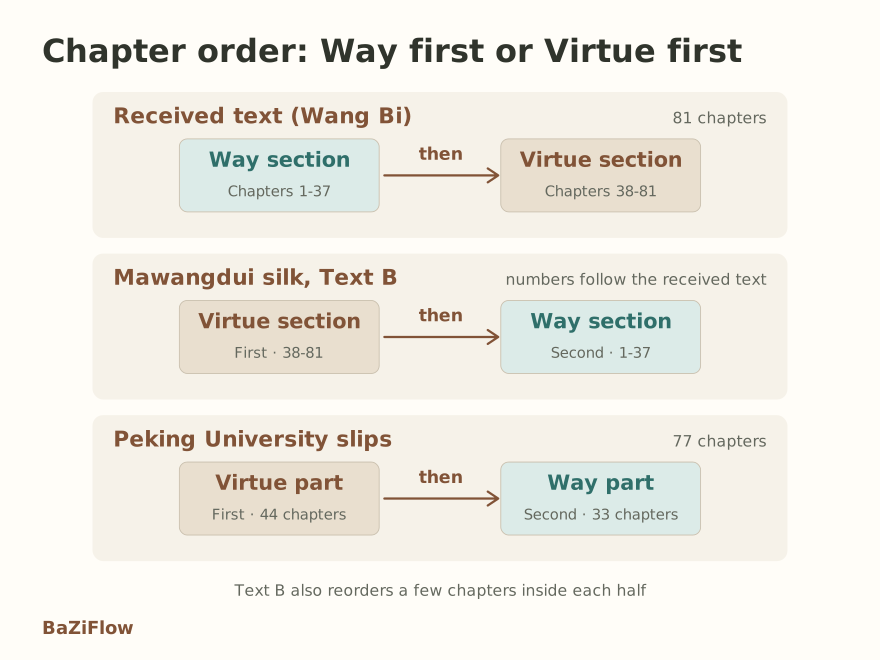
Sketch of chapter order. The chapter numbers on the silk follow the received text; the slips’ chapter count follows their editors’ division.
The figure starts with chapter order. In the received text the Way section comes first (chapters 1-37) and the Virtue section second (38-81). Mawangdui silk Text B reverses this, and so do the Peking University Han slips, which have only 77 chapters. The Guodian slips are left out of the figure because they copy only part of the book.
Four texts that are often cited
Wang Bi and Heshang Gong
After the Tang, the two most widely read annotated editions, by Wang Bi (王弼) and Heshang Gong (河上公). Traditionally eighty-one chapters: 37 in the Way section, 44 in the Virtue section.
1973 · Changsha
Two copies from Tomb 3, called Text A and Text B, both Virtue first. Text B is written on a full-width sheet of silk, and each of its two sections ends with its title and a character count.
1993 · Jingmen, Hubei
From Guodian Tomb 1, a Chu tomb of about the middle Warring States period. The Laozi falls into groups A, B and C and covers only part of the received book, by estimates from a third to two fifths.
Acquired 2009
Western Han bamboo slips given to the university, copied about the middle of the Western Han. The Laozi survives on 221 slips, over 5,300 characters, in 77 chapters, Virtue part first.
Chapter order: Virtue first or the Way first
The plainest difference is the order as a whole. The received text runs from chapter 1 to chapter 81. Silk Text B opens with chapter 38, “Highest virtue…”, and closes with chapter 37, “The Way is constantly nameless”.
Enlarge diagram · scroll sideways to read
Inside a chapter the wording can mostly be matched line for line; what changes is the order of chapters and which half comes first. The silk carries dots and similar marks that divide the text, but they do not add up to the eighty-one-chapter layout; the transcription numbers each stretch by the matching chapter of the received text so that the two can be compared.
The first subject differs too: the received text begins with the Way and naming, Text B with virtue and its loss. Why two orders existed, the materials do not say. Some researchers note that the essay explaining the Laozi (解老) in the Han Feizi (韩非子) also begins with the chapter on highest virtue; how that relates to the silk order is debated.
Chapter 38 side by side: a line short, a few more particles
Within one chapter the two texts differ in finer ways. Chapter 38 runs from highest virtue down to ritual; the received text lists five levels and silk Text B has four.
Enlarge diagram · scroll sideways to read
Three kinds of difference
The lower-virtue line is missing
After the line on highest virtue the received text has one on lower virtue that acts with an aim. Text B moves straight to humaneness.
Thin and plain, beginning and head
The received text has “the thinness of loyalty” and “the beginning of folly”; Text B has “the plainness of loyalty” and “the head of folly”, its word for plainness (泊) usually read as “thin” (薄). Elsewhere Text B writes “pull” and “that” with loan characters (乃, 罢) that editors read as the usual words (扔, 彼).
The added “ye”
Text B ends many clauses with the particle ye (也), as in “ritual is the plainness of loyalty ye”. The received text has none of these.
The transcription of Text B shows the word for rightness as a circle; the collated edition merging copies A and B reads it as rightness. Whether the received text added the lower-virtue line later or the silk copyist dropped it, scholars judge differently, and the materials cannot testify for either side.
Passages scholars keep returning to
Further on, several differences are often discussed. Most are single lines or single characters.
Enlarge diagram · scroll sideways to read
Chapter 39 is about “holding the One”. The received text lists heaven, earth, spirit, the valley, the myriad things and rulers; Text B has no myriad things, in either list. At the end of chapter 41 the received text says the Way “is good at bestowing and completing”, Text B “good at beginning and good at completing”; the two words differ in sense, and scholars choose differently.
In the same chapter the received text has the great vessel “completed late”; Text B writes mian (免) where it has “late”. Editors read it as “late”, which matches the received text, or as a word meaning “without”, which says something else. It is among the most discussed points, with no agreed conclusion.
In chapter 25 the received text says “the king is great” and later “the king occupies one of them”. Text B has “humans are great” for the first and keeps “the king occupies one” for the second; the same chapter also says “humans follow earth”. Scholars choose differently. Chapter 37 opens in the received text with “the Way is constantly without action and yet nothing is left undone”, in Text B with “the Way is constantly nameless”. The received text has that phrase again in chapter 48, where the matching place in Text B is a gap and cannot be compared.
Chapter 1 carries a punctuation question: “So constantly without desire, one observes its subtlety; constantly with desire, one observes its boundary.” Tradition cuts it either after “without desire” and “with desire”, or after “constantly without” and “constantly with”, taking desire with what follows. Text B has the particle ye after “without desire” and “with desire”, which many scholars take as support for the first cut; the tradition behind the received text has long had both.
Sort first
A line present or absent, a different character, and a different punctuation or reading are three kinds of difference; do not talk about them as one.
Then check the loan characters
Silk spellings are full of loan characters, such as the ones read as “thin” and “that”. Record the editor’s reading with the original spelling.
Finally name the source
Give the text, the chapter and the edition. Mark gaps with a box and do not fill them in yourself.
Slips: earlier, and more fragmentary
Besides the silk there are two sets of bamboo slips: the Guodian slips, found in 1993, and the Western Han bamboo books acquired by Peking University in 2009. Copying and finding do not run in the same order. Text B is generally taken to have been copied in the early Han and Text A somewhat earlier; the Peking University slips are put near the middle of the Western Han.
Enlarge diagram · scroll sideways to read
The Guodian slips order their chapters differently from the received text, and even the opening of a single chapter is written differently in the three texts.
The opening of chapter 19
Cut off sageliness
“Cut off sageliness, discard cleverness, and the people benefit a hundredfold; cut off humaneness, discard rightness, and the people return to filial care; cut off skill, discard profit, and there are no thieves.” (Received text, chapter 19, translated from the original.)
Cut off sageliness, discard knowing
Close to the received text, with a loan character for “cleverness”.
Cut off cleverness, discard disputation
“Cut off cleverness, discard disputation, and the people benefit a hundredfold; cut off skill, discard profit, and there are no thieves; cut off contrivance, discard deceit, and the people return to filial care.” Transcriptions differ in places: deceit is sometimes given as scheming, and filial care is written with other characters read as filial care.
Some researchers use this to discuss how the Laozi relates to Confucian ethics; others remind us that the slips are an excerpt, and what they do not copy cannot be taken as absent from the original. The Peking University slips are a different case: their editors divide them into 77 chapters, 44 in the Virtue part and 33 in the Way part, which does not match the received eighty-one.
For the core ideas of the book, see the Way and Virtue. For where non-action sits across the texts, see wu wei, and for how the Laozi and the Zhuangzi read side by side, see Laozi and Zhuangzi compared.
Questions readers ask next
Why does the Laozi we read put the Way before Virtue?
That is how the received text is arranged. The silk manuscripts and the Peking University slips put Virtue first, which shows that an earlier arrangement existed too. When and why the Way section moved to the front is not explained by the materials at hand, and a reason should not be invented.
Is silk Text B closer to the original because it is older than the received text?
Older does not mean closer. Age of copying, completeness and a documented origin are three separate questions. Text B is an early Han copy with many gaps left as boxes in the transcription and many loan characters; the Guodian slips are older still but only excerpts. Record the differences first, then weigh them.
What should I note when quoting the Laozi?
The text (received or Wang Bi edition, silk Text B, Guodian group A and so on), the chapter, and the edition or page it comes from. The silk itself carries no chapter numbers; the numbers in the transcription are matched to the received text, so say so when you write “silk chapter 38”.
Was this article helpful?
Part of a learning path
Sources & references
Continue reading
Daoist Thought and Religious Daoism: Sorting the Books, the Name and the Religion ↗
Cook Ding Carves the Ox: Skill, Attention and Nourishing Life ↗
Laozi and Zhuangzi: Reading Them Side by Side by Genre, Audience and Word Use ↗