

Support, climate and mediation ask different Bazi questions
Content version · · Sources & references
A phase chosen for support need not be chosen for seasonal adjustment or mediation. Compare the questions, then test five generating paths without turning them into remedies.
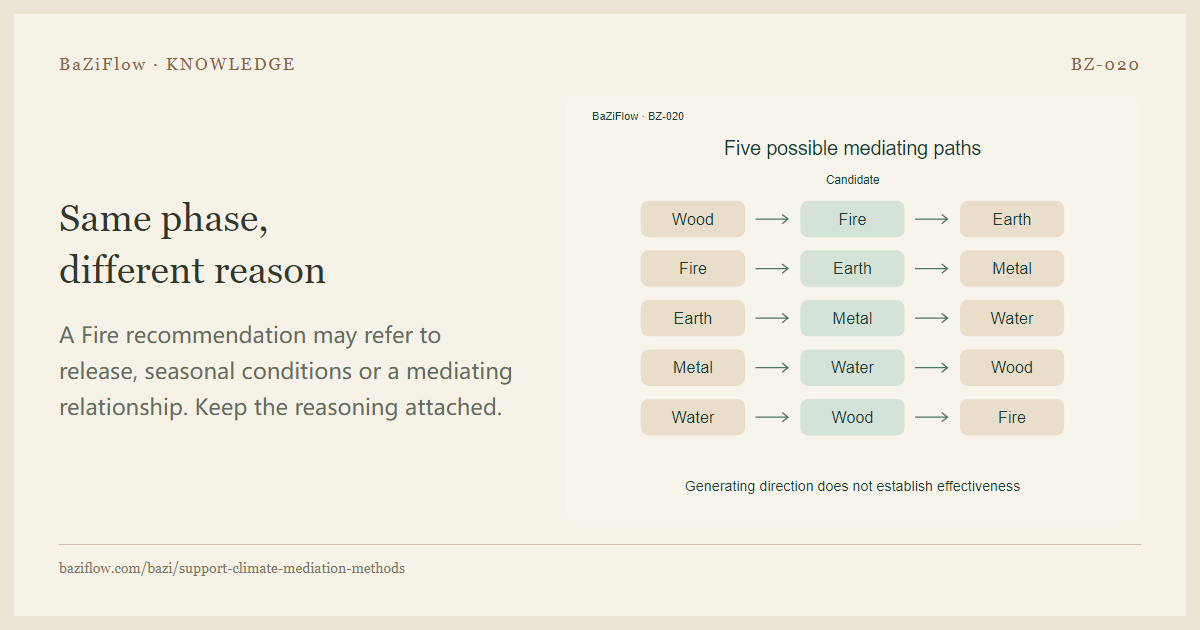
A Fire recommendation may refer to release, seasonal conditions or a mediating relationship. Keep the reasoning attached.
Read first
A correct arrow can still leave the question unanswered
Draw Metal generating Water, then Water generating Wood. Both arrows follow the generating cycle. Now ask a different question: has a particular chart successfully mediated a Metal–Wood problem? The drawing cannot answer. We have supplied no positions, season or evidence that the proposed obstruction is active in that chart.
This gap between a relationship diagram and an individual judgment is a useful starting point for mediation, traditionally called Tong Guan. The Tong Guan chapter of Di Tian Sui describes both connecting relationships and circumstances that obstruct them. Identifying a candidate middle phase is only part of the argument. A controlling relationship is not automatically an error that must be removed.
Check the five paths, then mark what the table lacks
The source's commentary names four middle-phase pairings (Wood–Earth via Fire, Fire–Metal via Earth, Earth–Water via Metal, Metal–Wood via Water); the fifth, Water–Fire via Wood, is completed here by the same generating logic. Each row below can be verified without a birth record. That makes it a lesson in the symbolic scheme; it does not make it a completed interpretation.
| Controlling direction | Candidate middle phase | Generating path |
|---|---|---|
| Wood controls Earth | Fire | Wood to Fire to Earth |
| Fire controls Metal | Earth | Fire to Earth to Metal |
| Earth controls Water | Metal | Earth to Metal to Water |
| Metal controls Wood | Water | Metal to Water to Wood |
| Water controls Fire | Wood | Water to Wood to Fire |
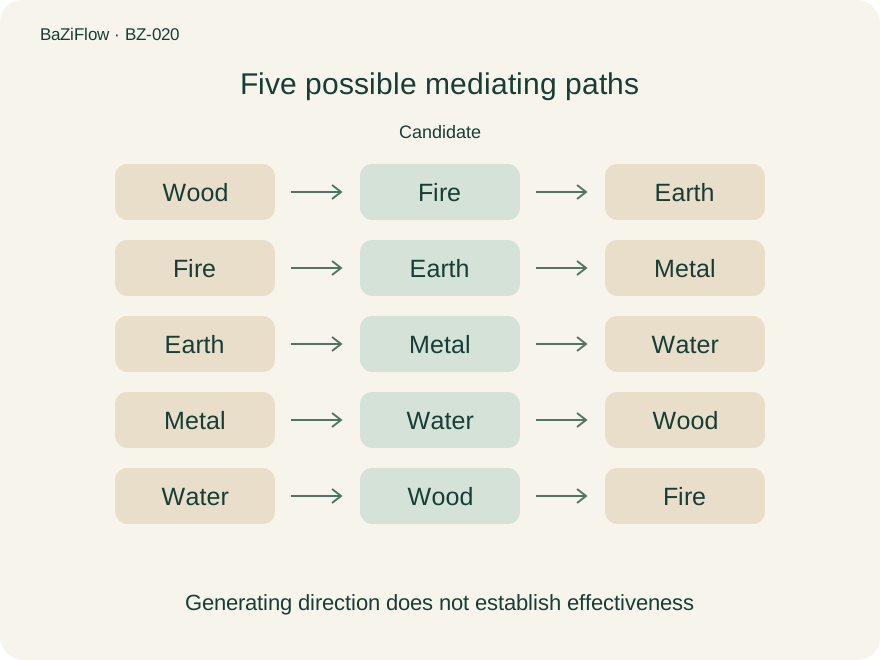
Original BaZiFlow relationship diagram. A possible middle phase is not a prescription.
Consider a worksheet that adds one Water symbol beneath the Metal–Wood row. We still need to know where that symbol belongs and how the selected method assesses its role. Water hidden in a branch and a factor appearing only in an examined year are not interchangeable pieces of evidence. If it belongs only to a future year, it must stay out of the original birth pillars.
The original controlling direction also remains part of the scheme. Adding a generating path does not erase Metal controlling Wood. Nor does the diagram show that putting a water-related object in a room would reproduce a chart relationship. That would be a separate real-world claim, requiring separate evidence.
Another reader may have selected Water for another reason
Suppose a note beside the same worksheet says that Water supplies support. Before treating it as a second confirmation of mediation, inspect its question. Support-and-restraint analysis commonly asks how assistance, output and control operate around the Day Master. Its premises include a strength argument, not merely the availability of a connecting arrow.
Di Tian Sui's body-and-function discussion and commentary present several ways of assigning body and use. Season, roots, placement and other relationships matter to the traditional assessment. Counting equal numbers of each phase would not recover those relationships. Likewise, a difference in counts does not demonstrate which factor should be selected.
Two statements ending in Water can therefore rely on different premises. Agreement in the last word is not independent evidence that either reasoning process has been completed. The same warning applies when two accounts disagree: first determine whether they are addressing the same problem. Useful, favorable and unfavorable roles explains why the shared vocabulary alone cannot settle this.
A historical Fire example shows two functions in one factor
The climate chapter of Zi Ping Zhen Quan discusses winter Wood with Fire. Within that account, Fire has an output function because Wood generates it, while also playing a seasonal role. The chapter separately distinguishes spring Wood with Fire from summer Wood with Fire. The two phase names do not carry the whole condition.
Seasonal adjustment uses the traditional vocabulary of cold, warmth, dryness and moisture. It is neither a reading of the day's weather station nor a medical examination. A tropical birthplace does not silently replace a winter month with a summer month in the calculation. If a school makes regional adjustments, its conventions need to be stated rather than inferred from a modern temperature report.
We can now return to a phrase such as favor Fire. It might concern Wood's output, the cited winter-Wood discussion, or the Wood–Fire–Earth connecting path in the table. Those are three possible arguments, even though they end in the same phase name. The historical passage establishes what that text discusses; it does not establish the effectiveness of a modern remedy.
Compare the premises that changed
For a study exercise, keep two records. The first lists only Metal and Wood. The second additionally records the location of Water and the relevant month. Do not prescribe a phase to either incomplete example. Instead, mark what the second record permits you to investigate that the first does not.
If an explanation remains word for word the same after those fields are supplied, check whether it used them. If the conclusion changes, it should identify the newly relevant condition. A more detailed input should produce a traceable analysis, not simply a longer generic description.
Finally, the three approaches are not ballots. A seasonal concern, a support concern and a mediation proposal may interact, but counting their preferred phase names conceals different questions and assumptions. State the priority adopted by the method, the conditions it depends on and what remains unresolved. Strong and weak Day Masters develops the evidence needed for the support question. None of these diagrams alone validates a purchase, relocation or health decision.
Sources & references
Continue reading
A Missing Element Is Not an Automatic Remedy Request ↗