

Distinguishing shared terms
Content version · · Sources & references
What combination, clash and star mean in each system: compare BaZi pairing, Ziwei palace spacing and astrological longitude through unequal combination gaps, a cross-sign conjunction and a 177° opposition candidate.
The short version5 min read
A shared term can name a stem–branch pairing, a palace reading scope or an angle between celestial positions. Identify the object and its conditions before comparing what the term does.
- BaZi relationships require actual stems or branches under its rules; Ziwei links set palace scope; astrological aspects test continuous degrees.
- Six Harmony pairs are not one fixed spacing, and conjunction can cross a sign boundary. Similar circles do not imply identical algorithms.
- Star may mean a relative category, a rule-placed marker or a physical body. Retain source, person and time layer with the word.
Read first
BaZi and Ziwei on One Question: Preserve Each Structure Before Comparing ↗
Ziwei Palaces and Astrological Houses: Twelve Regions, Different Methods ↗
One word may perform three different jobs
A Rat–Ox (子丑) combination, the three palaces linked to Life Palace, and Venus conjunct Mars can be described with related combination vocabulary. Their subjects are branches, palaces and celestial bodies respectively. The first needs a pairing table, the second a palace interval, the third longitude and an orb. Placing them side by side identifies their jobs; it does not reveal one universal combination algorithm.
Ordinary text is an additional trap. A Chinese domain character can occur inside an everyday word without naming a branch, and prose about cooperation need not establish a chart combination. Negation, hypothesis, quotation and another person’s chart also retain their own scopes. Return to authoritative structured chart data before deciding meaning, so a textual collision does not propagate into fabricated element counts or event interpretations.
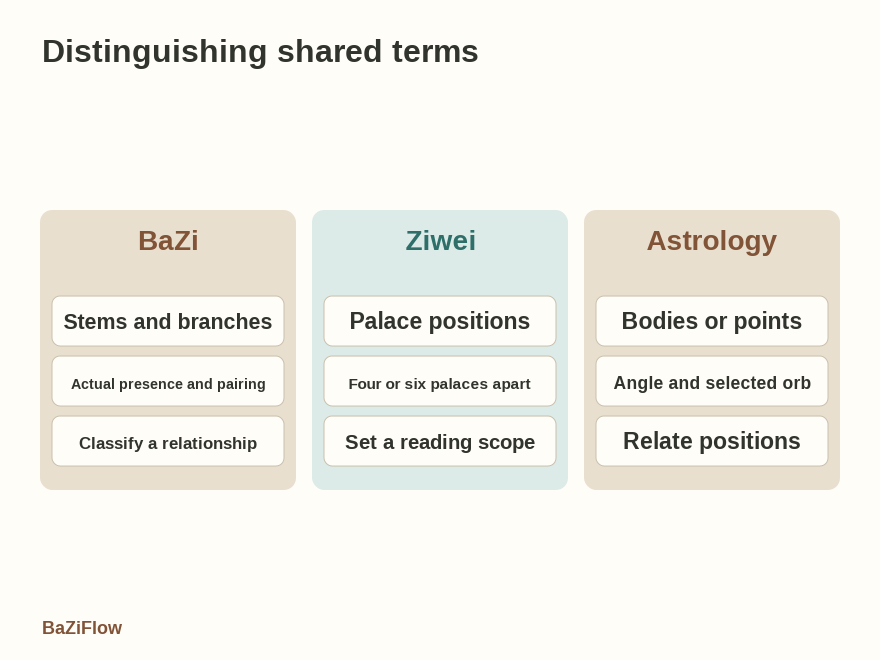
Three columns distinguish BaZi stem–branch pairing, Ziwei palace scope and astrological longitude aspects. Shared words have different objects and conditions.
BaZi contains both regular spacing and pairing exceptions
The Five Stem Combinations are Yang Wood–Yin Earth, Yin Wood–Yang Metal, Yang Fire–Yin Metal, Yin Fire–Yang Water and Yang Earth–Yin Water, separated by five positions in the ten-stem sequence. The Six Harmony branch pairs are Rat–Ox, Tiger–Pig, Rabbit–Dog, Dragon–Rooster, Snake–Monkey and Horse–Goat. Their spacing is not uniform. The regular stem construction therefore cannot simply be copied into the branch rule. The ring draws three pairs so the unequal distances are visible.
The Six Clashes are Rat–Horse, Ox–Goat, Tiger–Monkey, Rabbit–Rooster, Dragon–Dog and Snake–Pig, six positions apart. Traditional counting that calls this seven includes the starting position. Actual application also requires the branches to be present in the natal or timing layer under discussion. A combination is not automatically transformed. Sanming Tonghui treats these internal relationships, not arbitrary appearances of matching characters in a text.
Enlarge diagram · scroll sideways to read
Ziwei links first establish which palaces to read together
In twelve palace positions, taking a location every four palaces forms a three-part relationship, and six palaces away gives the opposite. Every palace has these neighbours. The construction first tells the reader which regions to consider together; it does not announce a particular event today. Life, Wealth and Career can form one related reading scope, with the opposite region bringing in Travel for Life Palace.
BaZi’s branch formation requires actual branch presence, whereas Ziwei’s linked palace positions exist through the layout. They may share a shape on a twelve-branch circle without sharing conditions. The stars, transformations and time layer then supply additional material. Turning “every palace has linked palaces” into “everyone has a completed branch formation” skips the difference in object type.
Enlarge diagram · scroll sideways to read
Cross-sign aspects require complete circular arithmetic
Aries 29° and Taurus 2° are full longitudes 29° and 32°, only 3° apart. Adjacent signs can therefore contain a conjunction under an appropriate threshold. Conversely, opposite ends of one sign can be nearly 30° apart, so same-sign membership alone cannot establish conjunction. Continuous degrees preserve finer information than a sector name.
Now compare Aries 28° with Scorpio 1°: longitudes 28° and 211°. Ordinary subtraction gives 183°, the shorter arc 177°, and deviation from exact opposition 3°. Aries’ opposite sign by name is Libra, yet these cross-sector positions may still qualify under a 3° or wider inclusive degree limit. Keeping each intermediate number prevents the long difference from being mislabelled as the short separation.
Enlarge diagram · scroll sideways to read
Even star needs an object definition
BaZi Wealth and Officer stars are relationship categories relative to the Day Master. Ziwei stars are placed through traditional calendar and assignment rules. Astrological bodies have ephemeris positions. A name mentioning Sun, Moon or star does not guarantee the same physical object is under discussion. Life Palace and rising also have different constructions; a shared birth-hour vocabulary does not equate them.
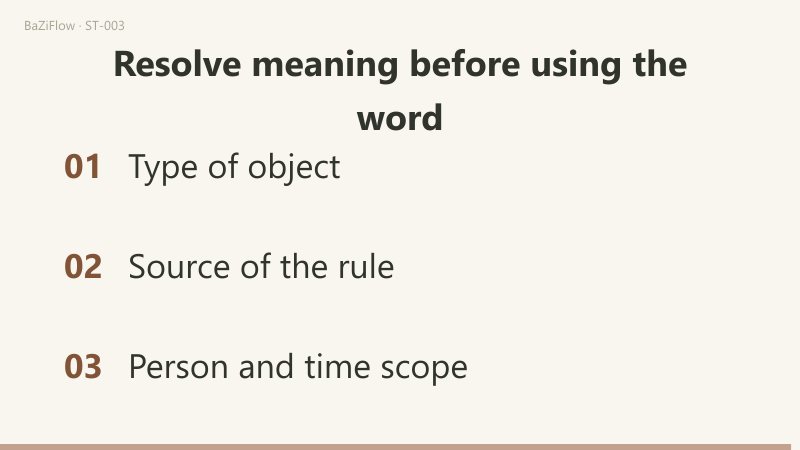
For a new term, write definition, object, condition, purpose, person and time layer. If all you have is “both traditions call it combination,” the comparison has not yet begun. If you can explain that one pairs objects, one sets scope and one measures an angle, you have learned a methodological difference beneath the resemblance. That is the habit that prevents the next familiar word from becoming an unsupported chart fact.
Find the definition
Identify the tradition and rule passage, not just a matching word.
Find the objects
Check actual stems, palaces or degrees in the current chart rather than extracting facts from generated prose.
Find the scope
Record whose chart, which time layer, and whether the sentence is fact or hypothesis before comparing.
Continue with Calculating angular distance.
Questions readers ask next
Does the word combination establish one in the chart?
No. It may occur in ordinary prose, a hypothesis, a quotation or another person’s chart. Only relevant objects satisfying the system’s actual conditions establish a relationship.
Can bodies in Aries and Taurus form a conjunction?
A degree-based conjunction may cross signs: Aries 29° and Taurus 2° are longitudes 29° and 32°, separated by 3°. The selected orb still decides inclusion.
Is a Ziwei three-palace link the same as a BaZi Three Harmony formation?
No. Each Ziwei palace has linked positions four palaces away. BaZi requires the relevant branches to appear and its own conditions to be checked. Reading scope is not a completed formation.
Was this article helpful?
Part of a learning path
Sources & references
Continue reading
Three sides, four directions: the four palaces read together ↗