

Daxu: heaven inside a mountain, holding and storing
Content version · · Sources & references
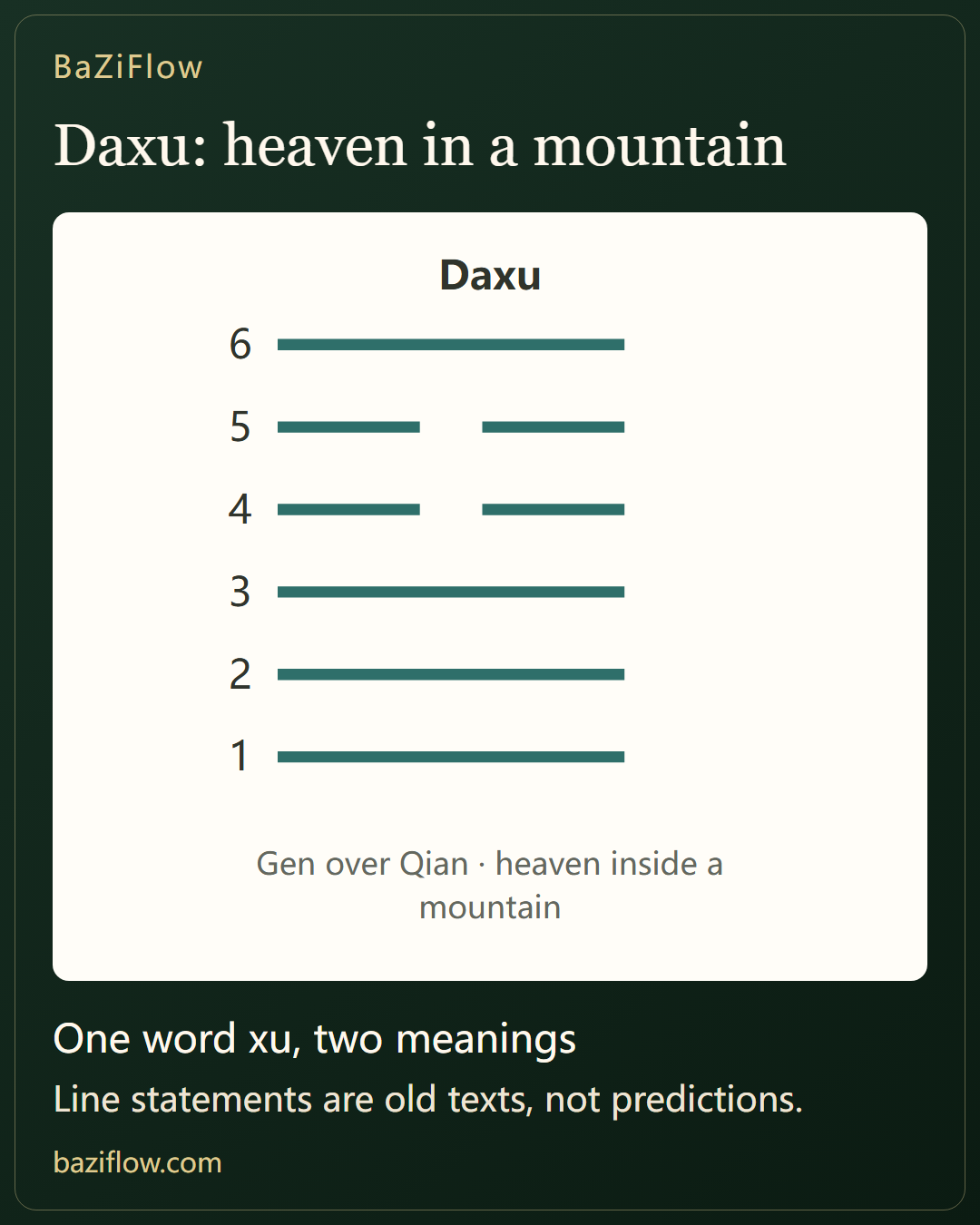
Daxu is the 26th hexagram: Qian below, Gen above, heaven inside a mountain. The word xu means holding back in the Commentary on the Judgments and storing up in the Image; six statements run from stopping to an open road.
The short version7 min read
Daxu puts Gen, the one that stops, on top of Qian, the strong. One word, xu, is used by the Commentary on the Judgments for holding back and by the Image for storing up; the six statements are a road from stopping to opening.
- Daxu (大畜) is Gen (mountain) over Qian (heaven), with three yang lines at the bottom. The Shuo Gua says "Qian is strength" and "Gen is stopping", so the figure shows the strong held inside the mountain.
- The Commentary on the Judgments praises the hexagram in a run of phrases and then says it "can stop the strong"; the judgment's "not eating at home" is explained there as nourishing the worthy.
- Lines 1, 2 and 3 each stop in their own way; lines 4 and 5 turn to a young ox and a gelded boar; the top line is only "what a thoroughfare of heaven", and its Small Image says the Way is greatly carried out.
Read first
The Sixty-Four Hexagrams: How Upper and Lower Trigrams Form One Figure ↗
Judgment and Line Statements: Whole Hexagram or Single Line? ↗
Heaven inside a mountain: Qian below, Gen above, one word with two meanings
Daxu (大畜) is the 26th hexagram. The lower trigram is Qian (heaven), the upper is Gen (mountain). The first, second and third lines are yang, the fourth and fifth are yin, and the top line is yang again. The Shuo Gua says "Qian is strength" and "Gen is stopping", so the layout is plain to read: the strong below, what stops it above.
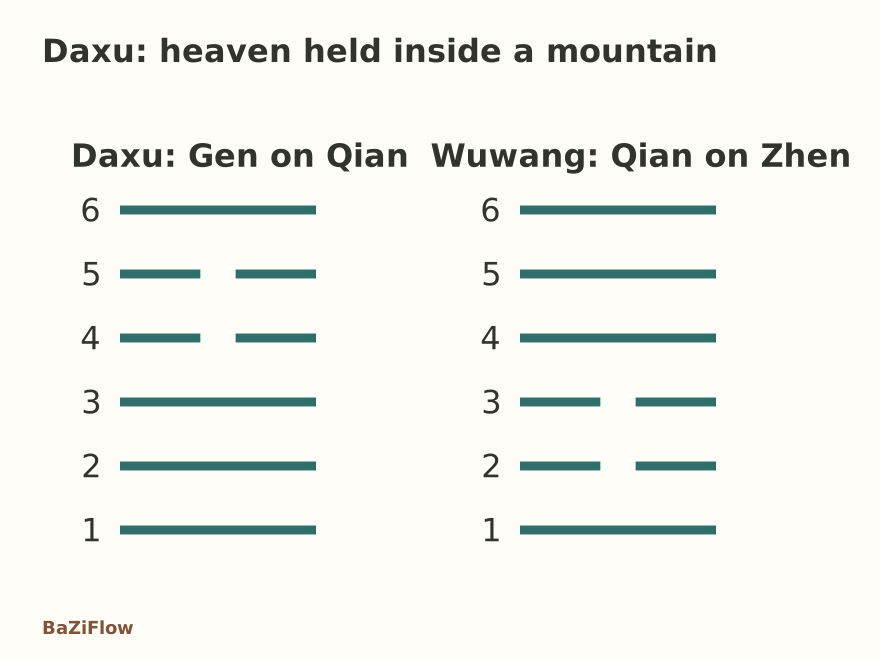
Daxu and its reversed form Wuwang: turn Daxu over and the three yang lines move from the bottom to the top.
Enlarge diagram · scroll sideways to read
Three words in Daxu
- Xu
- The name is read xu, close to the word "to store". In this hexagram it has two uses: the Commentary on the Judgments says "can stop the strong", which is holding back; the Image says "to store up his virtue", which is accumulating.
- Gen and Qian
- With Gen on top and Qian underneath, the figure itself is a hold: the mountain outside, heaven within.
- Not eating at home
- Three words in the judgment, literally "not eating at home". The Commentary on the Judgments answers them with three words of its own: nourishing the worthy.
The two meanings do not conflict here. Holding back something strong is also a way of keeping it. In each section below it is worth asking which of the two the word means.
The Commentary on the Judgments: a run of praises, then "can stop the strong"
The judgment of Daxu is "fitting to stay on course; not eating at home brings good fortune; fitting to cross the great river". The Commentary on the Judgments (彖传) first praises the hexagram's character and then explains the judgment line by line.
Daxu: firm, strong, solid and sincere, radiant; day by day it renews its virtue. The firm rises and honors the worthy. It can stop the strong: this is great rightness. "Not eating at home brings good fortune": it nourishes the worthy. "Fitting to cross the great river": it answers to heaven.
Enlarge diagram · scroll sideways to read
"The firm rises and honors the worthy" is read off the figure: the top line is yang, a firm line at the highest place, and the Commentary takes that as honoring the worthy. "It can stop the strong: this is great rightness" is the hinge of the passage: Gen is able to stop the strength of Qian, and the Commentary calls that great rightness. The last two clauses annotate the judgment, one by one: "not eating at home" is nourishing the worthy, and "crossing the great river" is answering to heaven, which in this hexagram is the lower trigram, Qian.
The Image: heaven within the mountain, learning the earlier words
The Image changes the angle. Instead of holding something back it speaks of putting something in.
Heaven is within the mountain: Daxu. The noble person widely learns the earlier words and the deeds of the past, so as to store up his virtue.
Enlarge diagram · scroll sideways to read
"Earlier words and deeds of the past" means what people before him said and what has already been done. The first act is to learn it, and the second is to store the result up as virtue. The word for "store" is the same character the Commentary on the Judgments uses for "stop the strong", yet here it means accumulating: the same mountain holds back toward the outside and keeps safe toward the inside.
The six lines: first self-stopping, then restraint, then the road
The six statements fall into three groups by position. The three below are Qian's yang lines; the three above belong to Gen.
Enlarge diagram · scroll sideways to read
Take the three yang lines first. Each stops differently. Line 1: "danger; it is fitting to stop", and the Small Image says this way "it runs into no disaster". Line 2: "the cart sheds its axle strap". The strap that binds the axle to the cart has been taken off, so the cart cannot go by itself, and the Small Image says that, being in the middle place, he has no fault. Line 3 stops most loosely. "A good horse gives chase": the horse is running, and the text allows "fitting to have somewhere to go", on condition that "day by day he drills the cart and its guard". The Small Image says "those above share his aim". Across the three yang lines the stopping moves from a halt, to taking a strap off, to running while drilling, and the road opens a little at a time.
Lines 4 and 5 write differently. The subject is now an animal under restraint: "the board on a young ox" (the original word is traditionally read as a board tied across the ox's horns), and "the tusk of a gelded boar". Both are fortunate, and each Small Image gives a single word: joy, celebration. The top line has only five characters, "what a thoroughfare of heaven; success", and the Small Image says "the Way is greatly carried out".
Xiaoxu, Wuwang, Guimei: neighbors and the sequence
Put Daxu beside the ninth hexagram, Xiaoxu (小畜). Both have Qian below; they differ in the upper trigram.
Enlarge diagram · scroll sideways to read
The upper trigram of Xiaoxu is Xun, which the Shuo Gua calls "entering", and its figure has a single yin line. The upper trigram of Daxu is Gen, "stopping", and its figure has two yin lines.
The reversed hexagram of Daxu is Wuwang (无妄): turn Daxu upside down and Gen the mountain becomes Zhen the thunder, below, with Qian the heaven above; that is the right-hand figure at the top of this article. Its inverse is Cui (萃) and its nuclear hexagram is Guimei (歸妹). The Xu Gua sets it between Wuwang and Yi (頤): not acting rashly comes first, and once something is stored up the text turns to nourishing.
Questions readers ask next
Is xu pronounced like the word for livestock?
The character is the same one that means livestock, read chu in that sense. In the hexagram name it is usually read xu, close to the word for storing, and it can mean either holding back or storing up. The Commentary on the Judgments and the Image of this hexagram each use one of the two.
Does "not eating at home" mean staying away from home meals?
Literally, yes: not eating at home. The Commentary on the Judgments explains it with three words, nourishing the worthy, and ties it to feeding. Whether the phrase means holding a post away from home or being supported by others, the text does not spell out. Quote the letter and the Commentary.
Why do lines 4 and 5 use a young ox and a boar?
The text gives no reason. The statements say only "the board on a young ox" and "the tusk of a gelded boar", and each Small Image adds one word, joy and celebration. Which animal stands for what is a later guess and not something these two lines settle.
Was this article helpful?
Sources & references
Continue reading
Wuwang: thunder under heaven, from "no recklessness" to "an undeserved calamity" ↗
Yi (頤): a hexagram shaped like a mouth, and the "upside-down" and "against" nourishing ↗
The Sixty-Four Hexagrams: How Upper and Lower Trigrams Form One Figure ↗
Judgment and Line Statements: Whole Hexagram or Single Line? ↗