

Tian Gui: the day-plus-hour star
Content version · · Sources & references
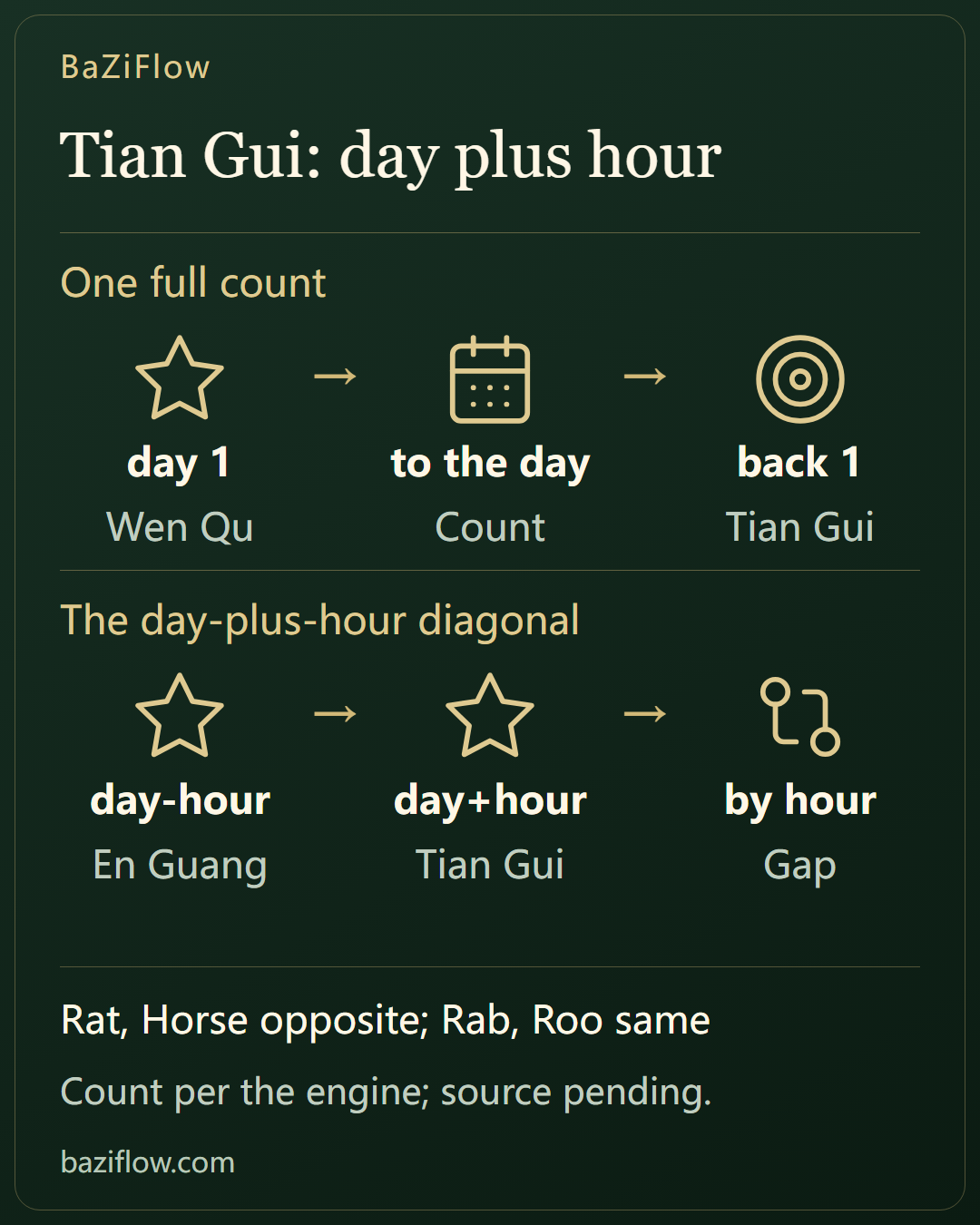
Tian Gui counts from the Wen Qu palace to the birth day and steps back one, so it follows day plus hour number and ignores the month. A worked count, a lookup table, and why juan 1 to 3 of the Quan Shu lack it.
The short version6 min read
Tian Gui is the partner of En Guang: day 1 is put on a palace, counted to the birth day and stepped back one, only with Wen Qu as the start instead of Wen Chang. The landing follows "day plus hour number", and its position against En Guang depends on the hour alone, the day having canceled out.
- Tian Gui counts from the Wen Qu palace with day 1 on it to the birth day, then steps back one; Wen Qu is set by the hour, so only birth day and hour matter and the month plays no part.
- One more day moves it a palace forward and so does one more hour, so cells with the same "day plus hour number" share a branch; the lookup is the same table as San Tai's month-plus-day one.
- Its position against En Guang depends on the hour alone: Rat and Horse hours put it directly across, Rabbit and Rooster hours in the same palace; the Quan Shu juan 1 to 3 we hold has no "Tian Gui".
Read first
What do Zi Wei's supporting, malefic and minor stars actually do? ↗
Counting from the Wen Qu palace
Tian Gui (天贵) is the twin of En Guang (恩光), with the same method and a different starting point. Find Wen Qu (文曲) from the hour, let lunar day 1 sit on its palace, walk forward one palace per day to the birth day, then retreat a single palace; where you end is Tian Gui.
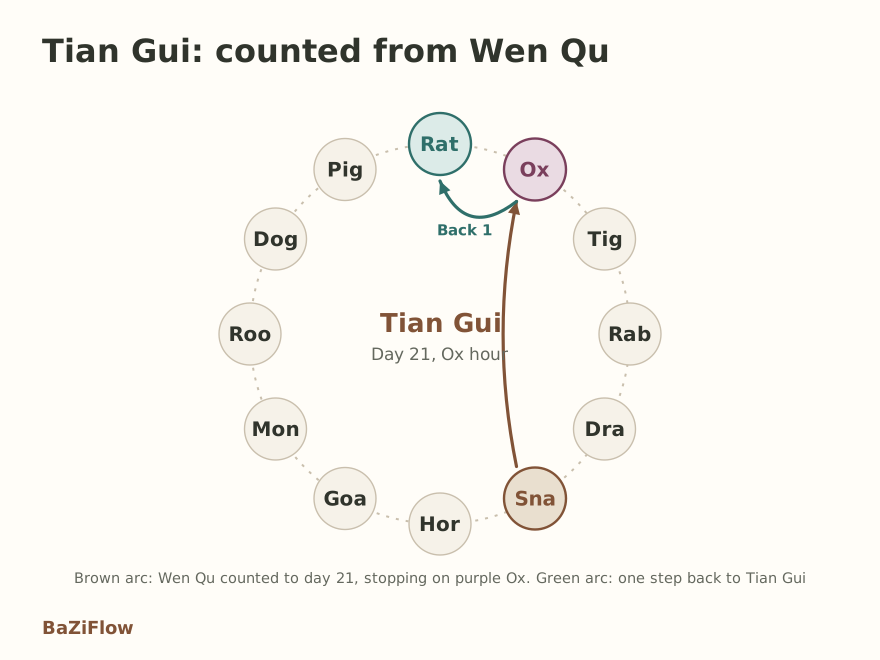
Ring sketch: the example is lunar day 21 in the Ox hour and the landing matches iztro 2.6.0; brown is Wen Qu, purple is where the count to day 21 stops, and green is Tian Gui after one step back.
The example in the picture is lunar day 21 in the Ox hour. In the Ox hour Wen Qu is on the Snake palace, so day 1 goes on Snake and counting to day 21 means going 20 palaces on, which stops on the Ox palace; one step back puts Tian Gui on the Rat palace.
Wen Qu starts the Rat hour on the Dragon palace and moves one palace forward for each later hour; see Wen Qu. Tian Gui therefore sits at the Dragon palace plus (hour number plus day minus two) places, again with no month.
Day plus hour: one anti-diagonal is one cell
Wen Qu moves forward with the hour, so for Tian Gui day and hour point the same way: one more day moves it a palace forward, and one more hour does too, so the two add rather than cancel. Walking in the table from upper right to lower left, one more day and one fewer hour, leaves Tian Gui where it was.
Enlarge diagram · scroll sideways to read
Reduce "day plus hour number" modulo 12 and read the matching row (the Rat hour counts as 0 and the Pig hour as 11):
| Remainder | Tian Gui | Remainder | Tian Gui |
|---|---|---|---|
| 0 | Tiger | 6 | Monkey |
| 1 | Rabbit | 7 | Rooster |
| 2 | Dragon | 8 | Dog |
| 3 | Snake | 9 | Pig |
| 4 | Horse | 10 | Rat |
| 5 | Goat | 11 | Ox |
This is the same table as San Tai's: San Tai looks up "month plus day", Tian Gui looks up "hour number plus day", one formula with a different term added.
Against En Guang: the hour decides
En Guang counts from Wen Chang and Tian Gui from Wen Qu, and both then travel "day minus two" places beyond their starting points. The day part is the same on both sides and cancels when they are subtracted; what is left is the distance between Wen Qu and Wen Chang, which depends on the hour alone.
Enlarge diagram · scroll sideways to read
Hour by hour, the number of palaces counted forward from En Guang to Tian Gui:
| Hour | Apart | Hour | Apart |
|---|---|---|---|
| Rat | 6 | Horse | 6 |
| Ox | 8 | Goat | 8 |
| Tiger | 10 | Monkey | 10 |
| Rabbit | 0 | Rooster | 0 |
| Dragon | 2 | Dog | 2 |
| Snake | 4 | Pig | 4 |
Three results from this table
- Same palace
- Born in the Rabbit or Rooster hour, Tian Gui and En Guang share a palace.
- Opposite
- Born in the Rat or Horse hour, the two stars sit directly across on the ring of branches.
- The rest
- Two, four, eight or ten apart, and each pair of hours, such as Ox and Goat, gives the same gap.
A "Tian Gui" the book does not show
In the Zi Wei Dou Shu Quan Shu (紫微斗數全書) as we hold it, juan 1 to 3, we searched for "Tian Gui" in both simplified and traditional forms and found none; the placement verses of juan 2 cover San Tai, Ba Zuo, Tai Fu and Feng Gao, but not this star.
Enlarge diagram · scroll sideways to read
Find Wen Qu first
Wen Qu starts the Rat hour on Dragon and goes forward: the Rat hour is on Dragon and the Pig hour on Rabbit.
Work out "day plus hour number"
Divide by 12, keep the remainder and read Tian Gui's branch from the table above.
Check against En Guang
Then look up "apart" for the birth hour and confirm the two stars' relative position.
Two problems from Wen Qu
A birth on lunar day 20 in the Goat hour: where does Tian Gui land?
The Goat hour is number 7, 20 + 7 = 27, remainder 3, so the Snake palace.
Tian Gui and En Guang share a palace: which two hours could the birth be in?
A shared palace happens only in the Rabbit and Rooster hours.
Its twin is En Guang, which starts at Wen Chang and follows day minus hour; read together, the two show what the day and the hour each contribute.
Questions readers ask next
Is Tian Gui a "partner star" of Wen Qu?
In the count it is: it starts at the palace where Wen Qu sits. Whether the two stars are partners in meaning is not written in the books we hold, and cannot be deduced from the count.
Why are En Guang and Tian Gui in opposite palaces on my chart?
Their relative position is set by the birth hour alone and has nothing to do with the day. At the Rat and Horse hours Tian Gui is always directly across from En Guang, and at the Rabbit and Rooster hours the two share a palace.
Why write an article on a star the book does not mention?
It is among the minor stars on the chart page and the engine gives its landing, so readers will see it on a chart. This article covers only how the landing arises, and the meaning stays blank until a source turns up.
Was this article helpful?
Sources & references
Continue reading
En Guang (恩光): The Minor Star That Ignores the Birth Month ↗
Tai Fu (台辅): Counted from the Horse Palace, Two Places from Feng Gao and Wen Qu ↗