

Find the data divergence before reviewing the story
Content version · · Sources & references
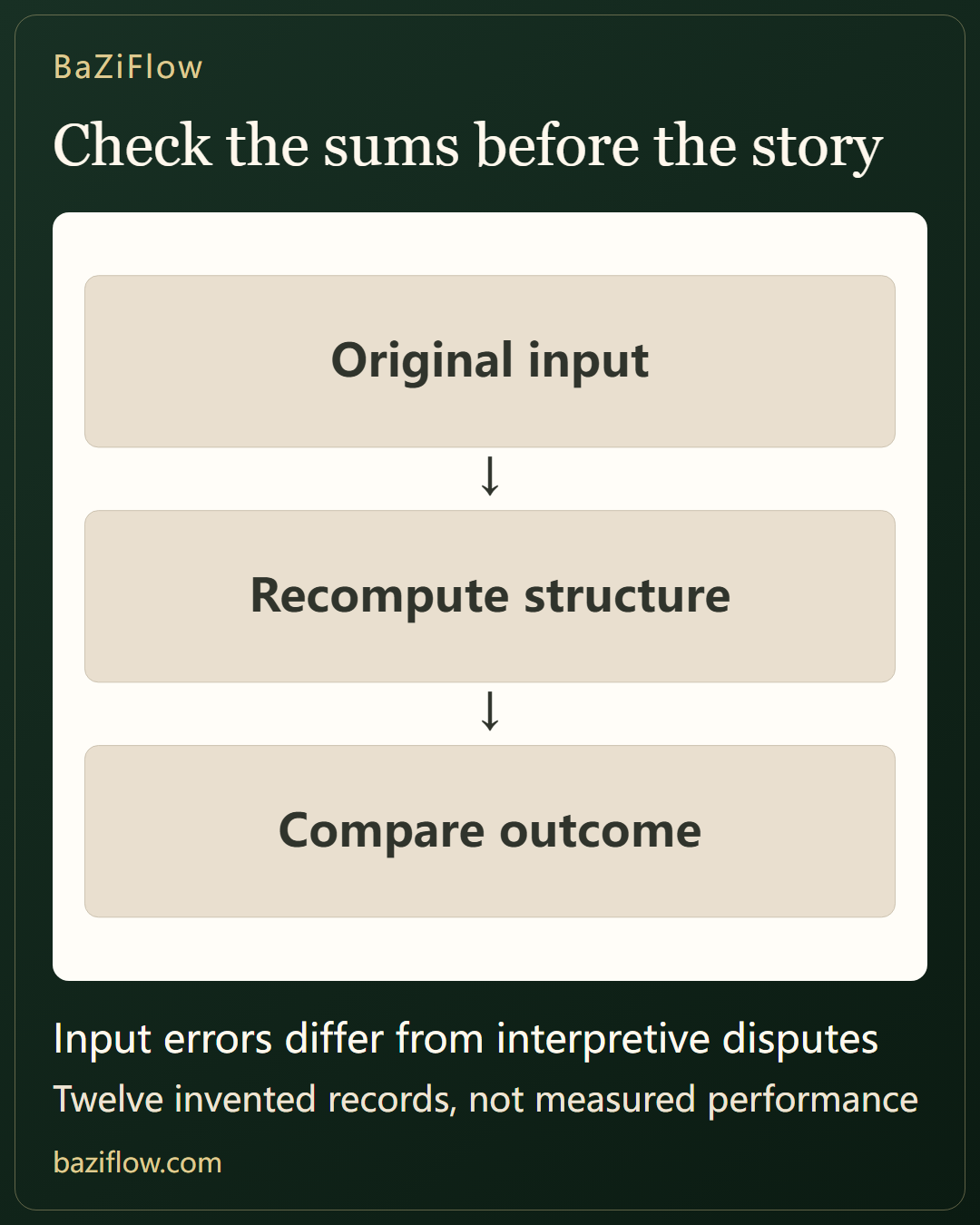
Audit a hypothetical copied-hour error, freeze the original matching criterion, and keep partial and unresolved cases visible without inventing an accuracy claim.
The short version6 min read
Copying hour nine as eight changes total 43 to 42, altering the lower trigram and moving line. This deliberate error shows why input checks come before outcome comparisons. Keep the original judgment and retain partial and unresolved cases instead of merging them into matches.
- The original 34 + 9 gives lower Li and line one; the hypothetical 34 + 8 gives lower Dui and line six. Upper total 34 remains unchanged.
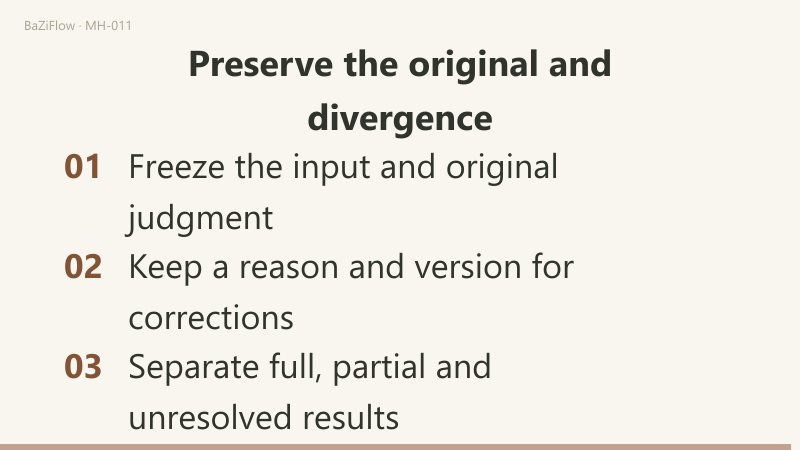
- Preserve the question, deadline and completion criterion before the result. A correction keeps the earlier value and its reason.
- The invented twelve-record exercise has three full, four non-matching, two partial and three unknown outcomes. Three ninths and three twelfths have different denominators.
Read first
Time-based Meihua casting: record the calendar before the sum ↗
Line texts and external signs: preserve the evidence layers ↗
Review the cases that do not make a good story
A collection of striking matches cannot tell a reader how many cases were recorded, how many failed to match, or how many never received an outcome. A useful Meihua review keeps those less memorable records visible. It also asks whether the interpretation was written before the outcome, rather than reconstructed afterward from a plausible narrative.
The recording practices below are modern review recommendations. They are not attributed to the Meihua Yi Shu as an ancient research protocol. Volume one's worked examples support arithmetic checks, while volume two warns against repeating a concrete story whenever the same figure appears. Neither source is treated here as an independently verified performance dataset.
Recompute the input before judging the interpretation
Use the plum-blossom example as a documentary calculation. Its year, month and day numbers are 5, 12 and 17, totaling 34. Adding the Monkey (申) hour number, 9, gives 43. The upper trigram comes from 34 modulo 8, remainder 2; the lower from 43 modulo 8, remainder 3; and the moving position from 43 modulo 6, remainder 1.
Now introduce an explicitly hypothetical transcription error: a note-taker writes 8 instead of 9 for the hour. This is not an accusation that the source contains that error. It is a deliberately altered copy used to test the review process.
| Record | Total after adding the hour | Lower trigram | Moving position |
|---|---|---|---|
| Values in the source example | 34 + 9 = 43 | Remainder 3: Li | Remainder 1: bottom line |
| Hypothetical faulty copy | 34 + 8 = 42 | Remainder 2: Dui | Exact division: line 6 |
One copied value changes both the lower trigram and the moving position. An elegant interpretation of the faulty record is still an interpretation of different input. The full input procedure is covered in time casting and calendar rules; here the purpose is to locate the earliest point at which two records diverge.
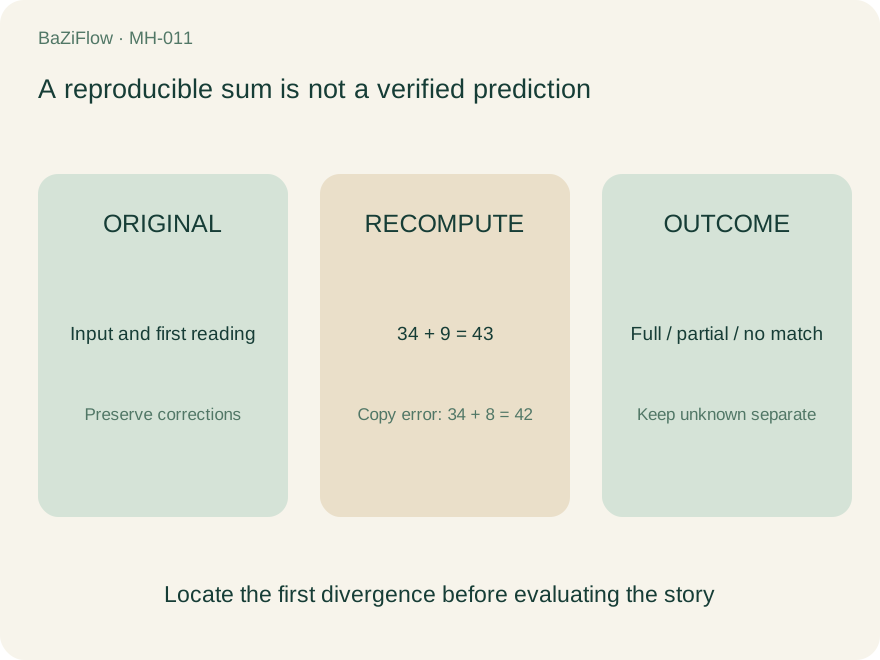
Original BaZiFlow review diagram. The faulty copy is a teaching example; the source’s Monkey (申) hour number remains 9.
When correcting it, retain the old value, the reason for correction and the revised version. An input correction and a disagreement about interpreting identical input should be reported separately. Overwriting the earlier file removes the evidence needed to tell them apart.
Hour 9
- 43 / Li / line 1
Copied hour 8
- 42 / Dui / line 6
Freeze the question and the matching criterion
Before the outcome, record the question's scope, its time window, the casting input, the chosen conventions and the interpretation actually made. “There will be progress” is hard to evaluate if progress has no definition. A first draft, final delivery and acceptance by another person are different milestones.
An anonymous task with a previously agreed deadline can serve as a practice question. The record need not reveal names, contact details or private life events. It does need a stable completion criterion: a prediction about finishing the work should not later be redefined as merely sending an initial draft because that is what happened.
Keep later additions separate. A new interpretation may be useful for learning, but it is not a prediction that was already present in the earlier note. The same applies to an external sign remembered after the result. Preserve when the observation was recorded and when its interpretation was added; line texts and external signs explains those evidence layers.
A denominator example, not a performance claim
Imagine twelve practice records: three fully meet the predeclared criterion, four do not, two meet only part of it and three remain unresolved. These numbers are invented for arithmetic teaching. They are neither BaZiFlow test results nor an estimate of Meihua accuracy.
If the measure is full matches among the nine records with assessable outcomes, the count is 3/9. If the statement is the current share of all twelve that fully match, it is 3/12. Both can be described accurately, but the three unresolved records must remain visible. Treating partial and unresolved cases as successes would produce 8/12 by changing the categories, not by improving the evidence.
For a partial match, specify which original condition was met and which was not. For an unresolved case, distinguish a deadline that has not arrived, missing feedback and an outcome that cannot be verified. No feedback is not evidence of a match; a not-yet-due case is not automatically a failure. Later evidence can update the outcome field while leaving the original interpretation intact.
12
- Full match
- 3
- No match
- 4
- Partial
- 2
- Unknown
- 3
What a classical example can and cannot establish
Volume two's opening discussion warns that repeating the plum-blossom or peony figure does not require the same girl picking blossoms or a trampling horse to appear again. A new case needs its own observations and reasoning. Reusing the old plot with a few names changed hides the absence of new evidence.
Correct arithmetic, a documented convention and a matching real-world outcome are distinct achievements. Reproducing 34 and 43 establishes that part of the calculation; it does not independently validate every inference in the narrative. A selected set of memorable accounts also lacks the denominator supplied by a complete case log.
End a review by identifying what changed: transcription, calculation, rule selection, interpretation or outcome information. Preserve the unaffected record rather than rewriting it into a seamless success story. Before placing the results beside a different method, read Meihua and Liuyao compared so that each retains its own inputs and interpretive conventions.
9 assessable records
- 3/9 full matches
12 total records
- 3/12 full matches
Questions readers ask next
Why should changing hour nine to eight leave the upper trigram unchanged?
The upper total uses only the fixed year, month and day values, which still add to thirty-four. Only the second total changes from forty-three to forty-two, affecting the lower trigram and moving position under this procedure.
Why not count partial and unknown cases as matches?
Partial cases have not met all predeclared conditions, while unknown cases lack sufficient outcome information. Combining them changes the definition of full match. The resulting eight out of twelve is an example of misclassification, not improved performance.
Should an interpretation based on a copied-input error be deleted?
Retain the original input and interpretation alongside the correction, its reason and the revised version. That distinguishes an input repair from a disagreement about the same input and prevents later knowledge from masquerading as an earlier judgment.
Was this article helpful?
Theme: Reflection & emotions
Part of a learning path
Meihua: from trigrams to Body and Use and review · Step 6 of 6 available
Sources & references
Continue reading
Generation, control and strength: keep the layers separate ↗