

Pi (否): a blockage and where it ends
Content version · · Sources & references
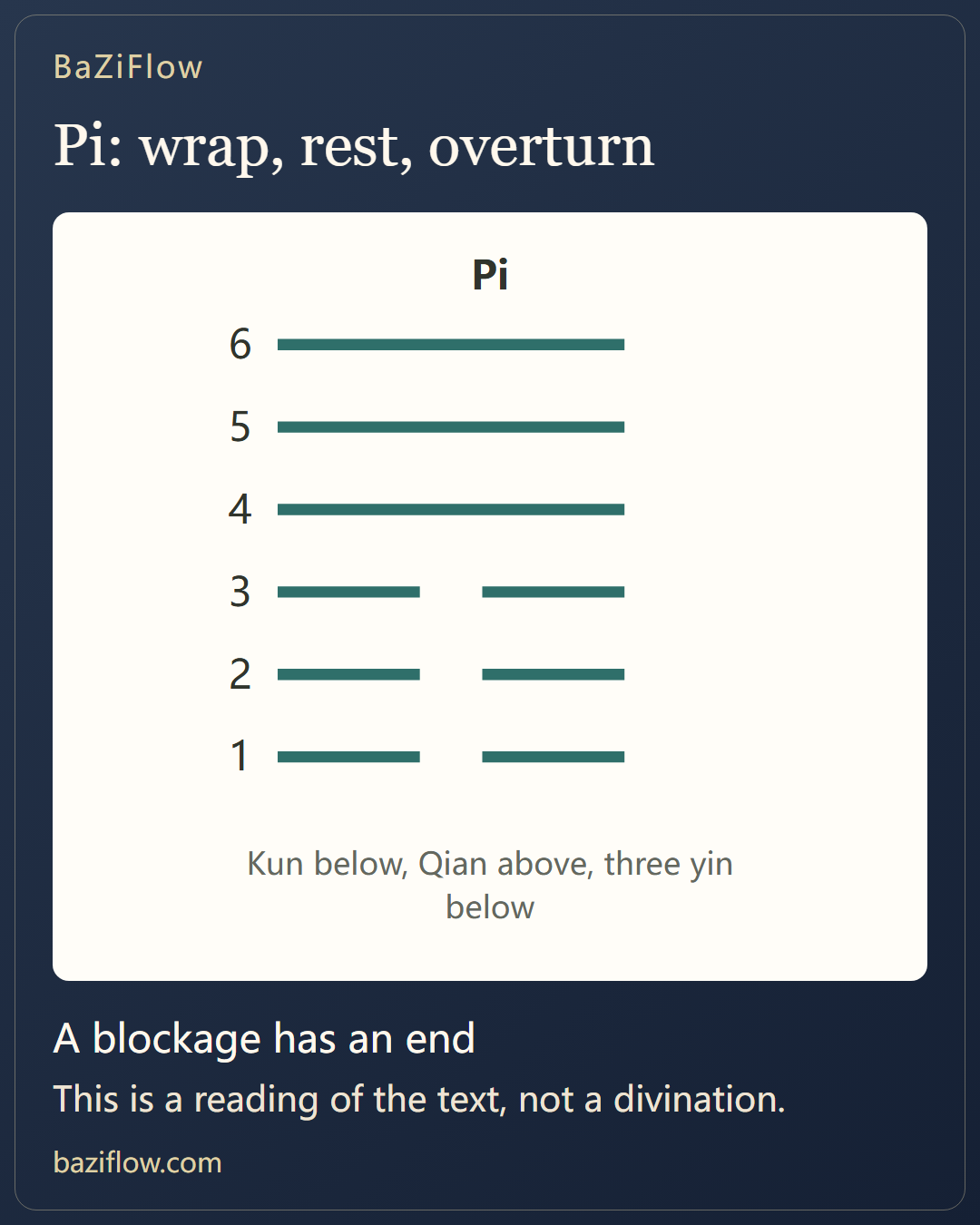
Pi has Kun (earth) below and Qian (heaven) above: three yin lines under three yang. Read the Judgment, the Great Image "restrain virtue and avoid hardship", and the words wrap, rest and overturn that carry the lines.
The short version7 min read
Pi puts heaven above and earth below, and the text says they "do not interact". A line of verbs runs through its six statements, starting with "wrap", passing "rest" and arriving at "overturn": a blockage is first held, then stopped, then turned over.
- Pi stacks Qian (heaven) on Kun (earth). The Commentary on the Judgments says heaven and earth do not interact and all things do not pass through, and sets inner against outer: yin within, yang without; petty within, noble without.
- The subject of the Great Image is the noble person, and the conduct is "restrain virtue and avoid hardship; do not be honored with a salary": drawing in virtue to keep clear of misfortune.
- The word "wrap" occurs in lines 2, 3 and 5; line 4 has "a mandate", line 5 "rests the blockage", the top line "overturns the blockage", and the end is "first blockage, then joy".
Read first
The Sixty-Four Hexagrams: How Upper and Lower Trigrams Form One Figure ↗
Judgment and Line Statements: Whole Hexagram or Single Line? ↗
Heaven above, earth below: why it is called "no interaction"
In Pi (否, read pǐ) the positions are the other way round from Tai: Kun (坤, earth) sits below and Qian (乾, heaven) above, three yin lines under three yang lines. Heaven stands high and earth lies low, each at its own end. The text calls this arrangement "no interaction".
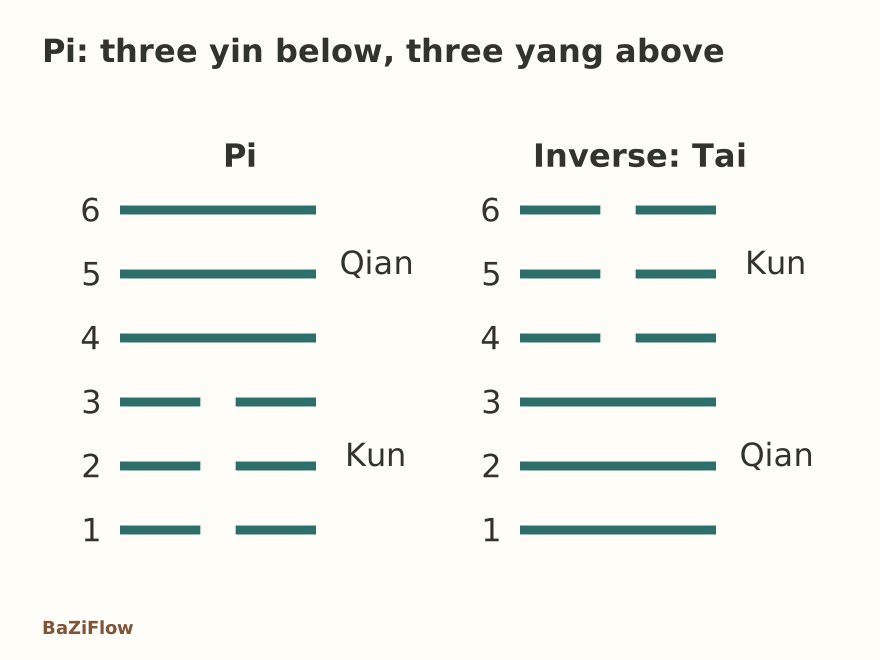
Pi and Tai: heaven above and earth below is Pi, heaven below and earth above is Tai, and the two are each other's inverse.
Enlarge diagram · scroll sideways to read
Three words before reading Pi
- Pi
- The name, read pǐ here, meaning blocked and impassable. The Commentary on the Judgments glosses it: "heaven and earth do not interact and the ten thousand things do not pass through".
- The wrong people
- The Judgment's phrase, literally "not the people there should be". The same two words appear in line 3 of Bi, "joining the wrong people".
- Inner and outer
- Inner means the lower trigram, outer the upper. Pi is Tai with the two exchanged, so here yin is inside and yang outside.
The Judgment: the wrong people, and not favorable for the noble person
The Judgment of Pi reads: "Blockage by the wrong people; it does not favor the noble person's steadfastness; the great go out, the small come in." The last clause is Tai's turned round: where Tai has the small departing and the great arriving, Pi has the great departing and the small arriving. The Commentary on the Judgments first sets out the consequences in two sentences, each using "no interaction" once:
Enlarge diagram · scroll sideways to read
Then the Commentary on the Judgments sets out inner and outer: "inside yin and outside yang, inside yielding and outside firm, inside the petty and outside the noble; the way of the petty grows, the way of the noble fades." The noble person is in the outer trigram and the petty person in the inner, and these three pairs can be read next to the Judgment's "not favorable for the noble person".
The Great Image: the noble person restrains virtue
The Great Image (大象) of Pi reads: heaven and earth do not interact, Pi; the noble person uses it to restrain virtue and avoid hardship, and cannot be honored with a salary. The first half is the figure, and the subject of the second is the noble person, with two actions: "restrain virtue and avoid hardship" and "cannot be honored with a salary". Restrain means to draw in, avoid is to keep clear of, hardship is misfortune; the last phrase means a salary cannot be taken as glory.
Enlarge diagram · scroll sideways to read
In the Great Image of Tai, "the sovereign" does three outward things: cut and complete, assist, help and guide. In Pi the noble person draws in. One faces outward and the other inward.
Six lines: wrap, rest, overturn
A line runs through the six statements of Pi, and it starts with "wrap": line 2 "wraps up and bears", line 3 "wrapped in shame", and in line 5 "tied to a clump of mulberry", where the same character occurs in a variant form. After that come line 4 "there is a mandate", line 5 "rests the blockage" and the top line "overturns the blockage".
Enlarge diagram · scroll sideways to read
First six opens with the very clause that opens first nine of Tai, thatch grass pulled up with its roots in one cluster, and the second half parts ways. Tai goes on to "setting out brings good fortune", Pi to "steadfast, good fortune; success". One Small Image puts the aim outward, the other puts it with the ruler.
Six in the second place: "wraps up and bears; for the petty person good fortune, for the great person blockage, yet success". Wrapping and bearing is to wrap something and carry it respectfully. The petty person gains, the great person meets a blockage and still succeeds, and the Small Image (小象) says "he does not throw the group into disorder". Six in the third place has two characters, "wrapped in shame", and the Small Image says the position is not right: a yin line has taken the third place.
Nine in the fourth place reads "there is a mandate: no blame; companions are attached to blessing". The last clause is often read as those of his kind being drawn to blessing together, and the Small Image comments "his will is carried out".
The neighbors of Pi: Tai and Jian
For the neighbors of Pi, start with Tai, which is both its inverse hexagram and its reversed hexagram: reverse the polarity of every line and you get Tai, turn the whole figure upside down and you still get Tai. The nuclear hexagram is Jian (漸), Gen below and Xun above, a new pair of trigrams made from the middle four lines.
Enlarge diagram · scroll sideways to read
Things cannot pass through forever, so it was followed by Pi.
The Xu Gua says Pi comes out of Tai, with one reason: things cannot pass through forever. It then continues in the same pattern, things cannot be blocked forever, and so comes Tongren. The pattern occurs twice, once from passage to blockage and once from blockage to Tongren. The Small Image says something similar of the top line: when blockage ends it topples.
Questions readers ask next
Why is the character read pǐ here?
In this hexagram it is read pǐ, meaning blocked and impassable; in everyday Chinese the same character is read fǒu and means "no". Reading the name as pǐ is the convention for the Zhouyi.
Is line 2, "the petty person has good fortune, the great person meets blockage, yet there is success", passing judgment on people?
It describes two positions: the petty person gains, while the great person meets a blockage and yet there is success. The Small Image comments on the second half with "he does not throw the group into disorder". This is the old text separating two situations, not a verdict on a kind of person in real life.
What does "it is about to perish, it is about to perish; tie it to a clump of mulberry" mean?
The first phrase is "about to perish, about to perish", a repeated warning to oneself; the second is usually read as binding oneself to the root of a mulberry bush for stability. The Small Image says only that the position is right.
Was this article helpful?
Sources & references
Continue reading
Tai (泰): heaven below, earth above, and the words "no going without a return" ↗
Tongren (同人): gate, clan, wild and outskirts, how wide is the circle of the same? ↗
The Sixty-Four Hexagrams: How Upper and Lower Trigrams Form One Figure ↗
Judgment and Line Statements: Whole Hexagram or Single Line? ↗