

The Sun: the child on the white horse
Content version · · Sources & references
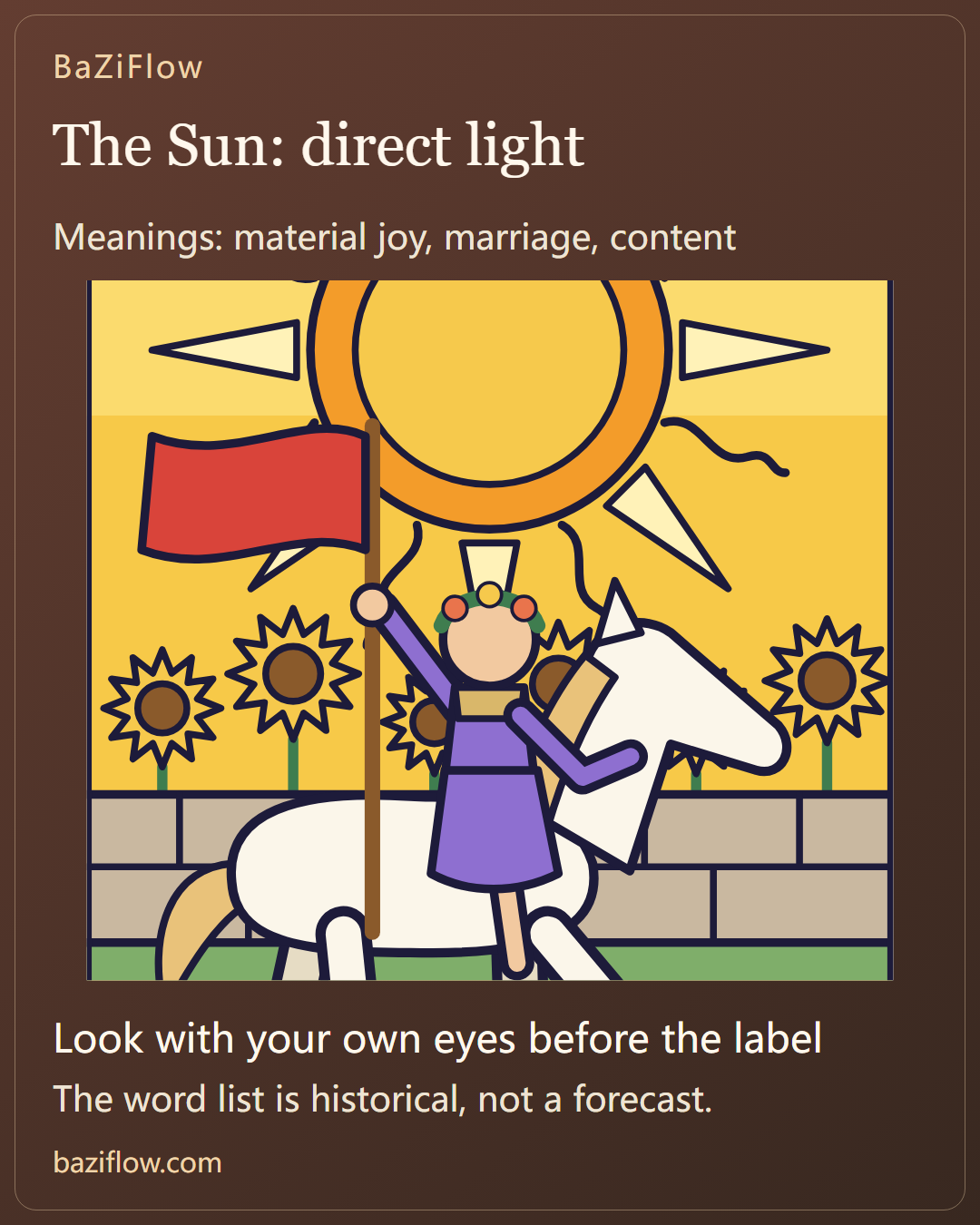
The Sun shows a naked child on a white horse with a red banner, and sunflowers behind a wall. Separate the picture, the three-word list and Waite’s direct-light gloss, then practice looking before reading.
The short version6 min read
The Sun shows a naked child on a white horse with a red banner, sunflowers and a low wall behind. Waite says the light here is direct, not light at second hand.
- The picture (RWS original): a great sun with a face, rays alternating straight and wavy; a naked child with a wreath on a white horse, a large red banner behind; sunflowers over a wall.
- Only three words in the list, and half a sentence for the reversed card; the happiness named is the material kind, with marriage and contentment beside it.
- Part II speaks in a much higher register: from the light of this world to the light of the world to come, the heart of a child, and a sun that is “direct” against reflected light.
Read first
The child on the white horse, sunflowers behind the wall: the picture in three layers
When Waite turns to the Sun, the first thing he mentions is not the sun. He says the naked child mounted on a white horse and displaying a red standard has been mentioned already as the better symbolism connected with this card. What he has to say about the sun itself comes later.
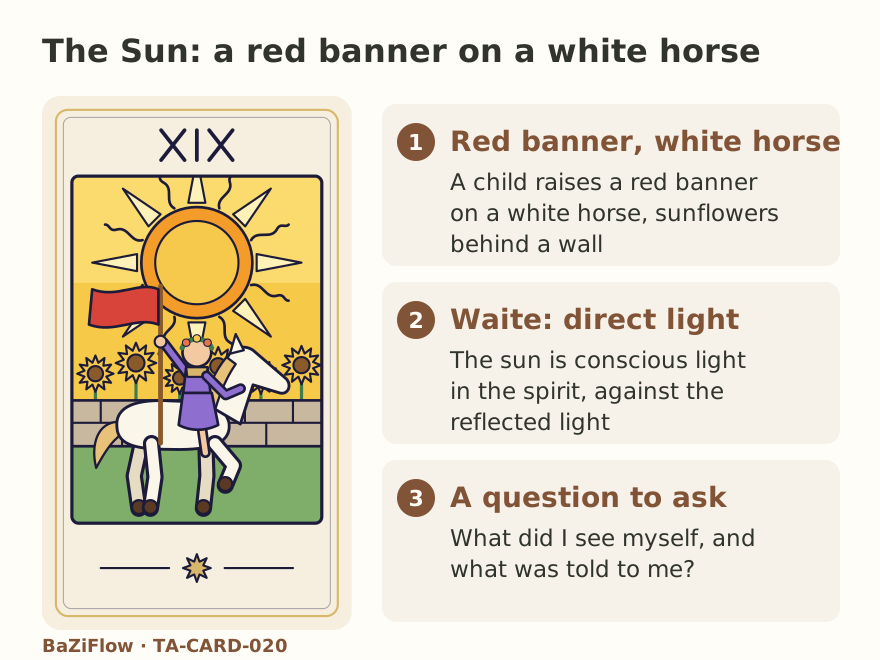
The Sun as BaZiFlow drew it: banner and white horse.
Set beside the Rider-Waite-Smith original: XIX at the top; a great sun above with a human face and rays alternating straight and wavy; a naked child with a wreath and a red plume, arms spread, on the back of a white horse; a very large red banner streaming behind the child; and in the background a low brick wall with a few sunflowers behind it.
Enlarge diagram · scroll sideways to read
A list of three words: material happiness, fortunate marriage, contentment
Waite’s divinatory meanings are unusually short: material happiness, fortunate marriage, contentment. The reversed entry is shorter still, half a sentence: the same in a lesser sense.
Material happiness, fortunate marriage, contentment.
Part II speaks in a far higher register. It says the card signifies the transit from the manifest light of this world to the light of the world to come, which goes before aspiration and is typified by the heart of a child. For the same card, Part II writes about a passage of light and Part III about goodness in everyday terms.
Enlarge diagram · scroll sideways to read
Sun, child, wall: what Waite reads as direct light and the road home
The passage on the child in Part II holds a small itinerary: the child comes out of “the walled garden of the sensitive life” and travels on “the journey home”, with the great and holy light going before the endless procession of humanity.
Enlarge diagram · scroll sideways to read
Then he changes angle, calling that last allusion “again the key to a different form or aspect of the symbolism”: the sun is that of consciousness in the spirit, the direct as the antithesis of the reflected light, and the characteristic type of humanity has become a little child, in the sense of simplicity and innocence in the sense of wisdom.
Sun, child, wall: what Waite reads each as
- Sun
- Consciousness in the spirit, “the direct as the antithesis of the reflected light”. Under the Moon he writes of reflection, and the two lines can be read side by side.
- Child
- Simplicity and innocence in the sense of wisdom; he bears the seal of Nature and of Art and signifies “the restored world”.
- Wall and road
- The child leaves the walled garden of the sensitive life and travels home. The low wall is something you can see on the RWS card, the “walled garden” is Waite’s symbolic phrase, and the two need not be equated.
His last sentence goes further: when the self-knowing spirit has dawned in the consciousness above the natural mind, that mind in its renewal “leads forth the animal nature in a state of perfect conformity”. He does not name the white horse in the picture; reading the horse as the animal nature is a later association.
How to read it: at a gallery, direct light first, light at second hand after
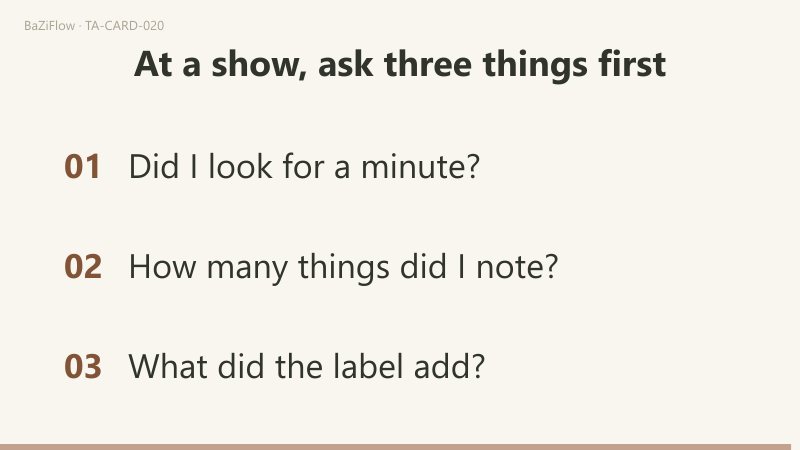
Waite sets the direct light and the reflected light against each other. Use that pair to plan one weekend visit to an exhibition, where every work has a wall label beside it and there is an audio guide at the door.
Stand still and look for a minute
Do not read anything; look with your own eyes and note three things you can see: colors, shapes, positions will do. This column matches “the direct light”.
Then read the wall label
Mark the label’s information item by item, especially what cannot be seen in the work: date, materials, the artist’s intention. This column matches “the reflected light”, which others hand on to you.
Set the two columns together
Draw a line under what the label says and you did not see, and under what you saw and the label does not mention. Where the two columns overlap stands firmer than either column alone.
Enlarge diagram · scroll sideways to read
What was seen directly, and what was told
Seen myself
- The colors are warm
- There is a window in it
Told to me
- “The painter meant waiting”
- “Painted in the 1930s”
Writing them together
- Write my own three lines first
- Then add two from the label
Reversed and neighboring cards: the same, in a lesser sense
Waite writes only half a sentence for the reversed card. It offers no second set of words, only: the same as upright, in a lesser degree.
The same in a lesser sense.
Enlarge diagram · scroll sideways to read
Three cards that write about contentment and light
The card before: reflected light
There Waite calls the intellectual light a reflection, with the unknown beyond. That list centers on hiding, darkness and error; the Sun’s list centers on material things, marriage and contentment.
A man who has feasted
Waite writes of a goodly personage feasted to his heart’s content, wine plentiful on the counter behind him, and adds that the picture offers the material side only. The list has concord, contentment, physical well-being.
A family under a rainbow
The list is contentment, the repose of the entire heart, and the perfection of human love and friendship. It describes a heart at rest, while the Sun’s list sits closer to goodness in daily life.
Questions readers ask next
Does the Sun simply mean everything goes well?
Waite’s list names three things only: material happiness, fortunate marriage, contentment, and the reversed card is just a lesser degree. It says nothing of “everything” and nothing of when. You can ask which of the three bears on your question.
What does the Sun mean reversed?
Waite writes half a sentence: the same in a lesser sense. He gives no opposite meaning; common phrases such as delay or over-optimism come from later methods, so say whose rules you are using.
How is the Sun’s light different from the Moon’s?
Under the Moon Waite calls the light intellectual and reflected; under the Sun he calls it conscious light in the spirit, “the direct”, against the reflected. Each line stands in its own entry and the two can also be read together.
Was this article helpful?
Sources & references
Continue reading
The Moon: a road between two towers, and Waite reads the moonlight as reflected light ↗
The Star: two ewers pour on water and land, and Waite’s list runs from loss to hope ↗