

Nine of Wands: waiting behind a palisade
Content version · · Sources & references
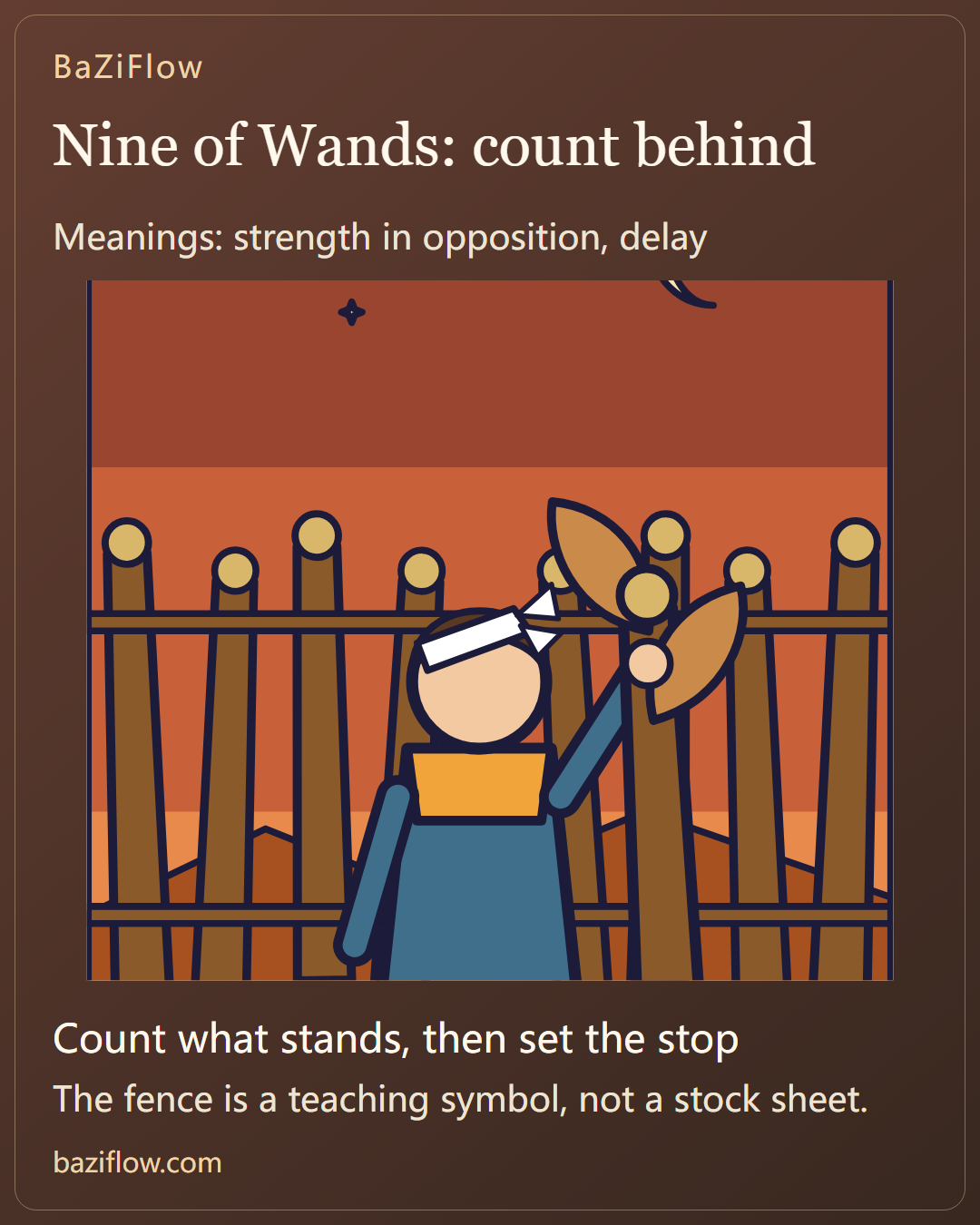
The Nine of Wands shows a bandaged figure leaning on a staff, as if awaiting an enemy, eight staves standing behind like a palisade. Read "strength in opposition", then count stock and set a stopping line.
The short version7 min read
The Nine of Wands holds no clash, only a figure leaning on a staff and a row of staves standing behind him. Waite's main sense is strength in opposition, with delay and suspension as adjuncts. Read it by counting what stands behind him and asking what he is waiting for.
- Nothing is struck in the picture: the figure waits, and what he waits for has not appeared. If attacked, Waite says, he would meet the onslaught boldly, and his build suggests a formidable opponent.
- The main sense is strength in opposition, with delay, suspension and adjournment as adjuncts, all of them words for setting something aside for a time.
- Reversed it is obstacles, adversity, calamity. The one additional line, "generally speaking, a bad card", points a different way from the main entry.
Read first
Start with the picture: a figure leaning on his staff, a row standing behind
Waite keeps it short: a man rests on his staff, watching, expectant, for an enemy who may be on the way. Eight more staves stand at his back, upright and orderly, like a palisade.
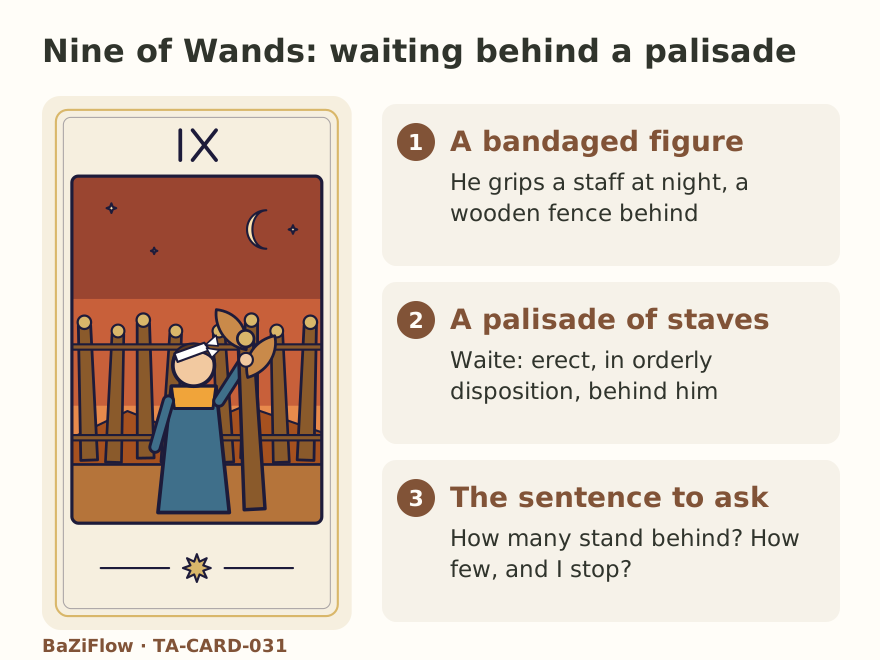
Nine of Wands: the one who waits, a fence behind
On the Rider-Waite-Smith card itself the figure wears a white band around his head, glances to one side and grips the staff in both hands. The staves behind him stand one by one before low hills, small leaves sprouting from their tops, and the ground at his feet is a flat grey. Nine staves in all: one in his hands and eight at his back.
Enlarge diagram · scroll sideways to read
What Waite lists: strength in opposition, then delay and suspension
Waite gives the main sense as strength in opposition: if attacked, the figure would meet the onslaught boldly, and his build shows he might prove a formidable antagonist. With that main significance come all its possible adjuncts: delay, suspension, adjournment.
The card signifies strength in opposition. If attacked, the person will meet an onslaught boldly; and his build shews that he may prove a formidable antagonist. With this main significance there are all its possible adjuncts—delay, suspension, adjournment.
Enlarge diagram · scroll sideways to read
Lean, palisade, headband: what each rests on
Three things in the picture deserve to be taken one at a time: the posture of leaning and waiting, the row of staves behind, and the white band on the head. Waite writes the first two and does not mention the third.
What backs the lean, the palisade and the headband
- The lean, the look
- Waite has him rest on his staff, expectant, "awaiting an enemy". He does not say who the enemy is or when it comes, and does not say the figure has been hurt.
- Eight staves behind
- Waite writes them "erect, in orderly disposition, like a palisade". "Orderly" and "like a palisade" are his comparisons. In the Rider-Waite-Smith picture they stand before low hills with small leaves at their tops.
- The white headband
- Waite does not mention it, yet it is visible in the Rider-Waite-Smith picture. Modern teaching often reads it as "has been hurt before", which is a borrowing.
Enlarge diagram · scroll sideways to read
Reading the row as "a reserve already prepared" is the handiest figure teaching offers: the staves are not in his hand but stand at his back, ready for him to step up to.
How to read it: count what stands, then draw a stopping line
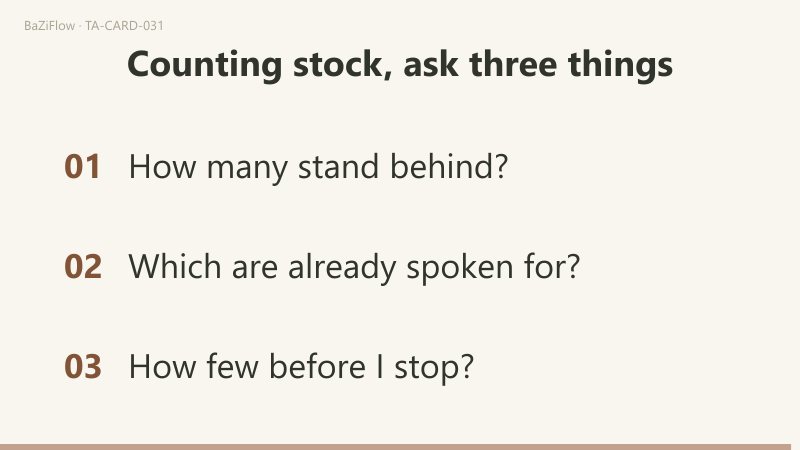
The easy slip with the Nine of Wands is to read waiting as having nothing to do. In Waite's list, delay, suspension and adjournment sit with "strength in opposition", so waiting is the posture of the card itself. Put the nine staves onto a batch of stock and there are three moves:
Count: how many stand behind?
In the picture one staff is in hand and eight stand behind, each its own staff. When counting stock, write the real number too, not "about", and do not count a bundle as one.
Sort: which are already spoken for?
Waite says the staves are "in orderly disposition". Orderly means each has its place: which units have been ordered, which are set aside for regulars, and which are truly free to move.
Line: how few standing before you stop?
Delay, suspension and adjournment are all in the list, so pausing needs no separate excuse. Writing down beforehand "when only this many are left, no new orders" beats working it out when the last unit is going.
An example: on Friday night a soap seller counts one best-selling bar before the weekend market, nine boxes in all: one on the table, eight standing in the car boot. Lay the nine out by purpose:
Enlarge diagram · scroll sideways to read
Of the nine, only three can be sold on the spot, not eight. The line can be drawn here: once those three are down to one, no new reservations are taken, and anyone who asks hears that in advance.
After the count
Adds up
- A real number, not "about"
- Every unit has a place
Does not add up
- Counting ordered stock as free
- No line to stop at
Add a line
- Show the ordered ones apart
- Write how few means stop
Reversed and neighboring cards: obstacles, adversity and a line that says "a bad card"
Waite's reversed words are only three: obstacles, adversity, calamity, with no comment. The additional meanings also hold one line, "generally speaking, a bad card", from other readers, which points a different way from the main entry's strength in opposition: the main entry describes a posture that holds, while the extra gives a verdict. Say which layer you quote.
Enlarge diagram · scroll sideways to read
Three cards about holding on, and where each puts the topic
Clasping what he has
Waite writes a crowned figure clasping a pentacle, with one over his crown and two under his feet; the list is surety of possessions, holding to what one has, gift, legacy and inheritance, and reversed suspense, delay and opposition. What is held is what already exists, where the Nine holds a line.
Another figure facing staves
In the Seven six staves are raised toward him and he holds the height; in the Nine no staff is raised toward him, and he only waits.
The next card: all the staves on one back
Where the Nine has eight standing behind him, the Ten has them carried on one person's shoulders, and Waite writes that he is oppressed by their weight.
Questions readers ask next
Is the Nine of Wands a bad card?
Waite's main entry gives strength in opposition and says the figure would meet an attack boldly, while other readers in the additional list write "generally speaking, a bad card". The main entry and the extras judge it differently, so say which layer you are quoting.
What does the Nine of Wands mean reversed?
Waite's reversed words are obstacles, adversity and calamity, with no further comment, and the additional list has no reversed line for this card. Delay, suspension and adjournment belong to the main entry as its adjuncts and are not reversed readings.
Does the Nine of Wands mean I must fight?
Nothing is fought in the picture; it shows waiting. Waite writes "as if awaiting an enemy" and neither says the enemy has come nor gives an outcome. What the card shows is a posture of holding and waiting, and who the opponent is has to come from your question.
Was this article helpful?
Sources & references
Continue reading
Seven of Wands: one staff on the height, six raised from below ↗