

Golden Carriage: two places on from Emolument
Content version · · Sources & references
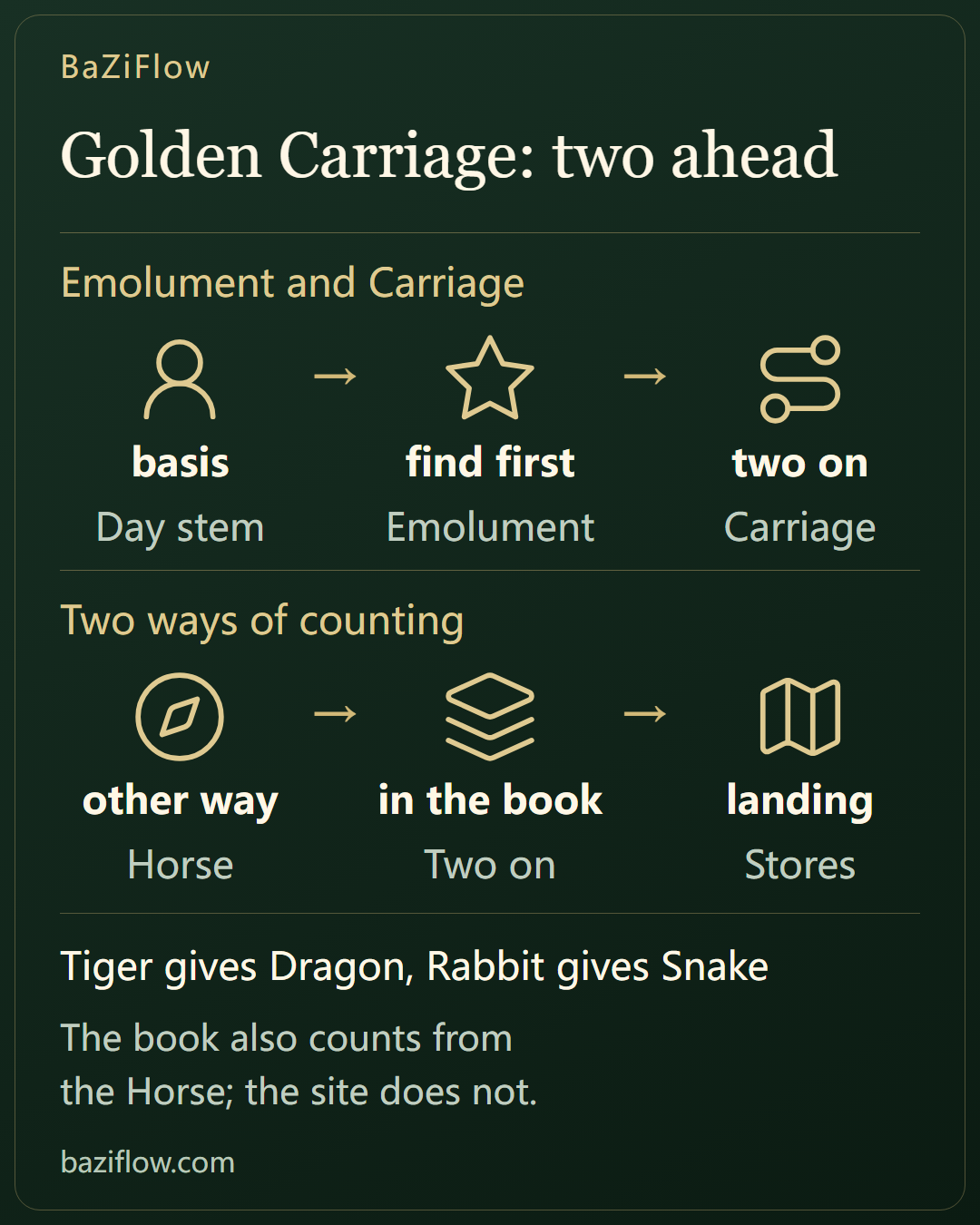
The Golden Carriage starts from the day stem and sits two branches ahead of its Emolument. A look-up table, the Sanming Tonghui image, why Yin stems count forward, the book's second count from the Horse, and two charts.
The short version8 min read
The basis of the Golden Carriage is the day stem: find the day stem's Emolument branch, count two branches ahead, and the branch you reach is the Carriage, which you then look for in the branches of the year, month, day and hour pillars.
- The Carriage of the ten day stems lands on eight branches, Dragon, Snake, Goat, Monkey, Dog, Pig, Ox and Tiger, always two ahead of the Emolument: Yang Wood from Tiger to Dragon, Yin Wood from Rabbit to Snake, Yang Water from Pig to Ox.
- The Sanming Tonghui compares it to a gentleman in office who needs a carriage to carry his emolument; the same section records a second count, two branches ahead of the Traveling Horse, which the site does not use.
- The site line about material support and a helpful spouse is a modern summary; the book says it is good to meet it in the day or hour pillar, with one sentence for women and one for men.
Read first
Symbolic Stars in BaZi: Check the Reference and Rule Before the Meaning ↗
A carriage for the emolument: why it sits two places ahead
The Golden Carriage travels with the Emolument: find the day stem's Emolument first, then go two branches ahead of it. The branch you reach is then checked against the four pillars.
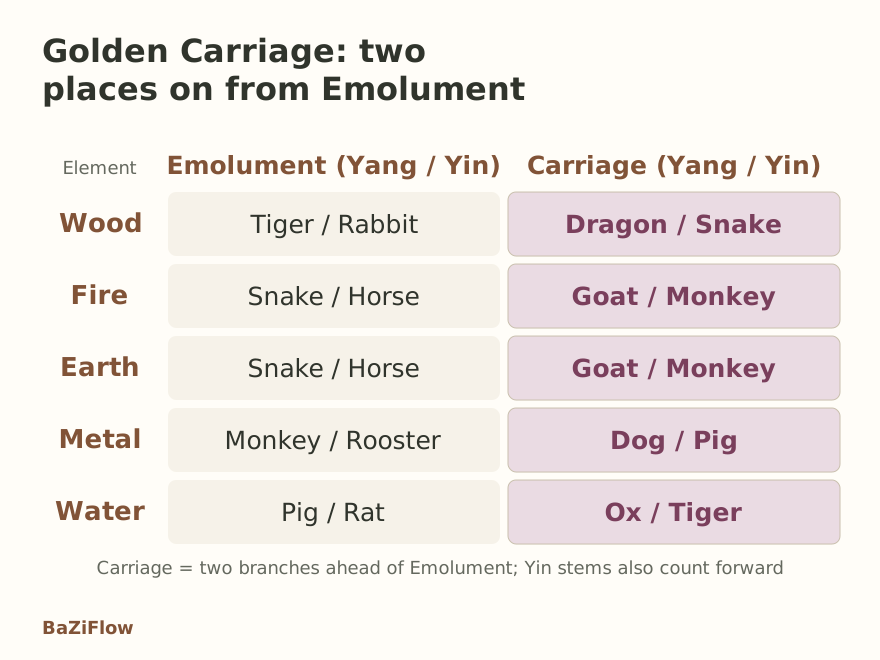
Sketch: the Carriage column, from the site engine, checked cell by cell against "two branches ahead of Emolument"; Yang and Yin stems alike count forward along the branch order, so ten stems fall on eight branches.
Each row of the picture is a pair of stems. Wood stems have their Emolument on Tiger and Rabbit, and two ahead are Dragon and Snake; Fire and Earth stems have it on Snake and Horse, with the Carriage on Goat and Monkey; Metal stems have it on Monkey and Rooster, with the Carriage on Dog and Pig; Water stems have it on Pig and Rat, with the Carriage on Ox and Tiger. How the Emolument is found is in the previous article on the Emolument Star.
Juan 3 of the Sanming Tonghui (三命通会) appends the Carriage to its section on the ten stems' Emolument and gives it a section of its own, "On the Golden Carriage" (the book writes the second character with a variant of the one the site uses). It explains the name:
A carriage is a vehicle, and "gold" means noble. Take a gentleman in office who receives emolument: he needs a carriage to carry him. So the Golden Carriage always sits two branches ahead of the Emolument; for a Yang Wood Rat person whose Emolument is at Tiger, Dragon is the Golden Carriage.
The point is plain: a gentleman who has taken office and draws a salary needs a vehicle to carry him, a precious one, hence "golden", and it stands two places ahead of the Emolument. The book's example is a Yang Wood Rat person, Emolument at Tiger, two ahead is Dragon, and that fits the picture cell for cell.
Yin stems count forward too: a side check that is often misstated
All ten stems use "Emolument, then two ahead", and the Yin stems do not count backward. Set Yang Wood and Yin Wood side by side:
Enlarge diagram · scroll sideways to read
One easy mistake needs flagging: some explanations call the Carriage "the branch after Peak". That holds only for Yang stems: the Peak of Yang Wood is Rabbit and the next branch is Dragon. A Yin stem runs backward in the stage table, so the Peak of Yin Wood is Tiger, and the branch after it in its own direction is Ox, while the Carriage is Snake. The book's own words are "two branches ahead of the Emolument", and the site table does the same for all ten stems.
The book's second count: two ahead of the Horse
The same section records another way of counting:
The Bazi jinshu says: the branch two places ahead of the Traveling Horse is named the Golden Carriage.
The book goes on to say that this "again takes the place two ahead of the Horse as the Carriage". It is a different starting point: not the day stem's Emolument, but the Traveling Horse, two places on. The Horse falls on Tiger, Monkey, Snake or Pig, and two ahead of those are Dragon, Dog, Goat and Ox. How the Horse is fixed is in the article on the Traveling Horse.
Enlarge diagram · scroll sideways to read
In the book's own example, a Yang Wood Rat person, the two counts happen to give the same branch: the Emolument of Yang Wood is Tiger and two ahead is Dragon; the Horse of a Rat is Tiger and two ahead is Dragon as well. Change the stem and the two counts part: the Emolument of Yin Wood is Rabbit, its Carriage is Snake, and Snake is not among the four branches of the Horse count. The site uses only the first, so what is found depends on the day stem alone.
A Yang Wood day and a Yin Wood day: two Carriage hits, Emolument in the month
Enlarge diagram · scroll sideways to read
In chart one the day master is Yang Wood and its Carriage is Dragon, one on the year pillar and one on the hour pillar; the Tiger of the month is the Emolument of Yang Wood, and the Rat of the day is no match. Chart two belongs to a Yin Wood day master whose Carriage is Snake, and the year and hour pillars hit; the Rabbit of the month happens to be the Emolument of Yin Wood, so the Emolument Star and the Golden Carriage each take their own pillars in one chart.
Only four of the sixty day pillars put their own Carriage on the day branch: Yang Wood Dragon (甲辰), Yin Wood Snake (乙巳), Yang Metal Dog (庚戌) and Yin Metal Pig (辛亥).
The book's words, the site's words, and a pattern with the same name
Enlarge diagram · scroll sideways to read
The site describes the Golden Carriage as "a position of material support and a helpful spouse, with living conditions and social surroundings relatively comfortable". The section in the book is shorter and more specific: the carriage image first, then one sentence for a woman and one for a man, and the note that meeting it on the day or hour pillar is good. The site's "helpful spouse" points in the same direction as the book, but the wording differs, and the site marks all pillars alike.
Try two cells
The day master is Yang Water. Where is the Carriage?
Its Emolument is Pig, one ahead is Rat and two ahead is Ox, so the Carriage is Ox.
Which day masters have the Carriage on the Goat?
Yang Fire and Yang Earth: their Emolument is Snake, and two ahead is Goat.
This star follows the Emolument Star in the series, and after it comes the Seal of Office, another one that starts from the day stem.
Questions readers ask next
Is the Golden Carriage simply the branch after Peak?
Only for the Yang stems. For a Yang stem, Peak is one place after the Emolument and the Carriage one place further. A Yin stem runs backward in the stage table, so its Peak is one place before the Emolument, yet its Carriage still sits two ahead of the Emolument. The site table uses "two ahead of Emolument" for all ten stems.
Zi Wei Dou Shu also has a Golden Carriage. Is it the same thing?
Only the name is shared. In the Zi Wei Dou Shu Quanshu, "Golden Carriage escorts the emperor" is a pattern: Zi Wei sits in the Life palace with the Sun and Moon flanking it in the neighboring palaces. The Bazi shensha is looked up from the day stem. The two systems have different fact models and cannot borrow from each other.
Does it mean something when the day pillar sits on its own Carriage?
Only four of the sixty day pillars can do that. The book says it is good to meet the star in the day or hour pillar, which weights those two more; the site checks all four pillars and marks them alike.
Was this article helpful?
Sources & references
Continue reading
Emolument Star (禄神): The Day Stem's Own Post, and Why It Never Sits on a Storehouse ↗
Seal of Office (国印贵人): One Branch per Day Stem, Eight Places After the Emolument ↗