

Define the subject, then compare candidates
Content version · · Sources & references
Compare the two Parents candidates in a supplied Qian document question with Gou’s lack of visible Wealth in a goods question, keeping selection evidence separate from any predicted outcome.
The short version6 min read
A Qian document question has two visible Parents candidates: Dragon Earth at three and Dog Earth at six. A Gou goods question has no visible Wood-Wealth. Both are valid candidate states to preserve before a justified selection or further procedure is available.
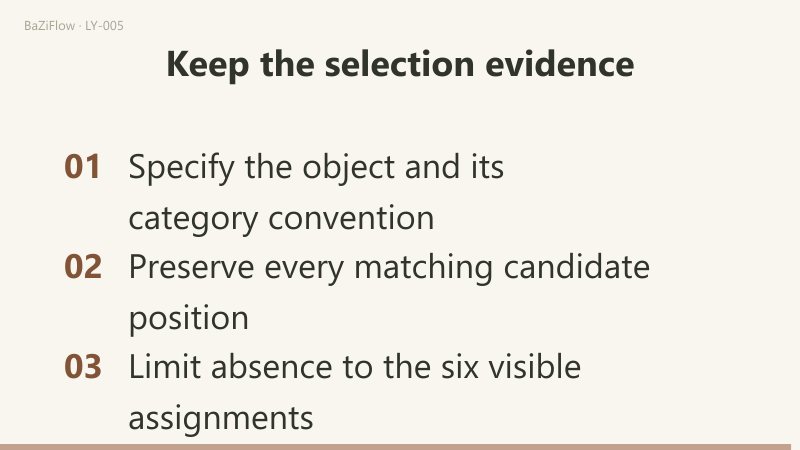
- A broad application question may concern paperwork, resources or a person; state the actual subject before assigning a category.
- The two Parents candidates in Qian follow from Earth generating palace Metal, and a Self marker alone does not delete one of them.
- No visible Wealth in Gou describes the six assigned lines; it neither proves an object absent nor permits relabeling another category.
Read first
Keep the selection separate from the outcome
In Liuyao, the Useful God (用神) identifies the subject or line chosen as the main focus of a question. The literal English phrase “useful god” can be misleading: it is not an instruction to choose the most reassuring label or the strongest-looking line. Nor is it interchangeable with the same term in Bazi.
A selection should be explainable before an interpretation of success or failure is written. Record what the question concerns, which traditional category is being used, and which lines fit that category. If two lines remain plausible or none is visible, preserve that state rather than presenting an unsupported unique answer.
“Will the application go well?” might concern delivery of a document, receipt of resources, or another person's cooperation. Those are different subjects. Narrowing the question does not manufacture certainty; it prevents the focus from quietly moving between subjects during the explanation.
The Useful God chapter of Zengshan Buyi includes documents and written agreements under Parents, and material goods under Wealth. It also lists traditional ranges for Siblings, Officials/Ghosts, and Descendants. These are conventions of the method, not ordinary-language keyword matching. A document mentioning a sibling does not automatically become a Siblings line if the object under discussion is the document itself.
The historical lists also contain social roles and assumptions that should not be imposed on modern people without explanation. For a modern subject with several reasonable mappings, identify the chosen convention and acknowledge the alternatives. Do not pretend that an old text explicitly classified every contemporary institution or device.
Question wording
- Application
Possible subjects
- Document / goods / person
Two supplied exercises produce different candidate states
Our first exercise supplies Qian and asks only about a document. Qian belongs to the Metal palace. The relevant assignments are Dragon (辰) Earth at line 3 and Dog (戌) Earth at line 6. Each generates palace Metal, placing both in the Parents category. The document convention therefore yields two visible candidates.
Our second exercise supplies Gou and uses material goods as the subject. Gou also belongs to the Qian Metal palace. Its lower Xun trigram receives Ox (丑) Earth, Pig (亥) Water, and Rooster (酉) Metal; upper Qian receives Horse (午) Fire, Monkey (申) Metal, and Dog Earth. There is no Wood branch among those six visible assignments. Since Metal controls Wood, the Wealth category has no visible candidate here.
| Supplied exercise | Target category | Visible candidates | Honest current state |
|---|---|---|---|
| Qian, document | Parents | Line 3 Dragon; line 6 Dog | Two, requiring a stated comparison |
| Gou, material goods | Wealth | None among the six visible lines | Visible absence, requiring another applicable step |
These are constructed selection exercises, not actual consultations. No calendar or complete movement information has been supplied, and neither exercise predicts delivery or acquisition. For the calculations behind the categories, see Najia and the relative labels.
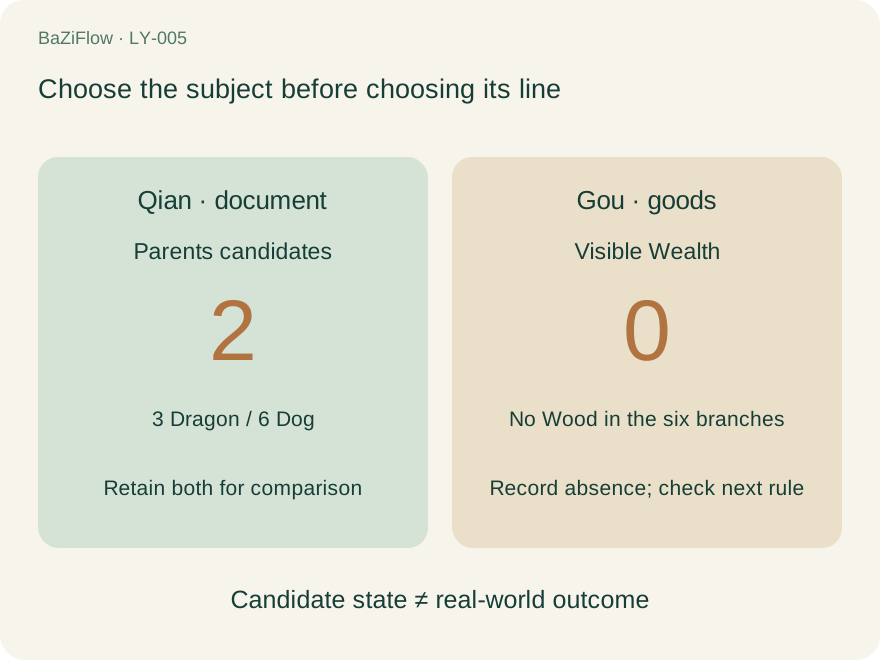
Original BaZiFlow candidate comparison. Counts describe visible chart assignments, not the number of real objects or an outcome.
Qian / document
- 3 Dragon; 6 Dog
Gou / goods
- No visible Wealth
Repetition needs a reason for preference
Qian's line 6 is also Self, but that positional marker does not by itself erase the Parents candidate at line 3. Self and Response placement is a separate operation from choosing the question's focus. Likewise, two Parents entries do not establish that there are two actual documents.
Zengshan Buyi includes a worked case with several Parents entries and gives Dragon's alignment with the month as a reason for selecting it. That case includes calendar and change information, including a transformed Goat (未) Earth line. It must not be reduced to the claim that the primary Qian hexagram has three visible Parents lines, or that line 3 is always the answer whenever Parents repeats.
We borrow only the methodological point: preference needs explicit conditions. Our supplied Qian exercise lacks those conditions, so both candidates remain listed. A school-specific priority rule should be named with its scope, not applied retrospectively because one candidate gives the desired story.
Original source example
- Dragon month supplied
- Changed Goat also present
This exercise
- Month/day unresolved
- Two candidates retained
Visible absence has a limited meaning
The incomplete-category verses in Bushi Quanshu include Gou among hexagrams lacking visible Wealth. That agrees with the six-branch calculation above. Its discussion of hidden lines also recognizes that an absent useful category requires further handling.
“No visible Wealth line” does not mean that the person owns nothing, that an object does not exist, or that acquisition is impossible. It is a statement about this layer of the chart. Changing Rooster Metal into Wood or relabeling Siblings as Wealth would not resolve the absence; it would corrupt the original assembly.
A subsequent hidden-line procedure must state which text and rule it follows. This article does not combine fragments from different traditions into a convenient shortcut. It stops at identifying the missing visible category so that the next step can be performed and checked on its own terms.
Gou visible branches
- Ox Pig Rooster
- Horse Monkey Dog
Wood-Wealth matches
- 0 visible candidates
Freeze the focus before comparing later conditions
The weather section of the Golden Strategies discusses Parents and Wealth in relation to rain and clear weather, followed by seasonal and phase considerations. Even a broad topic can therefore contain different attributes of interest. A single keyword is not a universal selector for all questions in that topic.
Keep a compact selection record: the original subject, the category convention, the full candidate list, the selected line if justified, and the unresolved conditions. This is a modern recordkeeping recommendation, not a claim that the ancient texts prescribed this exact form. If the question later changes from a document to its sender, record a new subject rather than silently reusing the earlier selection.
Only then proceed to day, month, and strength or other relationships. Those considerations should evaluate the stated focus, not retroactively redefine the question to fit a preferred result. A resolved selection is still not evidence that a prediction is true; an unresolved selection should remain visibly unresolved.
Questions readers ask next
Does the number of candidate lines count real objects?
No. Candidate count measures matches within a chart filtered by a stated category. Actual object count is a separate observation. Two Parents entries establish two matching rows, not two observed letters or contracts.
Does a document mentioning siblings require Siblings as its focus?
Determine whether the question concerns the document or a person. Wording inside a title does not change the object under discussion. Under the document convention stated here, candidates are drawn from Parents rather than selected by keyword.
What can be completed without calendar information?
A known figure and palace can support the relative assignments and a category-based candidate list. Conditions needed to prefer one candidate may still be missing. Separating the completed list from the unresolved comparison shows what additional information is needed.
Was this article helpful?
Theme: Decisions & questions
Part of a learning path
Sources & references
Continue reading
Month and day effects: preserve the evidence behind strength ↗
Cycle void versus month break: two independent calendar tests ↗