

Supporting stars and their inputs
Content version · · Sources & references
Start with what a malefic label can establish, then trace placements to their inputs and read classical combinations in their stated conditions.
The short version7 min read
Stars outside the major roster have distinct placement inputs; identify their year, month or hour dependence before reading the current combination.
- A category label and a placement dependency are different facts; record year, month, hour and combined inputs separately.
- A year-based branch placement shared by many people does not establish shared palace topics or outcomes.
- Keep historical labels together with their conditions, especially Tian Kong, Di Kong and timing-layer stars.
Read first
The fourteen major stars: learn the roster and its structure ↗
What is Zi Wei Dou Shu? Read the palaces, stars and timing layers ↗
Outside the major roster, ask how each star is placed
Do not sort additional stars merely into reassuring and alarming labels. Their input dependencies explain why each is placed where it is.
Three neighbouring positions: Lu Cun and its companions
Enlarge diagram · scroll sideways to read
A Zi Wei chart can show many more names than the fourteen major stars. The number displayed depends on the chosen collection. Supporting and minor stars need their own placement record; a long list does not automatically provide more individual evidence.
Categories and dependencies do different jobs
A historical category of principal stars need not match the modern fourteen-major-star roster. Establish which names the author includes before comparing counts.
Enlarge diagram · scroll sideways to read
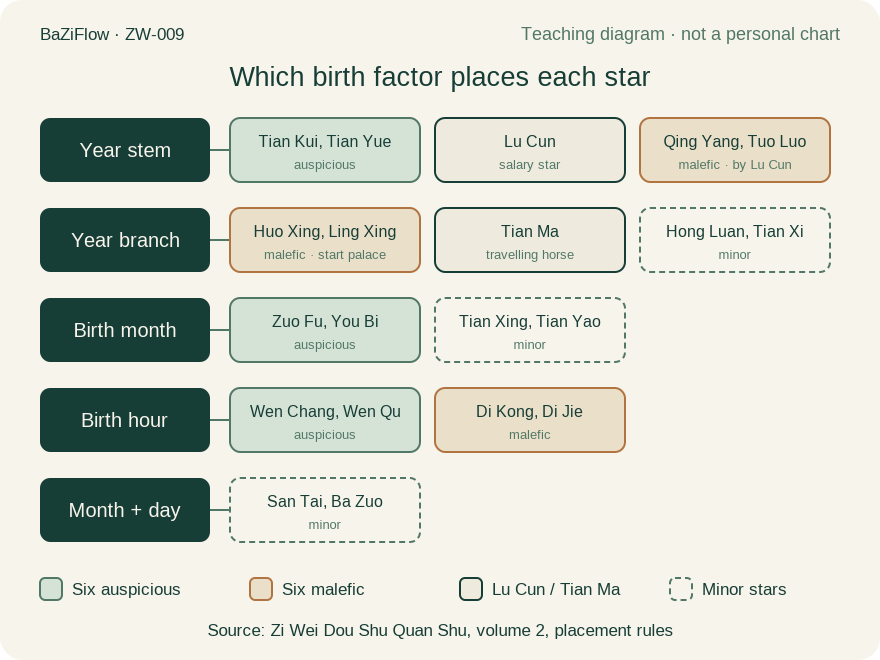
Zuo Fu and You Bi depend on the birth month in the quoted text. Wen Chang and Wen Qu depend on the double-hour. San Tai and Ba Zuo require the birth month and day: the month first places Zuo Fu and You Bi, then the birth day is counted from those positions. Calling the last pair “day-based” without its starting positions would hide an input.
Lu Cun offers a contrasting example. Its branch depends on the year stem; Qing Yang and Tuo Luo are then placed around Lu Cun. In a Yin Water year, the quoted example puts Lu Cun at Rat, Qing Yang at Ox and Tuo Luo at Pig. People with that year stem share these branch placements under the rule. They do not therefore share a Life Palace, a complete chart or an established life outcome.
From dependencies to three Yin Water-year positions
Use placement dependencies as a change test. A month change first prompts month-based checks; an hour change prompts hour-based checks. San Tai and Ba Zuo also require the month-dependent starting stars before the day count.
Enlarge diagram · scroll sideways to read
| Group | Stars | Placed by | Rule in volume two |
|---|---|---|---|
| Six auspicious | Zuo Fu, You Bi | birth month | Zuo Fu counts forward from Dragon and You Bi backward from Dog, the first month at the start |
| Six auspicious | Wen Chang, Wen Qu | birth hour | Wen Chang counts backward from Dog and Wen Qu forward from Dragon, the Rat hour at the start |
| Six auspicious | Tian Kui, Tian Yue | year stem | a rhyme gives two branches per stem, e.g. Yang Wood, Yang Earth and Yang Metal years at Ox and Goat |
| Lu Cun | Lu Cun | year stem | Yang Wood at Tiger, Yin Wood at Rabbit, Yang Fire and Yang Earth at Snake, Yin Fire and Yin Earth at Horse, Yang Metal at Monkey, Yin Metal at Rooster, Yang Water at Pig, Yin Water at Rat |
| Six malefic | Qing Yang, Tuo Luo | follow Lu Cun (year stem) | one branch ahead of Lu Cun and one behind: in a Yin Water year Lu Cun is at Rat, Qing Yang at Ox, Tuo Luo at Pig |
| Six malefic | Huo Xing, Ling Xing | year branch sets the start | Tiger, Horse and Dog years start Huo Xing at Ox and Ling Xing at Rabbit; Monkey, Rat and Dragon years start them at Tiger and Dog, and so on |
| Six malefic | Di Kong, Di Jie | birth hour | with Pig as the Rat hour, Di Jie counts forward and Di Kong backward |
| Tian Ma | Tian Ma | year branch | Tiger, Horse and Dog years at Monkey; Monkey, Rat and Dragon at Tiger; Snake, Rooster and Ox at Pig; Pig, Rabbit and Goat at Snake |
| Minor | Tian Xing, Tian Yao | birth month | the first month at Rooster and at Ox respectively, counting forward |
| Minor | Hong Luan, Tian Xi | year branch | count backward from Rabbit to the year branch for Hong Luan; Tian Xi sits opposite |
| Minor | San Tai, Ba Zuo | birth month sets Zuo Fu and You Bi; birth day determines the count | day one at Zuo Fu's palace counting forward gives San Tai; day one at You Bi's palace counting backward gives Ba Zuo |
For Huo Xing and Ling Xing the cited passage gives year-group starting positions. A method that also counts to the birth hour needs that additional rule documented; the starting palace must not be mistaken for the final position. The text calls the hour-based reverse-counted star Tian Kong, whereas the modern label used here is Di Kong. Keep it separate from a different year-based star also named Tian Kong.
Read the conditions around a favourable word
Additional stars contribute to a combination rather than issuing separate verdicts. Identify the topic, then check whether the named companions and conditions are actually present.
Enlarge diagram · scroll sideways to read
Volume two's northern/southern classification includes Wen Chang, Wen Qu, Zuo Fu and You Bi among eighteen principal stars. This article uses the familiar modern grouping of fourteen major stars, six auspicious stars, six malefic stars, Lu Cun/Tian Ma and other minor stars. These are editorial categories for reading this article, not a claim that every school divides the list identically.
The Four Transformations are another distinction: they describe transformations attached to particular stars under a selected rule. They should not be counted as four extra physical bodies. When two sources disagree about which names belong in a group, check the definitions before treating the charts as contradictory.
Finish with name editions and timing scope
Finish by checking edition and timing layer, especially historical Tian Kong versus the modern Di Kong label and stars introduced by timing overlays.
Volume one's star discussions include combinations with other stars and with palace conditions. Those passages support reading the conditions together; they do not prove that every classical sentence follows one universal modern reading order. Here the palace identifies the topic, and the actual combination supplies the material for interpretation. A claim about the topic still needs to remain separate from a verified fact about someone's life.
A statement based solely on a shared year-star label is weak personal evidence. To make a chart-specific comparison, retain its branch, the palace topic assigned in this chart, companions, layer and chosen brightness convention. A year-star placement can be shared while those other features differ.
A palace with no major star is not automatically empty of all content. Check which supporting stars are really there and which transformation relationships the selected method uses; do not invent them merely because an article says empty palaces still matter. Empty palaces and borrowed stars deals with that distinction.
Finally, natal placements and stars introduced by a decade or year belong in separate records. Hong Luan alone is not a wedding date, Tian Xing alone is not a lawsuit, and an unfamiliar star name is not proof of an additional danger. Where a source or a program's rule is missing, record the uncertainty instead of supplying a conventional-sounding conclusion.
Identify the dependency
Record whether a displayed star depends on year stem, branch, month, day or hour.
Check edition and layer
Distinguish same-named rules and natal versus annual entries without guessing from colour.
Return to the combination
Record the palace and actual relationships before testing the source conditions.
Trace the placement dependencies further with birth inputs and chart construction, keeping the roles of month, day, hour and year stem separate.
Questions readers ask next
Does a larger malefic count mean worse outcomes?
It is only a count within a selected roster; conditions still matter and the count cannot be converted into a real-world risk score.
Are Tian Kong and Di Kong always identical?
The cited hour-based historical Tian Kong corresponds to the modern Di Kong label, but another year-based Tian Kong requires a separate placing rule.
Why can shared year-star positions read differently?
The shared feature is a branch position; Life, assigned topics, companion stars and timing layers can still differ.
Was this article helpful?
Sources & references
Continue reading
Empty palaces and borrowed stars: keep the source location ↗
Zi Wei brightness levels are table entries, not life scores ↗