

Keep month and day effects traceable
Content version · · Sources & references
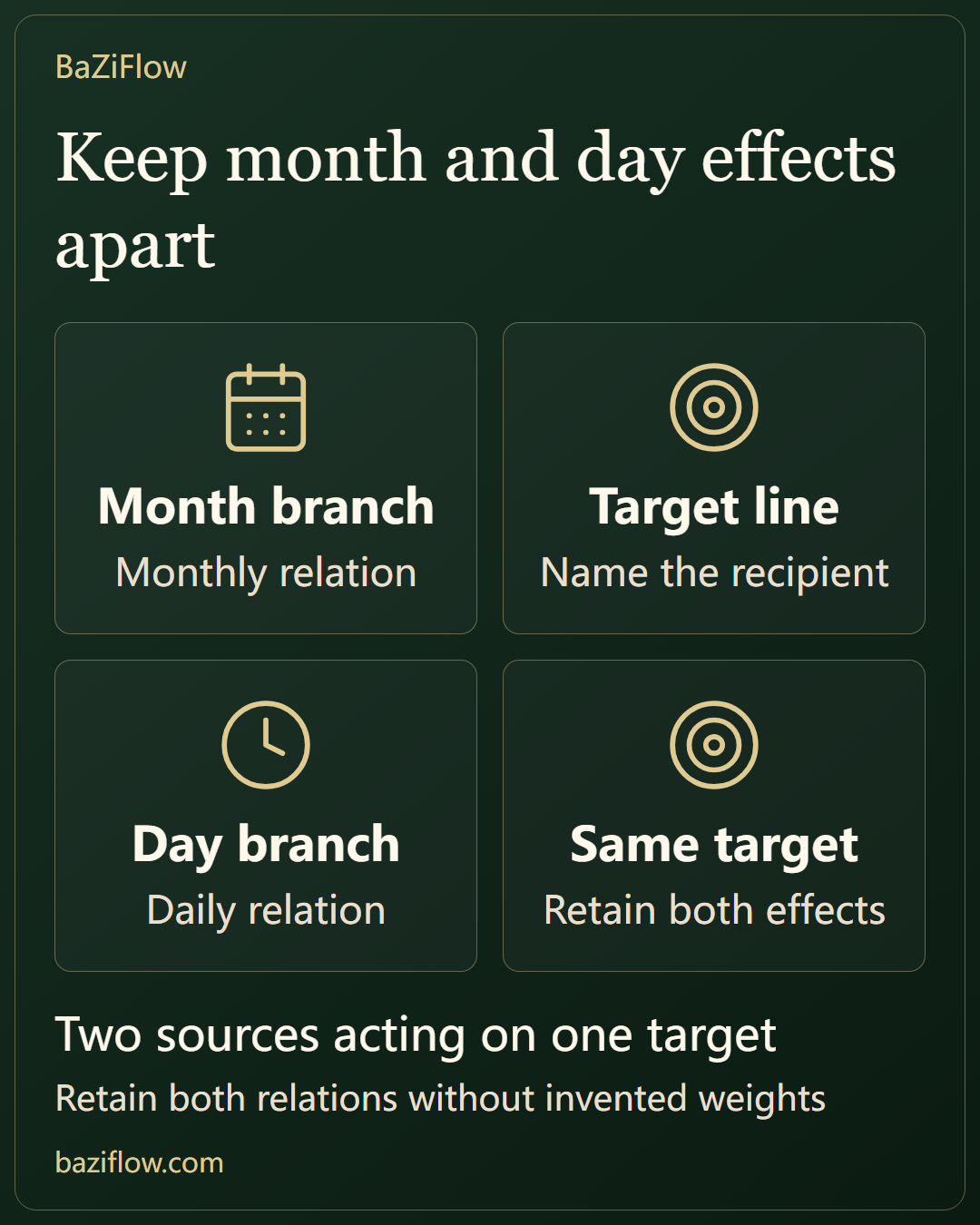
Compare swapped Rabbit and Rooster month–day roles, distinguish conditional hidden movement from day breakage, and keep opposing phase effects out of invented scores.
The short version6 min read
For a Rabbit line, Rabbit month with Rooster day gives a month match and a day clash; exchanging the calendar roles gives a month clash and day match. Preserve both inputs, the target and its original state before interpreting the competing conditions.
- Month and day are distinct source fields; exchanging the same two branches requires checking their effects again.
- The cited text distinguishes day clashes on strong and weak still lines, without rewriting the original coin values.
- Horse Fire controlling Rooster Metal can coexist with Goat Earth generating it; the text supplies no mandatory equal-weight cancellation.
Read first
Choosing the useful god: define the subject and retain candidates ↗
Record relations, not an unexplained strength score
A line can receive one kind of support from the month and a different pressure from the day. Compressing those observations into “strong” or “weak” too early hides both their sources and their conditions. Start by recording the month branch, day branch, target branch, and original moving or still state separately.
This lesson follows the Month Commander, Day Branch, and Hidden Movement chapters of Zengshan Buyi. Its terminology and qualifications matter: the text does not treat every clash as identical, nor does it make monthly strength erase every other constraint. The examples below are supplied partial conditions, not complete readings or conversions of real calendar dates.
Month input
- Relation to target
Day input
- Relation to same target
Swap the month and day, and the explanation changes
Let the target be a Rabbit (卯) Wood line. Rabbit and Rooster (酉) clash. In exercise A, the month is Rabbit and the day Rooster, with the target explicitly still. In exercise B, the month is Rooster and the day Rabbit. The two branch names are the same, but their roles have changed.
| Exercise | Month-to-line relation | Day-to-line relation | What must remain visible |
|---|---|---|---|
| A: Rabbit line, Rabbit month, Rooster day | Matches the month | Day clash | The condition for a strong still line to be activated by a day clash |
| B: Rabbit line, Rooster month, Rabbit day | Month clash | Matches the day | Both relations, followed by a check of other support or control |
| C: Rooster Metal, Horse (午) month, Goat (未) day | Fire controls Metal | Earth generates Metal | Two directions, without invented numerical cancellation |
The Day Branch chapter distinguishes a strong still line struck by the day, described as hidden movement, from a weak still line treated as day-broken under a clash. Exercise A illustrates the first conditional rule through its monthly match. It does not turn the label into a prediction of success. The Hidden Movement chapter explicitly allows beneficial or adverse effects depending on what that activity supports or controls.
Exercise B resembles the book's own discussion of Rabbit in a Rooster month and Rabbit day. Matching the day changes how the monthly clash is assessed, but the author goes on to consider additional moving Metal lines or transformation into Metal. Those qualifications prevent “not broken” from becoming an unconditional slogan. Keep the month clash in the evidence rather than deleting it from the record.
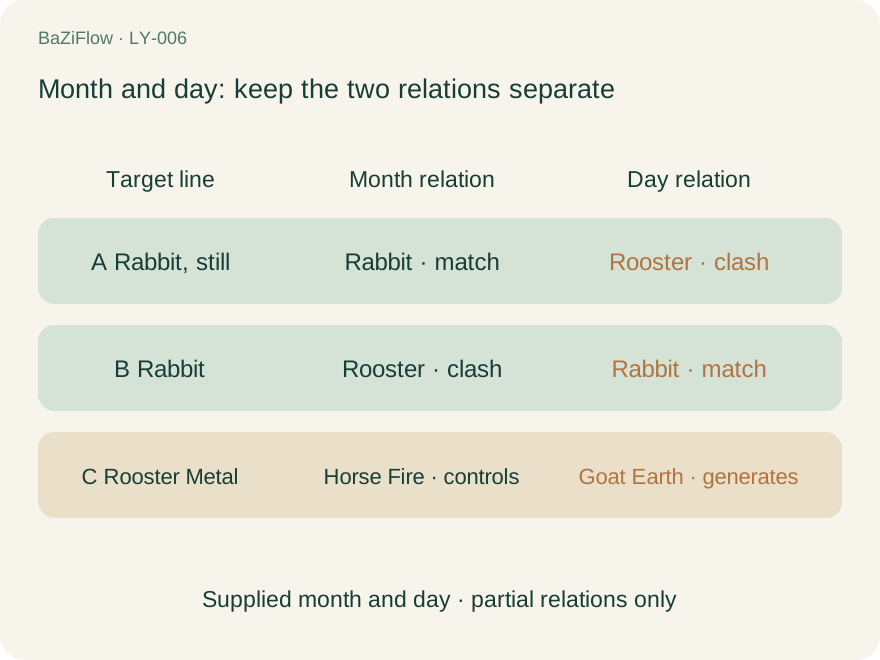
Original BaZiFlow comparison of supplied partial conditions. No full chart, actual calendar conversion, or event outcome is claimed.
Target Rabbit / A
- Month Rabbit: match
- Day Rooster: clash
Target Rabbit / B
- Month Rooster: clash
- Day Rabbit: match
Opposite directions do not define equal weights
In exercise C, Horse is Fire, Rooster is Metal, and Goat is Earth. Fire controls Metal; Earth generates Metal. Those relations are checkable. Calling one minus one and the other plus one would add a scoring scheme that the cited passage does not define.
The Month Commander chapter includes a case with this month–day relationship to Rooster Metal. It first discusses the competing effects, then considers additional moving lines and transformations. Extracting only the first two relations while retaining the original case's final verdict would conceal the omitted evidence. We use the relation exercise without borrowing that event outcome.
The recipient also matters. Support to the selected focus and support to a line controlling that focus are not automatically equivalent. Establish the useful-line selection first, then identify precisely which line receives each effect. A paragraph that says only “the chart is supported” may conceal a change of subject.
Make the calendar boundary an explicit input
This lesson uses month branches beginning at the relevant major solar-term (節) boundaries. The “Hexagram Qi” (卦氣) section in volume 5 of Zhouyi Shishu lists Beginning of Spring as the start of Tiger (寅), Awakening of Insects as the start of Rabbit, and Pure Brightness as the start of Dragon (辰). Rain Water, Spring Equinox, and Grain Rain are placed midway through those respective months.
We use that branch–term correspondence only, not the source's monthly hexagram arrangement as a substitute for a cast Liuyao hexagram. It also means that a lunar month's first day is not automatically the boundary used here, and not every one of the twenty-four solar terms begins another branch month.
For an actual timestamp close to a boundary, verify the calendar's solar-term instant and time zone. Record the day-change convention as well, especially near midnight or another adopted day boundary. Combining a month from one tool with a day from another tool's different settings can create an inconsistent input before interpretation begins. No such conversion is performed in our three supplied exercises.
Preserve constraints even when a line matches the month
The Month Commander chapter challenges an unrestricted claim that a line matching the month cannot be void or injured. It keeps the condition that a line voided within the current ten-day group is still void, and the competing control that can injure it. Monthly strength is therefore not permission to remove an inconvenient annotation from the chart.
Similarly, hidden movement is an interpretive condition applied to an originally still line. It does not rewrite the recorded coin sum into an old yin or old yang result. Keep that distinction when proceeding to moving and changed lines. Original casting data and later relational annotations must both remain recoverable.
The source uses “month commander” as another name for its month branch or month authority. That local terminology should not be carried unexamined into another divination system using a similar phrase. Likewise, the book's dispute with an indiscriminate “clash disperses” rule should be identified as its stated position, not flattened into a claim that all traditions use identical conditions.
A useful review ends with traceable statements: which month relation was found, which day relation was found, whether the target was originally still, and what other conditions remain unknown. A, B, and C demonstrate that limited task. They do not supply enough information for a complete outcome judgment, and no invented total score can replace the missing chart.
Casting record
- Still: value 7 or 8
Conditional annotation
- Day clash + strength
Questions readers ask next
Can month and day clashes be compressed into one label?
You can name their shared branch pair, but the source of each effect must remain visible. The method applies different conditions to monthly and daily roles. A bare clash label loses information needed to reconstruct which rule was applied.
Does hidden movement turn a recorded seven into nine?
No. Seven belongs to the casting record; hidden movement is a later annotation based on a day clash and the specified strength conditions. Separate fields preserve both the original still result and the interpretive rule without altering evidence.
Does Rain Water begin the next branch month here?
Under the stated boundary convention, Rain Water lies inside the Tiger segment. Beginning of Spring opens Tiger and Awakening of Insects opens Rabbit. A real timestamp near either boundary still requires a verified solar-term instant and time zone.
Was this article helpful?
Sources & references
Continue reading
Moving lines and changed counterparts: auditing Xu to Song ↗
Return generation and control: direction before interpretation ↗