

Star: where the house table begins
Content version · · Sources & references
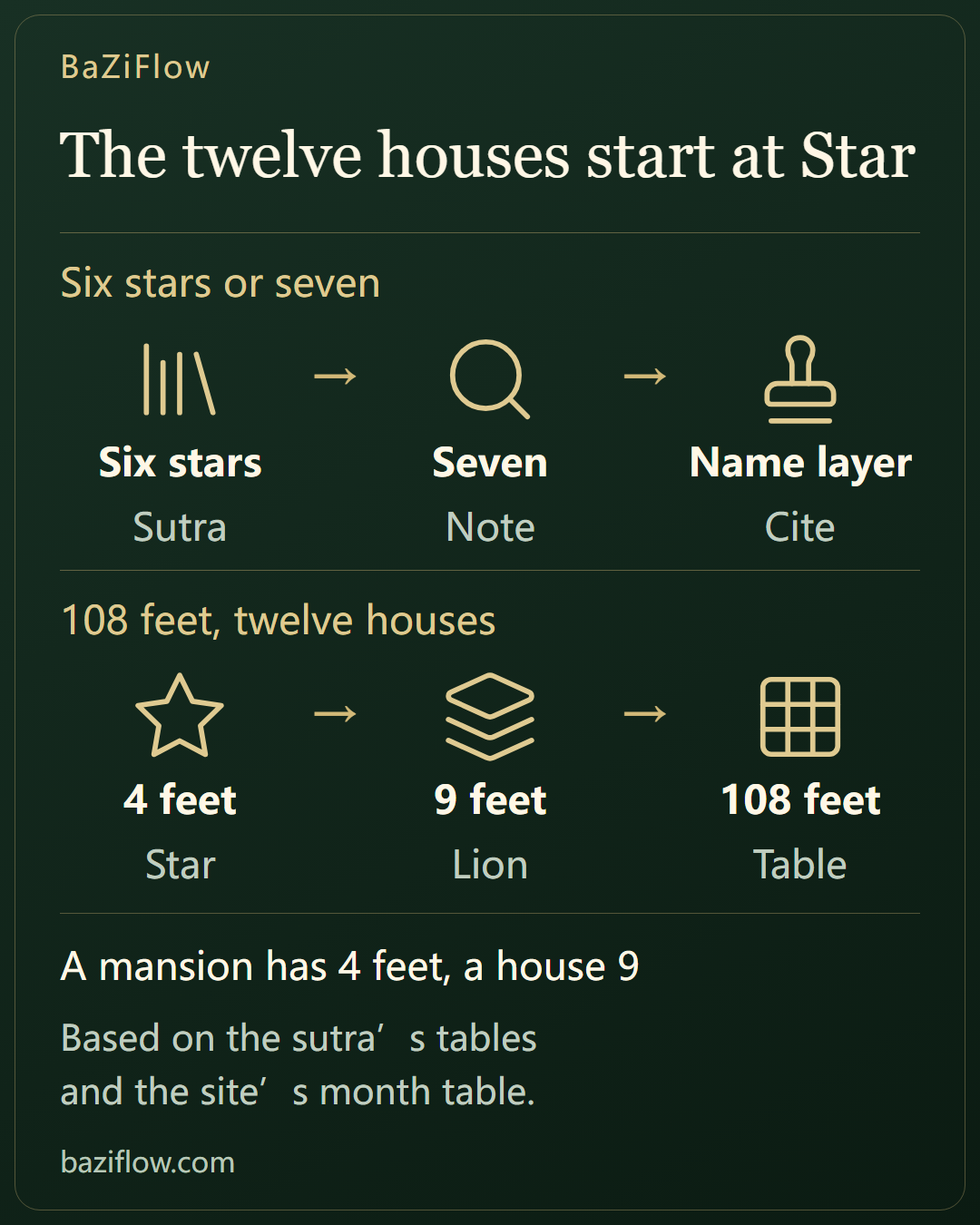
Star (星) is position 8 on the site’s 27-mansion ring. Its six-star picture against the note’s seven, the 108-foot twelve-house table that starts at it, two house numberings, and its old-calendar days.
The short version10 min read
Star (星) is position 8 on the site’s 27-mansion ring, between Willow and Extended Net. The Sukuyō Sutra draws it with six stars and starts its twelve-house table at it.
- The sutra’s picture gives Star six stars and the commentator’s note gives seven. The shape clause also lacks its object, so this article quotes the counts and leaves the shape alone.
- The house table runs 108 feet: 4 per mansion, 9 per house. It begins at the first foot of Star, and the first six houses end at half of Emptiness, exactly half the circle.
- Houses carry two numberings: the Lion house is first in fascicle 1 and fifth in fascicle 2, and all twelve differ by 4. A house number needs its fascicle.
Read first
What is Sukuyō astrology? How a birth mansion is found ↗
Sukuyō 27 mansions vs the 28 lunar mansions: what is the difference? ↗
Position 8 on the ring, between Willow and Extended Net
When the Sukuyō Sutra (宿曜经) lays out its twelve houses, the first stroke falls on Star (星). On the site’s ring of 27 mansions, counted from Hairy Head (昴) in the sutra’s order, it is simply position 8, with Willow (柳) at 7 before it and Extended Net (张) at 9 after it.
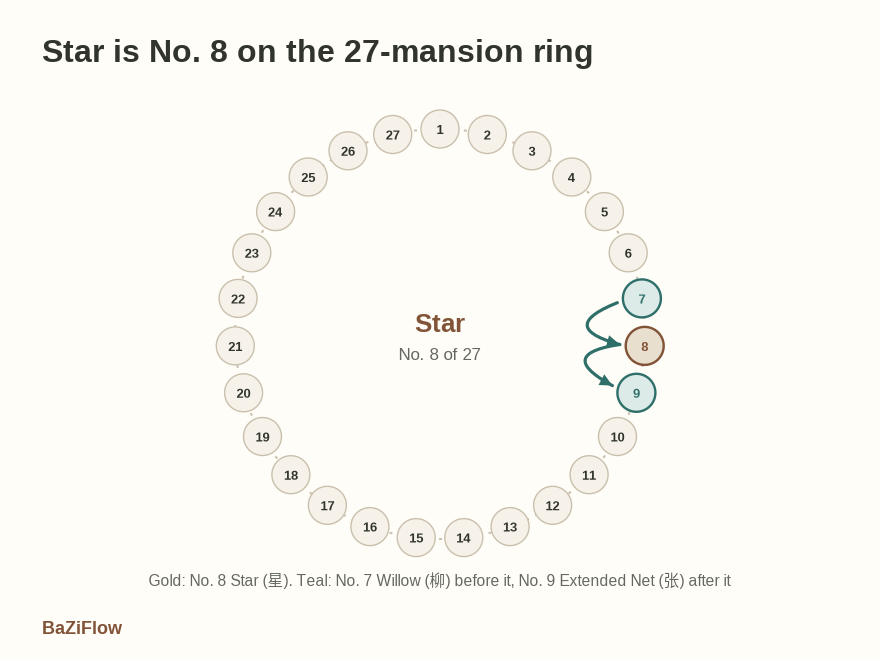
Gold Star sits at position 8 between Willow and Extended Net, where the first foot of the twelve-house table also begins; the even spacing does not show widths in the sky.
Gold marks Star and teal its two neighbors. It is 7 steps from the start at Hairy Head and 19 steps short of the last position, Stomach (胃). The commentator Yang Jingfeng labels all seven mansions of its group, Well (井), Ghost (鬼), Willow, Star, Extended Net, Wings (翼) and Chariot (轸), as mansions of the south, and Star is the fourth of the seven, exactly in the middle.
The sutra’s picture: six stars, and a note that says seven
The second chapter of the sutra gives each mansion a “picture” entry, twenty-eight in all with Ox included: how many stars, what shape, which deity. At the Hairy Head entry (see Hairy Head) Yang Jingfeng explains his method: the sutra’s star counts often disagree with Chinese astronomy, so he leaves the text alone and adds the Chinese figure in a note under the entry. The Star entry follows the same layout.
Star has six stars, shaped like “fierce”. It is the god Bhaga (薄伽).
The note Jingfeng adds at the end of the entry reads:
In Chinese astronomy, Star has seven stars, governs clothing and is a mansion of the south.
Enlarge diagram · scroll sideways to read
Other mansions read “shaped like” followed by an object: a razor for Hairy Head, a pestle for Extended Net, a hand for Chariot (轸). The Star entry says “shaped like fierce” and stops, which looks like a character dropped in copying. The e-text has it that way and there is nothing here to check it against, so this article gives no shape for Star.
The site’s own Star page links it to Alphard, the bright star of Hydra. That is a later identification of the sky, a third layer next to the sutra’s six and the note’s seven, and it cannot settle between those two numbers.
The house table starts at Star, and it spans 108 feet
The same sutra opens by describing how the Sun and Moon move, with the whole sky divided into twelve houses. How each house matches its mansions is laid out a little later, in a passage called “the division of houses and mansions”, but the very first sentence already names the starting point, Star:
The Sun governs the yang position. Starting from Star it goes on in order, taking Extended Net, Wings, Chariot, Horn, Neck, Root, Room, Heart, Tail, Winnowing Basket, Dipper, Ox and Girl, thirteen mansions, as far as half of Emptiness, which is exactly the middle of the Rat (子) position; this is divided into six houses.
The table counts in “feet” (足, literally a foot). When the immortal asks his question in the sutra, the premise is that the 27 mansions are broad or narrow in the sky yet are all divided equally into four feet, and each house takes charge of nine feet. So 27 mansions × 4 feet = 108 feet = 12 houses × 9 feet. The first house is written like this:
First: Star four feet, Extended Net four feet, Wings one foot. The Sun is in this position. Its god is like a lion, so it is called the Lion house.
Enlarge diagram · scroll sideways to read
The number of feet taken by the first mansion of each house runs 4, 3, 2, 1 and then back to 4. The Lion house opens with four whole feet of Star, the Maiden house with three of Wings, the Scales house with two of Horn, the Scorpion house with one of Root, and the Bow house again with four of Tail. Only the Lion, Bow and Ram houses start exactly at the beginning of a mansion; the other nine cut into a mansion partway.
The first six houses total 54 feet, and the table assigns them to the Sun’s share, with the last six to the Moon’s. Fifty-four feet is thirteen and a half mansions, and the end falls at half of Emptiness, which agrees with the opening line “as far as half of Emptiness”.
One house, two numbers: fascicle 1 and fascicle 2 differ by 4
The sutra numbers its houses in two ways. The table in fascicle 1 puts the Lion house first. The passage on forbidden directions in fascicle 2 lists houses with the Ram house first, which makes the Lion house fifth. Comparing all twelve one by one, the fascicle 2 number is always the fascicle 1 number plus 4, wrapping back to 1 after 12.
Enlarge diagram · scroll sideways to read
So “the fifth house” is the Bow house in fascicle 1 and the Lion house in fascicle 2. Cite it in full, such as “fascicle 1, first house (Lion)”. The fascicle 2 passage also names the mansion days that go with each house. For the Lion house it says “take the Star and Extended Net days”, listing only those two; Wings has just one foot there, and fascicle 2 files it under the Maiden house instead (“the Wings and Chariot days”).
The old-calendar days on which Star falls
The site finds a birth mansion with the NAOJ month-start table, using the Japanese old calendar (new moon fixed by Tokyo time). Each old-calendar month has a first-day mansion, and day N of the month counts N − 1 places on from it. Where Star lands depends on how many steps it is from that first-day mansion.
| Old-calendar month | First-day mansion | Day on which Star falls |
|---|---|---|
| Month 1 | Encampment (室) | Day 13 |
| Month 2 | Legs (奎) | Day 11 |
| Month 3 | Stomach | Day 9 |
| Month 4 | Net (毕) | Day 7 |
| Month 5 | Three Stars (参) | Day 5 |
| Month 6 | Ghost | Day 3; also day 30 in a 30-day month |
| Month 7 | Extended Net | Day 27 |
| Month 8 | Horn (角) | Day 24 |
| Month 9 | Root (氐) | Day 22 |
| Month 10 | Heart (心) | Day 20 |
| Month 11 | Dipper (斗) | Day 17 |
| Month 12 | Emptiness (虚) | Day 15 |
The day moves 2 to 3 days earlier each month, for the reason given in the table of first-day mansions (see Hairy Head). Two months stand out. Month 6 starts at Ghost, so day 3 is Star after Ghost and Willow, and after a full lap day 30 is Star again. Month 7 starts at Extended Net, with Star one place before it, so Star comes only after 26 steps, on day 27.
Enlarge diagram · scroll sideways to read
From November 1 the choice of calendar matters. The new moon came at 23:50 on the night of October 10 in Beijing, which was already past midnight in Tokyo, so November 1 is month 9, day 22 in the Japanese calendar but day 23 in the Chinese lunar one. Run on the Chinese dates, the same table would put Star on October 31 rather than November 1. The other four dates, July 16, August 12, September 8 and October 4, are the same under both.
Four terms used here
- Star
- The mansion called Star, position 8 on the ring.
- Foot
- The sutra’s small unit: 4 feet per mansion, 9 per house, 108 for the whole sky.
- First-day mansion
- In the site’s month table, the mansion on day 1 of an old-calendar month, from which the rest of the month is counted.
- House
- One of the twelve divisions of the sky, such as the Lion house; its number depends on the fascicle.
The same method takes you to the next position, Extended Net. For the wider background, see Sukuyō and birth mansions.
Questions readers ask next
Does “Star mansion” mean the stars in the sky?
In Sukuyō it usually names one of the 27 mansions, the one called Star. Only in a general sentence does it mean stars at large. The sutra uses both senses within one chapter, so read a quotation together with the lines around it.
The house table starts at Star. Does that make it the most important mansion?
The text only puts the start of the table here: the Sun’s six houses are counted from the first foot of Star and end at half of Emptiness. A starting point is a layout need. The sutra draws no ranking from it, and this article gives no verdict on anyone.
If my birth mansion is Star, should I think of six stars or seven?
The site’s birth mansion is a name produced by the month-start table, and it has nothing to do with star counts. Six and seven matter only when reading the sutra against its note, where each number needs its own citation.
Was this article helpful?
Sources & references
Continue reading
Willow (柳): Three Luminary Tables, a Picture Missing Its Deity, and Gaps Between Days ↗
Extended Net (张): Two Stars or Six, and Its Place Among the Vajra Peak Days ↗