

Page of Swords: sword up, eyes everywhere
Content version · · Sources & references
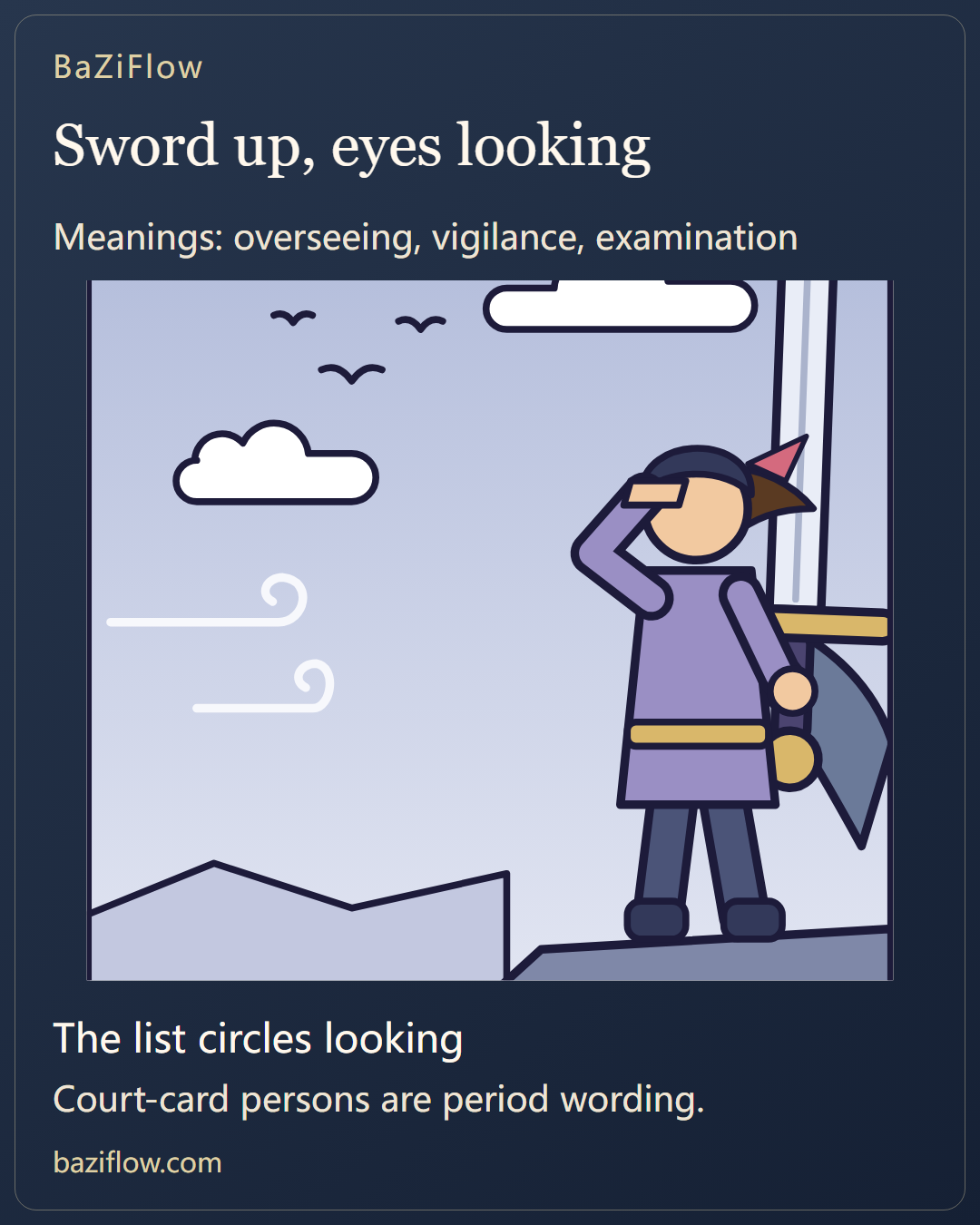
The Page of Swords shows a lithe, alert figure walking fast with an upright sword. Separate Waite's list from his period wording, then sweep a complaint letter left, right and behind before sending it.
The short version6 min read
In the Page of Swords the sword stands upright and the figure looks. Of the six words in Waite's list four are acts of looking, and the figure walks and glances about, as if an expected enemy might appear.
- Waite's picture: a lithe figure holds a sword upright in both hands, walking fast over rugged land with clouds massed wildly about his way, alert, with his gaze going every which way.
- The list: authority, overseeing, secret service, vigilance, spying, examination and related qualities; reversed it gives the more evil side of these, and an unforeseen, unprepared state.
- Court-card wording about persons is period phrasing; in teaching it reads as a stance, here "look as you walk, and check before you strike".
Read first
Sword upright in the hand, rough ground underfoot: see the feet and the eyes first
Waite describes the Page of Swords as a lithe, active figure holding a sword upright in both hands while in the act of swift walking. He passes over rugged land, the clouds about his way are collocated wildly, and he is alert, glancing in every direction as though an enemy he expects could show up at any moment.
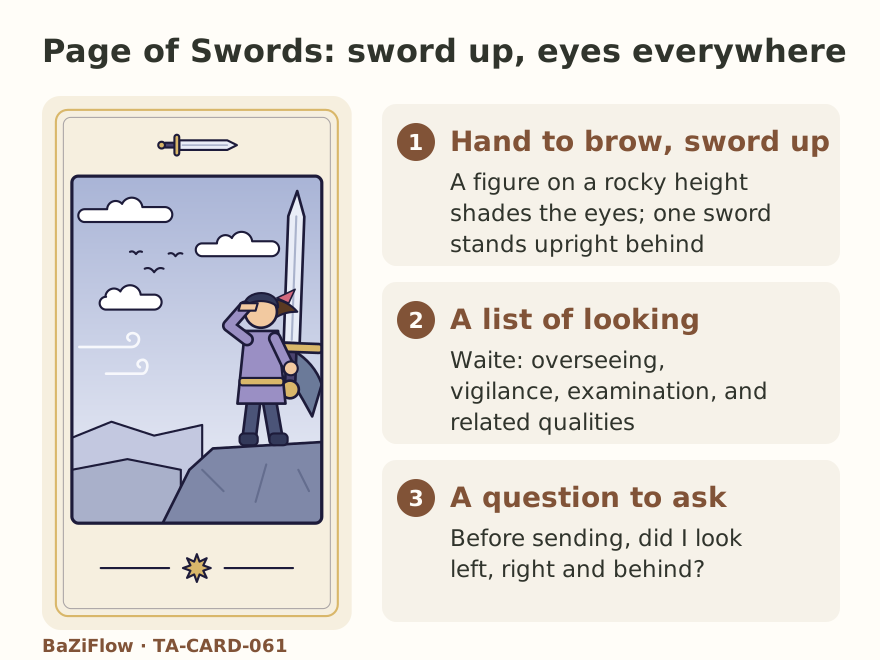
BaZiFlow original Page of Swords
The original Rider-Waite-Smith card has him on top of a green mound, the sword raised from beside his shoulder, hair blown out by the wind and the face turned to one side. Clouds are banked behind him, a flock of small birds is at the upper left and a wind-bent tree at the lower left. BaZiFlow's drawing is composed differently: the figure stands on a rocky height with one hand at the brow looking far off, the sword upright behind, wind lines and birds in the sky.
Enlarge diagram · scroll sideways to read
What Waite lists: overseeing, vigilance, examination, mostly looking
Waite's divinatory meanings run: authority, overseeing, secret service, vigilance, spying, examination, and the qualities thereto belonging. Of the six words, overseeing, vigilance, spying and examination are acts of looking, while authority and secret service are names of offices.
Authority, overseeing, secret service, vigilance, spying, examination, and the qualities thereto belonging.
Enlarge diagram · scroll sideways to read
Not one of the words is an outcome. They describe ways of working: standing high, looking closely, checking carefully. The closing phrase "the qualities thereto belonging" also shows that Waite is listing a family of qualities and not an event.
The additional meanings, Part III §4, from other readers add: "An indiscreet person will pry into the Querent's secrets", and under reversed "astonishing news". Those are other readers' rules, kept apart from the main entry.
Upright sword, wild clouds, rough ground: the text, the original card and the drawing
Three details are written and drawn differently in the three sources:
Sword, clouds, ground: where each detail comes from
- The upright sword
- Waite writes "a sword upright in both hands" and does not say where it points. On the Rider-Waite-Smith card it is raised beside the shoulder with the point up; in the drawing it stands behind the figure on one side.
- The wild clouds
- Waite says the clouds about his way are massed wildly and gives them no meaning. The original piles them behind him; the drawing paints white clouds, wind lines and birds.
- The rough ground
- Waite has him pass over "rugged land". The original is a green mound and the drawing a rocky height. Reading it as "the way ahead is unclear" is a later metaphor.
Enlarge diagram · scroll sideways to read
The text has no wind and no birds; the original draws hair blown out, and the drawing adds wind lines. The sense of alertness from wind and birds comes from a picture, so name the source of that feeling.
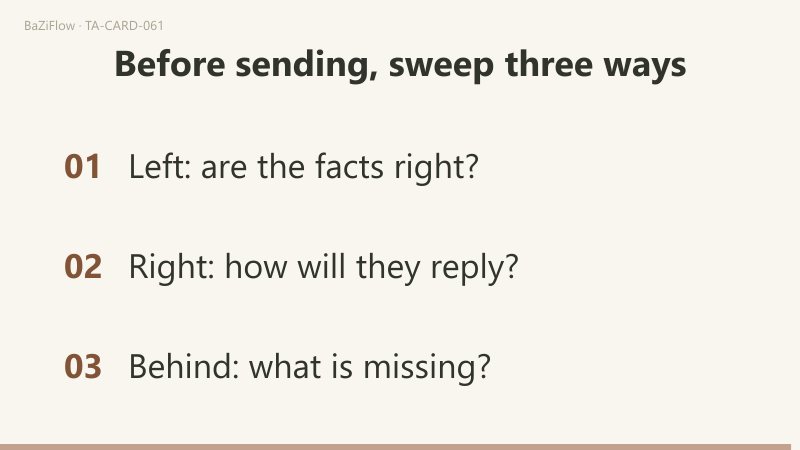
Using it: sweep a complaint letter left, right and behind before it goes out
Two features of the card are directly usable: the sword is upright and not yet swung, and the figure keeps glancing around. Put them on a complaint letter. You are writing to a renovation firm whose agreed completion date has slipped three weeks; the letter is drafted and not yet sent.
Look left: do the facts match?
Order number, dates, amounts, message history: go through them one by one. Every number and date in the letter should be traceable to a line in your records.
Look right: how will they answer?
Stand where the reader stands and list the two or three replies most likely. Put the evidence into the letter first, so that each reply already meets its answer.
Look behind: what is missing?
Waite's reversed side speaks of what is unforeseen and unprepared. Ask: if the reader asks "what outcome do you want?", does the letter say? Are the request and the deadline both there?
Keep the sword upright: while you sweep, the letter carries no guesses without evidence and no lines written in anger. One example for each direction:
Enlarge diagram · scroll sideways to read
Reversed and neighboring cards: the same vigilance, with "unprepared" on the other side
Waite's reversed side reads: the more evil side of these qualities; what is unforeseen, an unprepared state; and a mention that sickness is intimated (one word of a 1910 list). The upright words are about looking, and the reversed side points two ways that can be read as looking too much or not looking at all.
Enlarge diagram · scroll sideways to read
Three cards that hold swords, and the step each is on
The card before: every sword present
The last numbered card, with all the swords already down and a list of pain and sorrow. The Page holds just one, and he is still observing.
A hand from a cloud grips a sword
Waite's list circles triumph, conquest and the intensity of force; the sword is in a hand from a cloud and nobody walks. The Page's sword is in the hand of someone walking and looking.
The card after: riding in full course
Waite has him riding as if scattering enemies, with skill, bravery and defence in the list, but enmity and war as well. The Page is still glancing about; the Knight has already charged.
Questions readers ask next
Does the Page of Swords mean someone is watching me?
No. Waite's list has overseeing, vigilance, spying and examination, and the figure glances around, so what is described is a posture of alert looking. No second person is on the card and the text does not say he watches anyone. Reading it as "someone watches me" turns a posture into a person.
What does the Page of Swords mean reversed?
Waite's reversed side is the more evil side of those qualities, an unforeseen and unprepared state, and a mention of sickness (one word of a 1910 list). Following the upright words, you can read it as looking too much, or not looking at all. Another reader's line is "astonishing news".
How does the Page differ from the Knight of Swords?
Both hold swords. The Page walks fast and looks about with the sword upright; Waite has the Knight riding in full course as if scattering his enemies, with words like skill, bravery, defence, but also enmity and war. One still observes, the other has already charged.
Was this article helpful?
Sources & references
Continue reading
Ten of Swords: every sword in place, and a list that defers to the picture ↗
Knight of Swords: a full-speed charge, and no enemy in the picture ↗