

Jiji: when every line is in place
Content version · · Sources & references
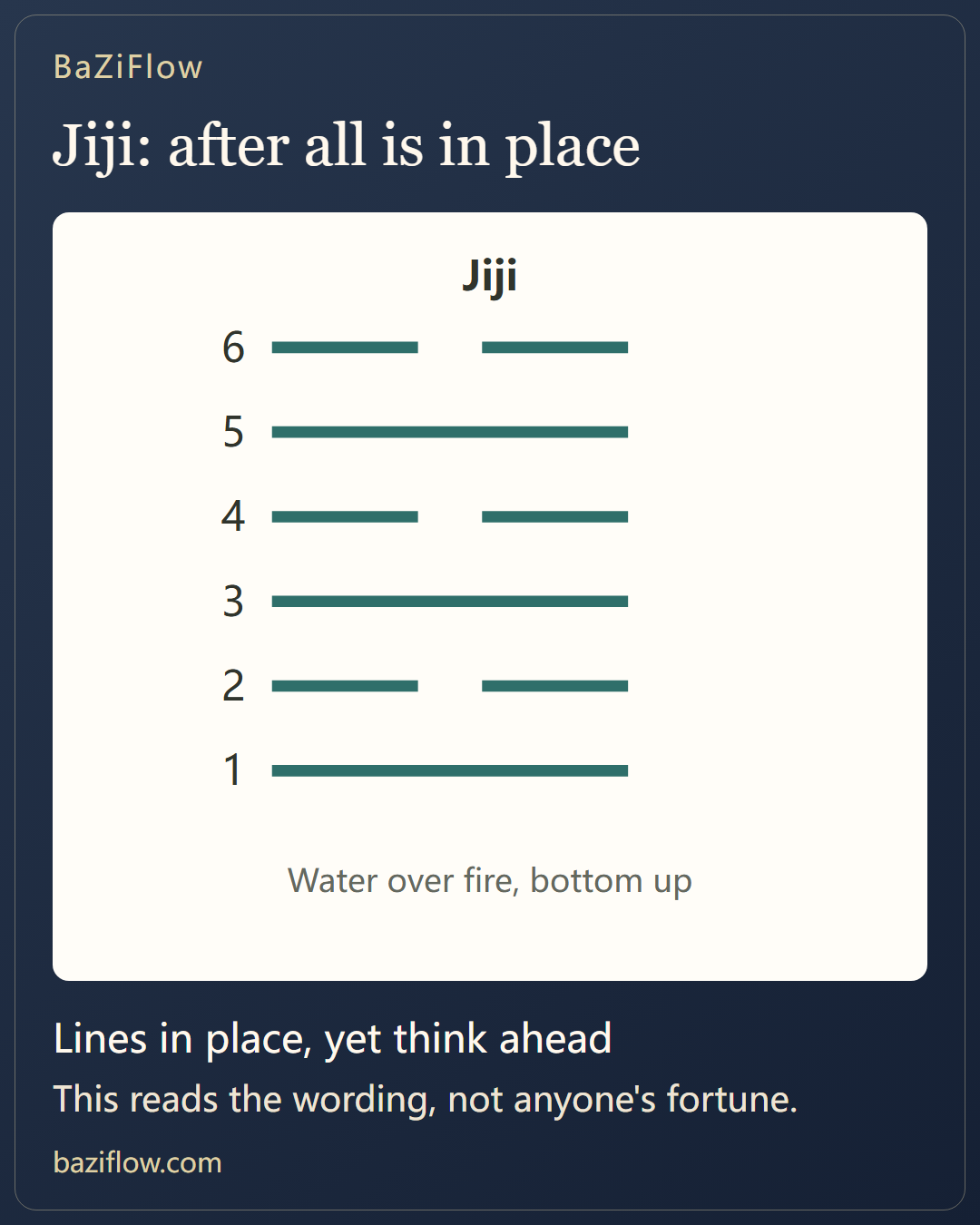
Jiji is the 63rd hexagram: Kan (water) above Li (fire), all six lines in their own places. Read "good at the start, disorder at the end", the Image on guarding ahead, and water rising from the tail to the head.
The short version8 min read
Jiji is the only hexagram whose six lines all sit in their own places. Its text is about what follows once a thing is done: a wheel dragged, a loss left unchased, a day spent on guard, and water that rises over the head.
- Jiji puts Kan (water) above Li (fire). Its six lines alternate yang and yin, yang on 1, 3, 5 and yin on 2, 4, 6, each in its own place, and the Commentary on the Judgments calls it "the firm and the soft correct, each in its place".
- For "good at the start, disorder at the end" the Commentary gives two reasons: the soft holds the middle, so the start is good; stopping brings disorder, since the way has run out. The Image turns this into one act: think of trouble and guard against it early.
- In the lines the water runs from "wets its tail" in line 1 to "wets its head" in line 6. The Small Images end on right, the middle way, exhaustion, doubt, timing, and "how can it last".
Read first
The Sixty-Four Hexagrams: How Upper and Lower Trigrams Form One Figure ↗
Judgment and Line Statements: Whole Hexagram or Single Line? ↗
Water over fire: six lines, each in its place
The upper trigram of Jiji (既濟) is Kan (water) and the lower is Li (fire). In the Shuo Gua Kan is "sinking" and Li is "clinging", in the sense of attaching to something. Counting from the bottom, the six lines are yang, yin, yang, yin, yang, yin: one yang, one yin, taking turns all the way up.
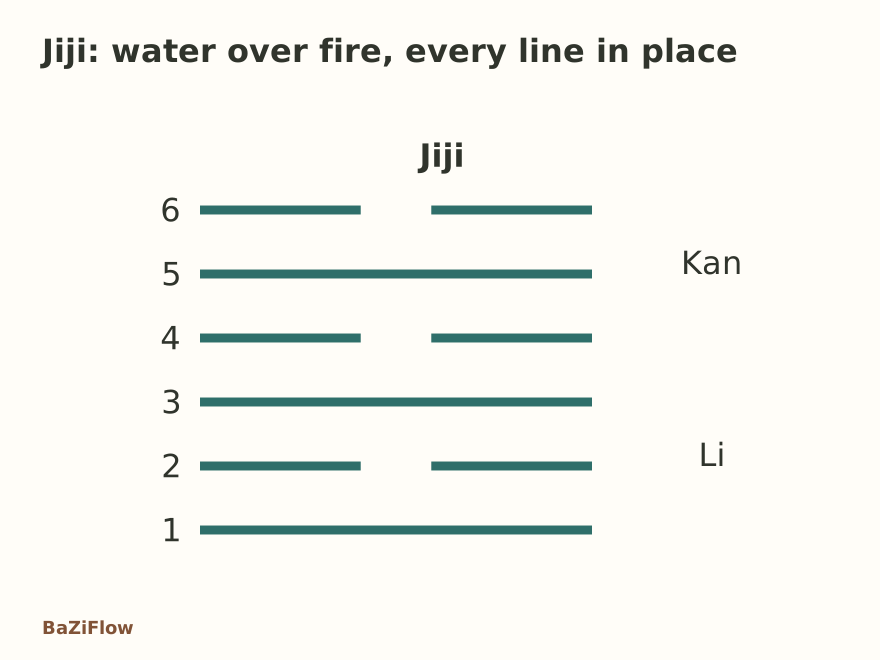
The six lines of Jiji: yang in places 1, 3, 5 and yin in places 2, 4, 6. Of the sixty-four hexagrams, only this one has every line in its own place.
Enlarge diagram · scroll sideways to read
Terms to know before reading Jiji
- Jiji
- Literally "already crossed": ji is to cross water, and the first word means "already". The name says the crossing is done.
- In place
- Places 1, 3, 5 are yang places and places 2, 4, 6 are yin places. A yang line in a yang place, or a yin line in a yin place, is "in place"; the general idea is in how line positions work. All six lines of Jiji are in place, and no other hexagram can say so.
- Ru (wet)
- To soak. "Wets its tail" and "wets its head" each occur once, the first in line 1 at the bottom and the second in line 6 at the top.
The Judgment and the Commentary: success in the small, good first, disorder last
The Judgment of Jiji is eight characters:
Success in the small. Fitting to hold firm. Good at the start, disorder at the end.
How to read the first two words, the Commentary on the Judgments says itself: "Jiji: success; the small ones succeed." On that basis tradition usually reads "success, the small succeed", so that what goes through is the small side. For the sentences after it, one good and one bad, the Commentary gives a reason apiece:
Jiji: success; the small ones succeed. Fitting to hold firm: the firm and the soft are correct and each is in its place. Good at the start: the soft holds the middle. Stopping at the end brings disorder: its way has run out.
Enlarge diagram · scroll sideways to read
The reason for "good at the start" is "the soft holds the middle": line 2 is a yin line and sits in the middle of the lower trigram. The reason for "disorder at the end" is "stopping brings disorder, its way has run out", and the key word is "stopping". The Commentary does not say the disorder comes from lines out of place. It has just said the opposite, that the firm and the soft are correct and in place. The disorder comes from reaching the end and halting.
The Great Image: think of trouble and guard against it in advance
Water above fire: Jiji. The noble person thinks of trouble and guards against it in advance.
The Great Image (大象) starts from a picture. The Shuo Gua has a sentence, "water and fire reach each other": the old word means to catch up with, to touch. The picture in Jiji is fire below and water above, two things already in contact. Tradition usually imagines it like this: the fire burns underneath and the water above takes the heat, a thing brought to completion.
What the Image takes from the picture is an act in two steps. First, thinking of trouble: working out beforehand what might go wrong. Second, guarding in advance: putting up a defense before it comes.
Enlarge diagram · scroll sideways to read
Many Great Images end on a virtue, such as unceasing strength or carrying things with ample virtue. This one ends on foresight, and its object is trouble, something that has not happened. The Judgment says "good at the start, disorder at the end", and the act the Image gives can be read as something to do while the start is still good.
Six lines: the water rises from the tail to the head
Enlarge diagram · scroll sideways to read
In this hexagram the water is written at the two ends. Line 1, "wets its tail", gets only the tail wet; by line 6, "wets its head", it has reached the head. The four lines between do not name water outright (one word in line 4 is traditionally read as "wet"; see below). They say how to cope.
Line 1 sits at the bottom. "Drags its wheel": the wheel is held back so it moves slowly, the tail gets wet, and yet there is "no blame". The Small Image gives its reason: "by right there is no blame".
Line 2, "the woman loses her carriage screen", is a loss. Tradition usually reads the word for the screen as the curtain that covers a carriage. The statement's way of dealing with it is "do not chase": do not go after it, and in seven days it will be found. The Small Image sums it up as "by the middle way", and line 2 does sit in the middle of the lower trigram.
Line 3 is a campaign: "Gaozong attacked the Guifang and conquered them after three years", and it ends with a warning, "do not use small people". The Small Image is two characters: "exhausted". The statement records a victory, and the Small Image comments on what it cost.
Line 4, "silk, with rag stuffing; on guard all day". Tradition usually reads the first word as the word for "wet", meaning seeping, and the rags as what is stuffed into a leak. On guard all day, the Small Image says, "because there is doubt".
Line 5 is the ruler's place: "The eastern neighbor slaughters an ox, but that is not as good as the western neighbor's modest offering, which truly receives the blessing." The east holds a grand sacrifice with an ox, yet the one who truly gets the blessing is the west, with its plainer rite. Tradition usually reads that offering as a small-scale sacrifice. The Small Image puts it down to timing and adds that "great good fortune comes".
Line 6, "wets its head; danger": the water is now over the head. The Small Image asks, "how can that last?"
Lay out where the six Small Images come to rest: right, the middle way, exhaustion, doubt, timing, how can it last. The last four, exhaustion, doubt, timing and whether a thing can last, can be read as questions that come up once something is done.
Jiji and Weiji: one figure, three readings
Change every line of Jiji to the opposite polarity and you have Weiji; this is its inverse hexagram (错卦). Turn Jiji upside down and you still get Weiji, its reversed hexagram (综卦). Take lines 2 to 5 and fold them into a nuclear hexagram (互卦), with Kan below and Li above, and again you get Weiji. All three relations hold at once, and among the sixty-four hexagrams only this pair can say so.
Enlarge diagram · scroll sideways to read
The general idea of reading a figure backward is in yin and yang lines, which uses this very pair as its example.
The Xu Gua puts Jiji after Xiaoguo, in one sentence:
Those who have passed beyond things must cross, so it is followed by Jiji.
That is, what has gone past must now get across, and so Jiji follows. The Za Gua gives Jiji a single word:
Jiji: settled.
"Settled" means fixed in place. Read it together with the Commentary's "stopping brings disorder": one says it is settled, the other says that to stop is to fall into disorder.
Questions readers ask next
Is Jiji a hexagram of success and completion?
Not simply. The first words of the Judgment are "success in the small", the Commentary reads them as "the small succeed", and "good at the start, disorder at the end" follows at once. The last of the six lines is "wets its head; danger". The text describes the state after a task is done, with some good fortune and some warning in it.
How are Jiji and Weiji related?
The polarity of their six lines is opposite everywhere, and turned upside down each becomes the other. The Xu Gua places them last in the sequence of sixty-four, Jiji first and Weiji after it.
If all six lines are in place, why does the Judgment say disorder at the end?
The Commentary sets two things side by side: "in their places" explains "fitting to hold firm", and "stopping" explains the disorder. The first speaks of where each line sits, the second of what comes after. When you read, first decide which sentence the Commentary is explaining.
Was this article helpful?
Sources & references
Continue reading
Xiaoguo: thunder above the mountain, and passing and meeting trade places ↗
Weiji: fire above water, no line in place, and yet each answers another ↗
The Sixty-Four Hexagrams: How Upper and Lower Trigrams Form One Figure ↗
Judgment and Line Statements: Whole Hexagram or Single Line? ↗