

Jian (漸): a wild goose and its six landings
Content version · · Sources & references
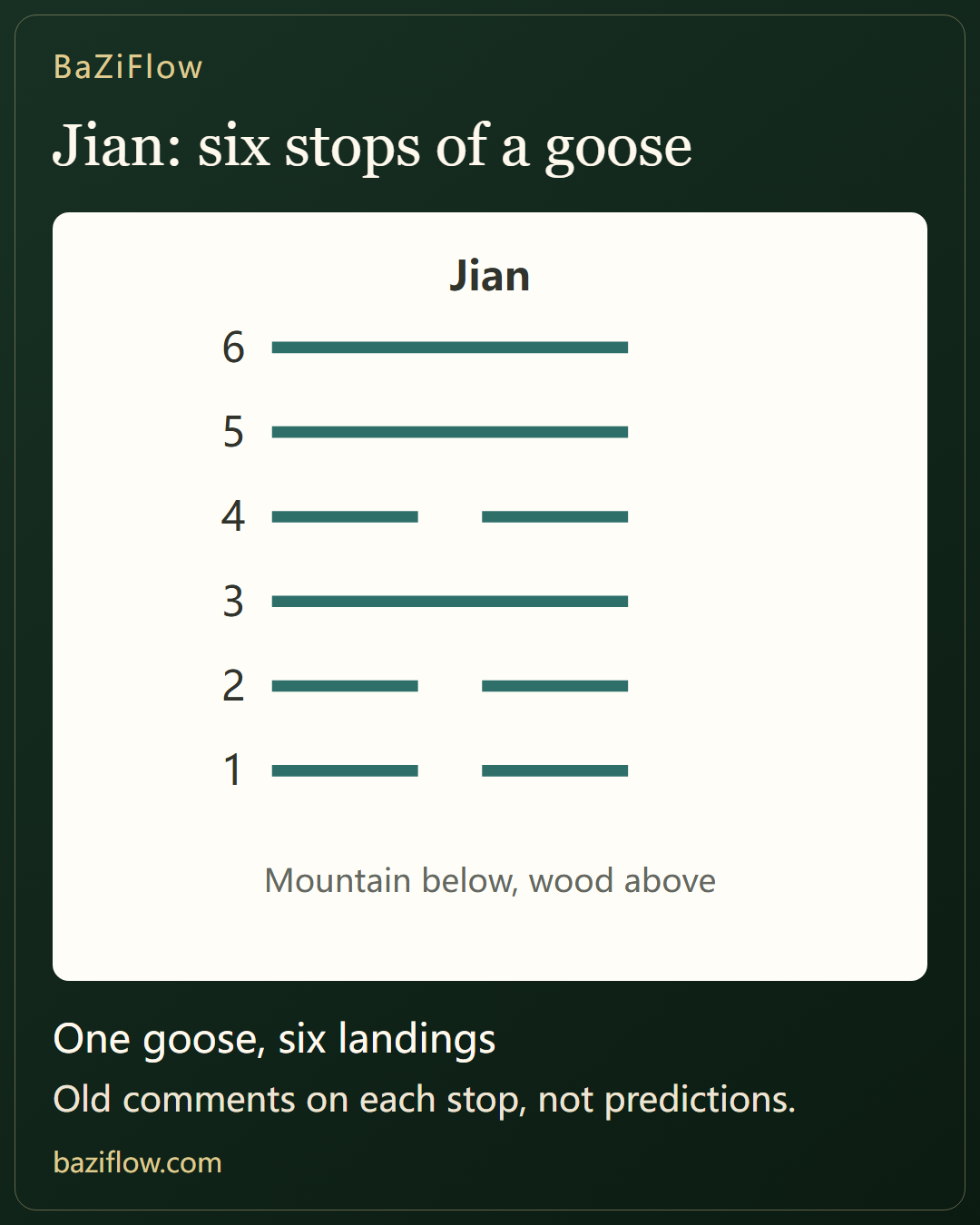
Jian is the 53rd hexagram: Gen (mountain) below Xun (wood). Read the Commentary’s three “advances”, the Great Image on a tree on a mountain, and six lines that follow one wild goose from the shore to the hill.
The short version7 min read
Jian has one wild goose that keeps changing where it lands: the shore, a boulder, dry land, a tree, a hill. The text uses each stop to show that advancing is gradual and that no two stops are alike.
- Jian stacks Xun (wood) on Gen (mountain). The Xu Gua glosses it directly, “Jian means advancing”, and the Commentary uses the word “advance” three times.
- The Great Image sets a tree on a mountain and gives the noble person two tasks: to dwell in worthy virtue, and to make customs good, one inward and one outward.
- All six lines begin “the wild goose gradually reaches”, and the places run shore, boulder, dry land, tree, hill, dry land. Line 3 and the top line name the same place, with opposite verdicts.
Read first
The Sixty-Four Hexagrams: How Upper and Lower Trigrams Form One Figure ↗
Judgment and Line Statements: Whole Hexagram or Single Line? ↗
A tree on a mountain: Gen below, Xun above
Jian (漸) is the 53rd hexagram, with Gen (mountain) as the lower trigram and Xun (wood, wind) as the upper. The Xu Gua glosses it in a single line: “Jian means advancing”. The judgment has only five characters:“a woman goes to be married: good fortune; fitting to stay on course”. In modern Mandarin the name sounds close to that of hexagram 39, Jian (蹇), though the tone differs (jiàn against jiǎn), and the characters and the figures are different.
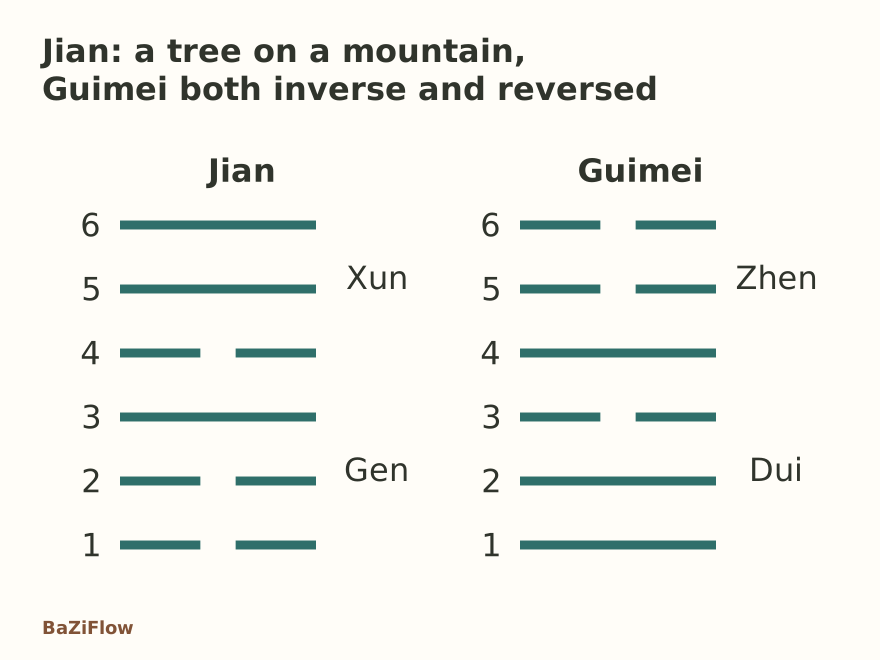
Jian and Guimei: they are each other’s inverse and also each other’s reversed hexagram, since swapping every line and flipping the figure give the same result.
Enlarge diagram · scroll sideways to read
Four words to know first
- Wild goose
- The goose is the subject of every line statement, each of which begins “the wild goose gradually reaches …”.
- Shore, boulder, dry land, hill
- The places where the goose lands: the water’s edge, a large rock, dry level ground, and a hill.
- Tree and branch
- A tree, and a branch that tradition usually reads as a flat, straight one; the goose lands only if it finds such a branch.
- A woman goes to be married
- The phrase is used in both the judgment and the Commentary; it does not recur in the line statements, where lines 3 and 5 speak of a “wife”.
The judgment and the Commentary: a woman goes to be married, and three “advances”
The judgment is “a woman goes to be married: good fortune; fitting to stay on course”, with nothing added. The Commentary on the Judgments expands it into five sentences:
In Jian the advance is like a woman going to be married: good fortune. Advancing, it gains its place, and going forward brings achievement. Advancing in the right way, it can set a state in order. Its place is the firm one, and it holds the middle. Stopping, and then entering gently: its movement is never exhausted.
Enlarge diagram · scroll sideways to read
The word “advance” appears three times. The first sentence likens Jian’s advance to a woman going to be married, something that happens in a fitting order. The second says that the advance reaches the place where it belongs (“gains its place”). The third says that it advances along the right path.
“Gains its place” can be checked on the lines. Among lines 2 to 5, lines 2 and 4 are yin on yin places and lines 3 and 5 are yang on yang places, so all four lines are matched to their positions. “Its place is the firm one and it holds the middle” is about line 5: a yang line in the fifth place, at the center of the upper trigram. The last sentence says that the lower trigram Gen is stopping and the upper trigram Xun is yielding: it stops first, then advances by yielding, and so its movement has no end.
The Great Image: a tree on a mountain, virtue and custom
On the mountain there is a tree: Jian. The noble person dwells in worthy virtue and makes customs good.
Enlarge diagram · scroll sideways to read
Tradition usually understands the image like this: a tree on a mountain grows higher year by year, and slowly. The noble person has two tasks, one inward, to dwell in worthy virtue, and one outward, to make customs good.
One way to read it: virtue is built up bit by bit, and customs shift bit by bit, and neither arrives in one step. The word jian rests on that slowness.
Six lines: one goose, six landings
All six statements share a single opening: “the wild goose gradually reaches …”. It is one goose that lands one stop after another, and what follows each stop belongs to that stop.
Enlarge diagram · scroll sideways to read
Line 1 is at the shore: “the little child is in danger; there is talk; no blame”. The Small Image calls it blameless on principle. Line 2 is on a boulder: “eating and drinking in ease and joy: good fortune”, and the Small Image adds “not eating for nothing”.
Line 3 is on dry land, and it is the only line of the hexagram that says “misfortune”: “the husband goes on campaign and does not return; the wife conceives but does not raise the child: misfortune; fitting to fend off bandits”. The Small Image answers in three sentences: “he has left the group”, “she has lost her way”, “they protect one another by yielding”, the last one matching “fitting to fend off bandits”.
Line 4 is in a tree: “perhaps it finds a flat branch: no blame”. The Small Image says “through yielding and gentleness”, using the very name of the upper trigram, and line 4 is the first line of Xun.
Line 5 is on a hill: “the wife does not conceive for three years, but in the end nothing prevails against it: good fortune”, and the Small Image says “it gets what it wished”. Lines 3 and 5 both speak of a wife and a pregnancy, one with misfortune, one with good fortune. In the top line the goose returns to dry land: the statement begins exactly as line 3 does, yet it continues “its feathers can serve as emblems: good fortune”, with the comment “it cannot be thrown into disorder”. Tradition usually reads “emblems” as bearing or as a model.
Guimei and Weiji: neighbors of Jian, and “an advance must have somewhere to go”
The inverse and the reversed hexagram of Jian are the same hexagram: Guimei (歸妹). Swap every line of Jian and you get Guimei; turn Jian upside down and you also get Guimei. Its nuclear hexagram (互卦) is Weiji (未濟): the three lines from the second up are yin, yang, yin and make Kan below, and the three from the third up are yang, yin, yang and make Li above.
Enlarge diagram · scroll sideways to read
The Xu Gua puts Jian after Gen because things cannot stay stopped forever and must advance. The hexagram that follows Jian is Guimei, and the reason the Xu Gua gives is “an advance must have somewhere to go”. One line of the Za Gua is about Jian itself:
Jian: the woman goes to be married, waiting for the man to go first.
For Jian, the woman’s going waits until the man has moved: one step comes after another. Its partner Guimei has a very different judgment: “setting out: misfortune; nothing is fitting”.
Questions readers ask next
Does “jian” just mean “slowly”?
The Xu Gua glosses it as “advancing”, and the word advance appears three times in the Commentary. The weight falls on going step by step, with each step in its place, and not simply on being slow.
Line 3 and the top line both say “the goose gradually reaches dry land”. Why is one bad and one good?
The text only gives what follows each: line 3 continues “the husband goes on campaign and does not return; the wife conceives but does not raise the child: misfortune”, the top line “its feathers can serve as emblems: good fortune”. The same place at a different line position, followed by different matters, gets a different comment; the text adds nothing between them.
Is Jian the same word as the hexagram Jian (蹇)?
No. They sound alike today but are written differently and have different figures. This one is Wind over Mountain, number 53; the other is Water over Mountain, number 39, which the Za Gua calls “hardship”.
Was this article helpful?
Sources & references
Continue reading
Gen: where in the body the stopping happens, from the toes to the jaw ↗
Guimei: from the junior sister to the empty basket ↗
The Sixty-Four Hexagrams: How Upper and Lower Trigrams Form One Figure ↗
Judgment and Line Statements: Whole Hexagram or Single Line? ↗