

Keep a recheckable Ziwei case record
Content version · · Sources & references
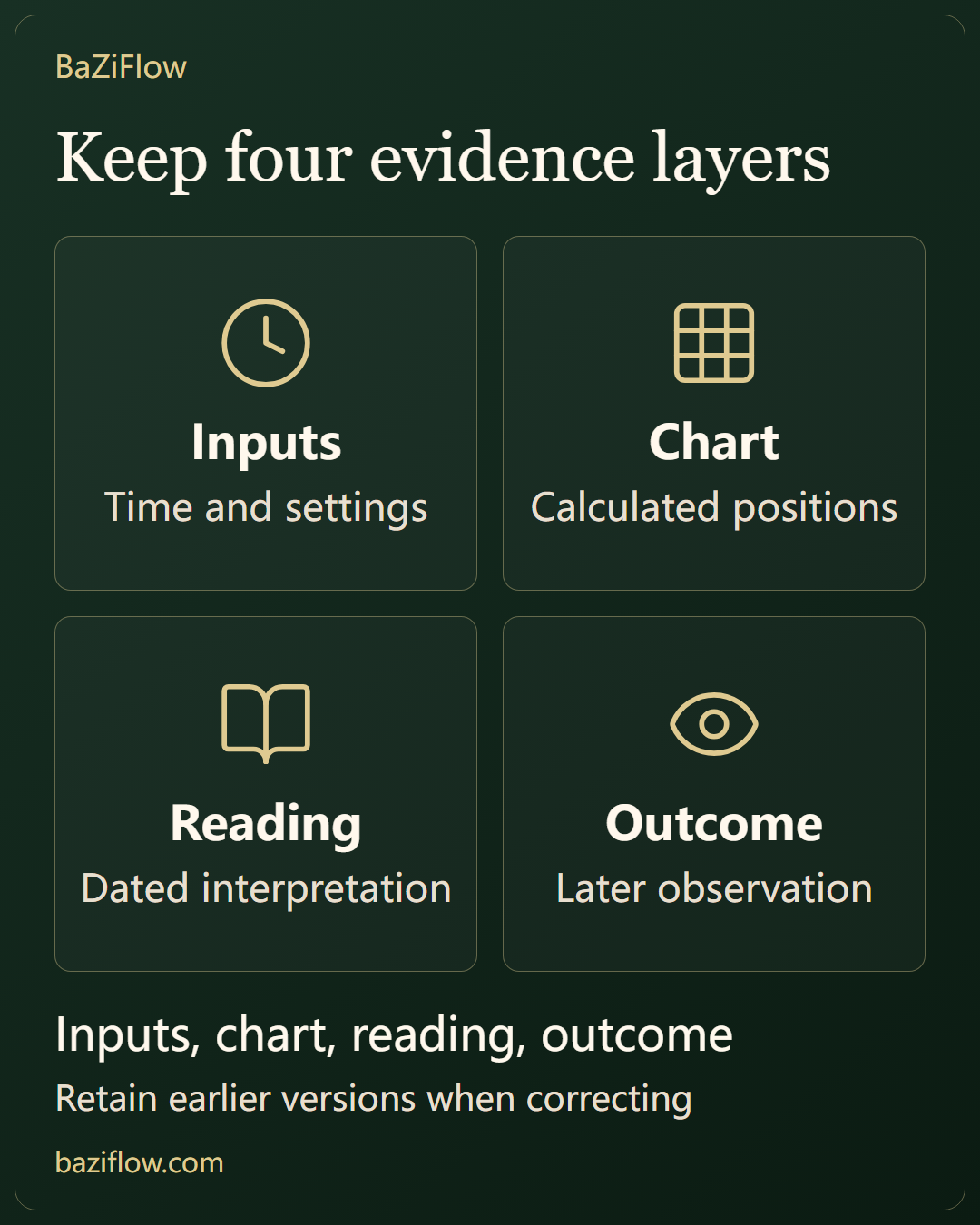
Preserve inputs, effective settings, chart excerpts and dated interpretations. A fictional late-night boundary comparison shows how to add a revision without rewriting the original evidence.
The short version6 min read
A recheckable case separates inputs and settings, calculated fields, dated interpretation and later observations. Another reader should be able to identify which evidence supported each sentence. In the 23:20 exercise, the day convention determines current versus following day, but missing birth details prevent any claim about calculated star changes.
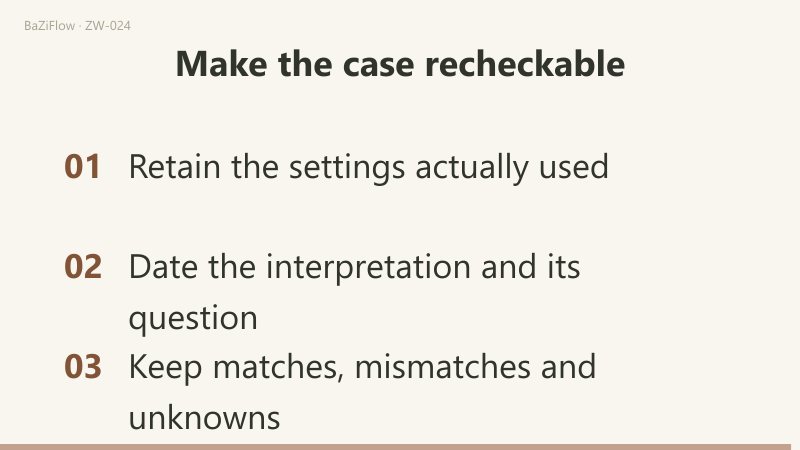
- Preserve supplied data, working assumptions and effective settings separately; a later correction creates a new version rather than an earlier fact.
- The same 23:20 maps to input day D or its following day under the two options; this rule result is not a calculated star arrangement.
- Chart fields, interpretations and observations each keep dates and sources, including mismatches and unknowns needed to reconstruct the comparison.
Read first
Why leap-month and midnight settings change a Zi Wei chart ↗
A correction should not erase how you got there
Imagine reopening a case after several months. The interpretation now sounds impressively close to what happened, but you cannot find its earlier wording. Was the topic narrowed after the event? Was a time window extended? Did a corrected birth detail change the chart? Without the earlier version, those questions are hard to answer.
Keep a dated original and add later observations separately. A correction can improve the record while remaining visible as a correction. This is a method for organizing study material, not an additional divination technique and not evidence that a prediction was reliable.
A useful case can be modest. It needs enough information to reproduce the relevant steps, not a dramatic life story. Unrelated private details add exposure without helping anyone check the calculation.
Recheckable record
- Inputs, rules, original wording
Story alone
- Only later confirmation
Keep the supplied data separate from the working value
State whether a date was supplied in a solar or lunar calendar and whether a leap month was specified. Record the time source and its uncertainty. Where the chosen method depends on location, time zone or a sex parameter, preserve what was actually entered. The point is to document dependencies, not to collect every available personal detail.
If a family recollection gives only a broad time range, an exact time chosen for a trial remains a trial value. It must not later be described as an exact recorded birth time. If better evidence arrives, create a dated revision and say which field it changes.
Use a case identifier for organization. Removing a name does not necessarily make a public example anonymous: a precise date, location and distinctive experience can identify someone together. Obtain the relevant person's permission before sharing a real case and publish only what is needed to understand the example. The R17 exercise contains no identifiable birth record.
Supplied evidence
- Approximate interval
Working assumption
- Selected trial time
A controlled comparison at 23:20
Take fictional case R17, for which the only stated clock time is 23:20. There is no complete birth date and no calculated personal chart. The cited iztro configuration documentation offers two conventions for the late Rat hour (晚子时): assign that period to the current day, or to the following day. This example uses those documented options to practice keeping a comparison record.
Save one trial as R17 with the current-day convention. Save a second as R17b with the following-day convention, keeping the other inputs and settings fixed. Retain both actual outputs when performing a real calculation. Do not overwrite R17 merely because the second convention is the one you later decide to study.
Nothing has been calculated in this article, so we cannot assert that a particular palace or star moves. A real comparison should list both changed and unchanged fields. Two different-looking screenshots alone do not explain which setting produced the difference. See leap months, hours and day boundaries for the surrounding choices.
The documented options also do not establish the current defaults of every product that uses the library. Record the settings actually in force for the case, including the tool or method version, rather than inferring them from a general help page.
Call the unspecified original date D. The rule comparison can state a definite intermediate result: R17 assigns 23:20 to D, while R17b assigns the same time to the day following D. That difference comes directly from the chosen day-boundary rule. Because D has no supplied calendar date, the record cannot continue by filling in a particular star’s new position.
“Following-day option selected” records a setting. “Late Rat belongs to the day after D under that option” records the rule result. “The Life palace therefore must move” would claim a calculation this exercise has not performed. Separating these sentences shows another reader exactly where the available evidence ends.
Current-day rule
Following-day rule
Preserve four different kinds of material
| Record | Retain | Do not replace with |
|---|---|---|
| Input / settings | Data, uncertainty, rules | A trial labeled confirmed |
| Chart | Field, owner, scope | An interpretation |
| Hypothesis | Date, question, method | A later rewrite |
| Observation | Date, source, result | Matches alone |
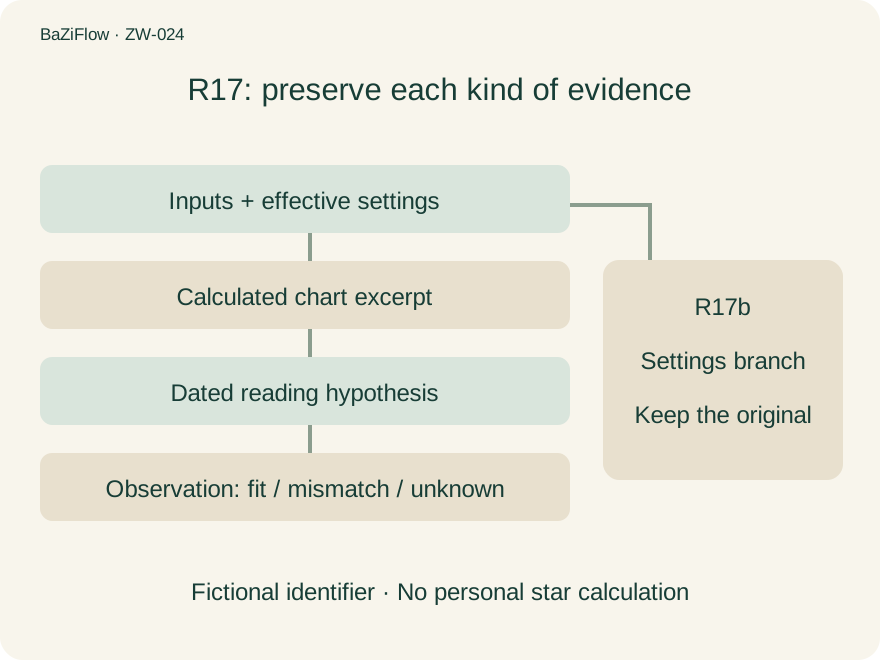
Original BaZiFlow record design. The fictional case has no complete birth date or calculated star results; the branch demonstrates version preservation only.
These can be sections of one private notebook. Their separation is conceptual: another reader should be able to tell what was supplied, what was calculated, what was inferred and what was learned later. A precise calculated field does not automatically validate the sentence interpreting it.
For a chart excerpt, retain the layer and palace location along with the star and any transformation source. A tightly cropped symbol can hide whether it belongs to the natal chart or a time layer. If colors matter, explain them in words; another interface may use a different palette.
Calculated field
- Layer, palace, star, source
Interpretive hypothesis
- Method, date, question
Give the reasoning a source and a date
For palace-stem work, “there is Lu” is an incomplete note. Retain the source palace, stem, table, affected star and destination. If the source is the birth year, label it accordingly. If several methods were consulted, name them separately instead of presenting the mixture as one universally shared rule.
Write down the question the interpretation was meant to address. A paragraph about a study schedule should not later be advertised as having predicted an unrelated relationship event. A changed question deserves a new entry. Comparing San He and Flying Star operations can help identify whether a disagreement lies in the calculation or the subsequent interpretation.
At review time, place the original wording beside the observations. Record a mismatch, a partial match or insufficient information plainly. Do not expand the time window or change the topic after seeing the outcome and then retain only “confirmed.” What makes the case useful is the visible path from evidence to claim, including the places where that path needed revision.
Match
- Keep the record
Mismatch
- Keep the record
Unknown
- Keep the record
Questions readers ask next
Which kinds of material should a recheckable case separate?
Keep inputs and effective settings, calculated chart fields, dated interpretations with their methods, and later observations distinct. They may share one notebook, but a later fact must not become an earlier claim, and an interpretation must not become a chart field.
What can the 23:20-only R17 exercise actually establish?
Under the cited options, the current-day convention retains input day D and the following-day convention assigns the late Rat hour to the next day. With no complete birth date or actual chart calculation, the example cannot identify a star or palace that changes.
Can an exact trial time be reported as a confirmed birth time?
No. If the source gives only an approximate interval, the exact time selected for a trial remains a working assumption. Record both separately. Better evidence can support a later revision while preserving the old input and interpretation.
Was this article helpful?