

Wuwang: thunder under heaven, one phrase and five words
Content version · · Sources & references
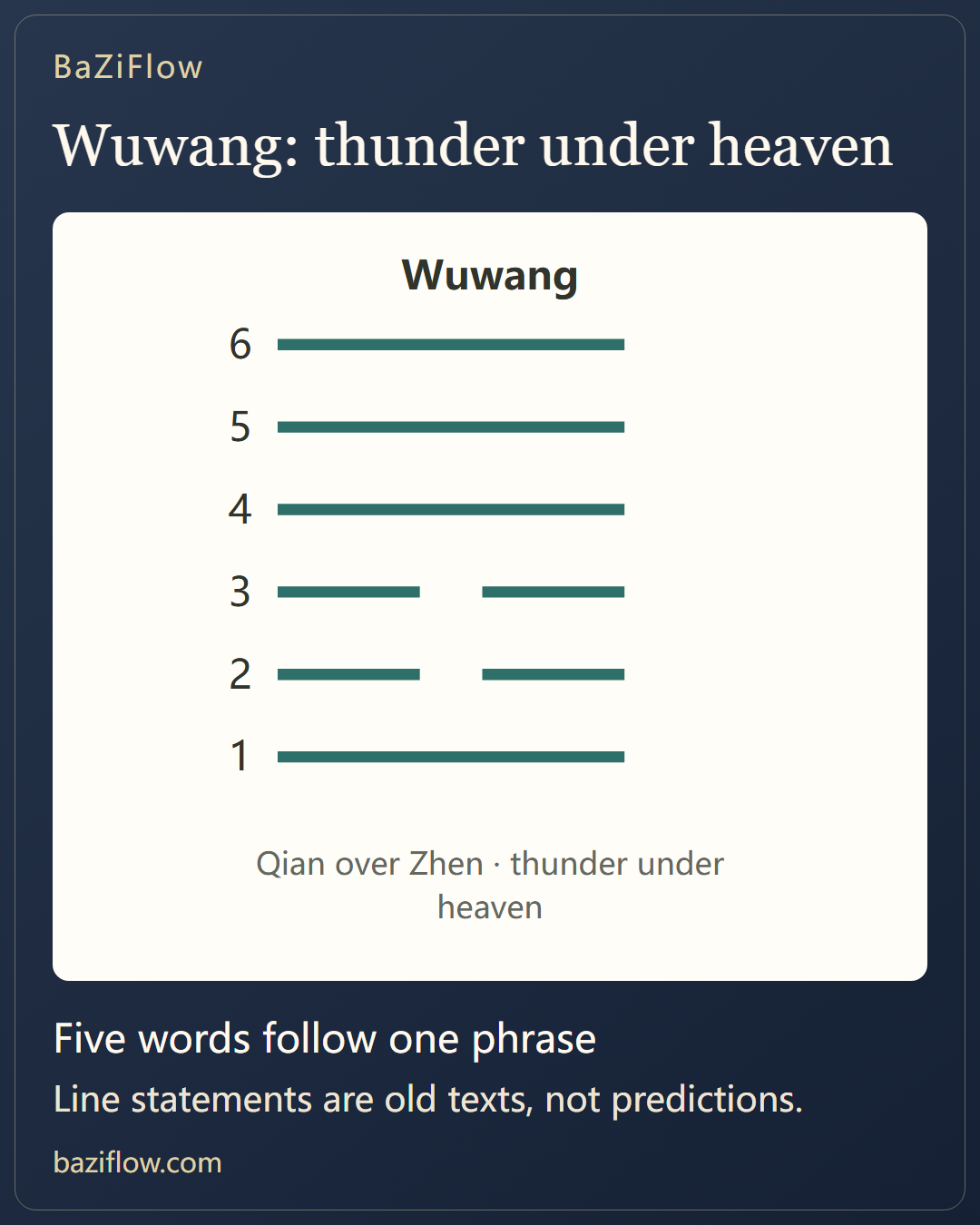
Wuwang (无妄) is the 25th hexagram: thunder under heaven. In the statements "wuwang" is followed by going, calamity and illness, the Small Images add medicine and action, and the Commentary ends on questions.
The short version8 min read
Wuwang literally means free of recklessness. The Xu Gua says that once one has returned there is no recklessness; the statements use "wuwang" as a modifier before going, calamity and illness, the Small Images add medicine and action, and the Commentary closes with two questions.
- Wuwang stacks Qian (heaven) on Zhen (thunder): line one is a yang line at the bottom, and of the five above it only lines two and three are yin. The Commentary on the Judgments says "it moves and is strong", the Great Image (大象) "thunder moves under heaven".
- The judgment is "yuan heng, li zhen" plus a condition: if not upright, calamity, and going on does not suit. The Commentary ends on two questions: where would going free of recklessness lead, and can one proceed without heaven's help?
- The words after "wuwang" are going, calamity and illness, and the Small Images add medicine and action. The ox tied in line three is generally taken as the source of the idiom "an undeserved calamity".
Read first
The Sixty-Four Hexagrams: How Upper and Lower Trigrams Form One Figure ↗
Judgment and Line Statements: Whole Hexagram or Single Line? ↗
Thunder under heaven: Qian above, Zhen below
Wuwang (无妄) is the 25th hexagram: Zhen (thunder) below, Qian (heaven) above. The yang lines are at the first, fourth, fifth and top places, and only the second and third are yin. The Shuo Gua says "Qian is strength" and "Zhen is moving", and the Commentary on the Judgments pairs the two words as "it moves and is strong".
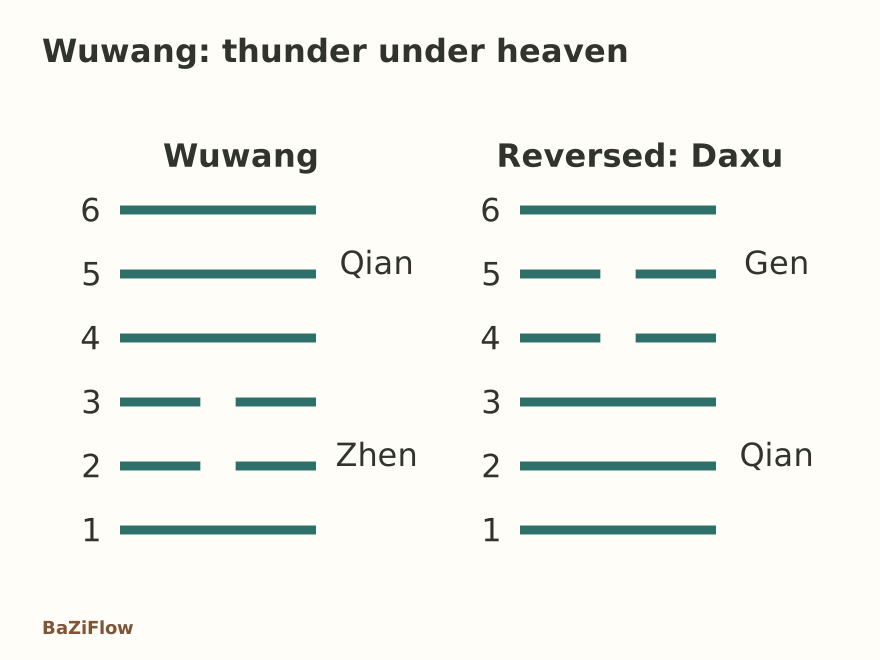
Wuwang beside its reversed hexagram Daxu: turn Wuwang over and you have Daxu.
Enlarge diagram · scroll sideways to read
Three terms before reading Wuwang
- Wuwang
- Literally, free of recklessness. Wang is the reckless, the false, the act that should not be done. The Xu Gua places it with a single phrase: "once one has returned, there is no recklessness".
- Calamity (眚)
- Calamity, and also fault. The "calamity" of the judgment and the "calamity in going" of the top line are the same word.
- Zi and she
- Traditionally, the first is a field in its first year after clearing and the second a field worked for three years. Both appear in line two.
The two characters of the name are not only a title. They come back inside the statements, in line one, line three, line five and the top line, and each time the word that follows is different. That is the thread for reading this hexagram.
The judgment and the Commentary: a condition in the judgment, two questions at the end
The judgment has three parts:
Yuan heng. Li zhen. If it is not upright there is calamity, and it is not fitting to go anywhere.
The first two, "yuan heng" and "li zhen", are the four words that Qian also has, divided here into two phrases. The last part adds a condition: if it is not upright, there is calamity, and going on is not fitting. The Commentary on the Judgments takes the judgment up like this:
Wuwang: the firm comes from outside and becomes the master within. It moves and is strong; the firm holds the center and is matched; very successful, and upright: such is heaven's decree. "If it is not upright there is calamity, and it is not fitting to go anywhere." Going free of recklessness: where would one go? When heaven's decree gives no help, can one proceed?
"The firm comes from outside and becomes the master within" is read off the figure: the only yang line of the lower trigram, the inner one, is line one, and that trigram is led by it. How it "comes from outside" is explained differently by the traditional theories of how one hexagram turns into another, and here the words are taken literally. "It moves and is strong" is Zhen below moving and Qian above strong. "The firm holds the center and is matched" is line five: a yang line occupying the heart of the upper trigram, with line two below corresponding to it. "Very successful, and upright: such is heaven's decree" sums up "yuan heng, li zhen".
The Commentary ends with two questions: "going free of recklessness: where would one go?", and "when heaven's decree gives no help, can one proceed?"
Enlarge diagram · scroll sideways to read
The Great Image: thunder moves under heaven, the kings respond to the season
The Great Image reads:
Under heaven thunder moves; all things share in Wuwang. The ancient kings accordingly responded to the season with abundance, and nurtured the ten thousand things.
"Under heaven thunder moves" is Zhen beneath Qian, thunder going about under the sky. The phrase translated "share in" is read in several ways; literally it puts the things of the world together with "wuwang", and a common reading is that each thing keeps to its own nature. What follows is the kings' conduct: "respond with abundance" means giving full effort, "to the season" means to what the time asks, and "nurtured the ten thousand things" means they fed and raised everything.
Enlarge diagram · scroll sideways to read
In the hexagram before, Fu, the thunder is still in the ground and the kings shut the passes. In this one the thunder is already moving under the sky, and the kings' act turns from closing to nurturing.
The six statements: what comes after "wuwang"
The word wuwang shows up four times in the six statements, and the Small Images attach it again in other places.
Enlarge diagram · scroll sideways to read
Line one, "wuwang, going brings good fortune", goes forward free of recklessness, with good fortune; the Small Image says "going free of recklessness: the aim is attained". Line two changes the subject: "not plowing yet harvesting, not clearing a new field yet having a ripe one: then it is fitting to have somewhere to go". The first word names a field in its first year after clearing and the second a field worked for three years. There are two ways to divide the sentence: one gives harvest without plowing and a ripe field without clearing, the other gives plowing without aiming at a harvest and clearing without aiming at a ripe field. The Small Image says only "not yet rich".
Line three, "a wuwang calamity: perhaps an ox is tied; the passer-by gains it, the townsman bears the calamity": someone has tied up an ox, a traveler leads it off, and the townspeople suffer for it. The Small Image restates it as "the traveler gets the ox, and it is the townsman's calamity". Line four, "can stay on course: no blame", has the Small Image "it has this from the start". Line five, "a wuwang illness: no medicine, and there is joy": an illness that came with no recklessness, which gives joy without medicine; the Small Image changes "illness" to "medicine": "a wuwang medicine must not be tried". The top line says "wuwang, yet going brings calamity; nothing is favorable", and its Small Image "wuwang action: the calamity of having reached the end".
Neighbors of Wuwang: Daxu, Sheng, Jian, and "no recklessness" in the Xu Gua
Turn Wuwang over and you have Daxu (大畜). Flip each line to its opposite and Sheng (升) results. The nuclear hexagram is Jian (漸), obtained by regrouping lines two to four and three to five; its derivation is in the structure of a hexagram.
Enlarge diagram · scroll sideways to read
The Xu Gua joins Wuwang to the hexagram before it in one short phrase:
once returned, there is no recklessness
Once the return has happened, recklessness is gone. For the next hexagram, Daxu, the Xu Gua says that only with this absence of recklessness can anything be stored up.
Questions readers ask next
Does wuwang mean "without recklessness" or "do not be reckless"?
Literally it is "free of recklessness", a state and not a command. The Xu Gua links it to the previous hexagram with "once one has returned, there is no recklessness". When quoting, keep the literal sense and do not turn it into "do not ...".
How is the idiom "an undeserved calamity" related to line three?
Line three gives a scene: someone has tied up an ox, a passer-by leads it away, and the people of the town bear the calamity. The idiom for a misfortune with no cause is generally traced to it, but the statement itself describes only that one scene and does not turn it into a rule.
How should line two's "not plowing, harvesting; not clearing, ripe field" be divided?
Two readings exist: joined, as "harvesting without having plowed, a ripe field without having cleared one", or split, as plowing without aiming at a harvest and clearing without aiming at a ripe field. The text is only those words, and the Small Image (小象) says just "not yet rich", without saying which reading it takes.
Was this article helpful?
Sources & references
Continue reading
Fu: thunder within the earth, from "a return not far" to "a lost return" ↗
Daxu: heaven inside a mountain, and the two meanings of one word, xu ↗
The Sixty-Four Hexagrams: How Upper and Lower Trigrams Form One Figure ↗
Judgment and Line Statements: Whole Hexagram or Single Line? ↗