

Great Post Road Earth: Yang Earth Monkey and Yin Earth Rooster
Content version · · Sources & references
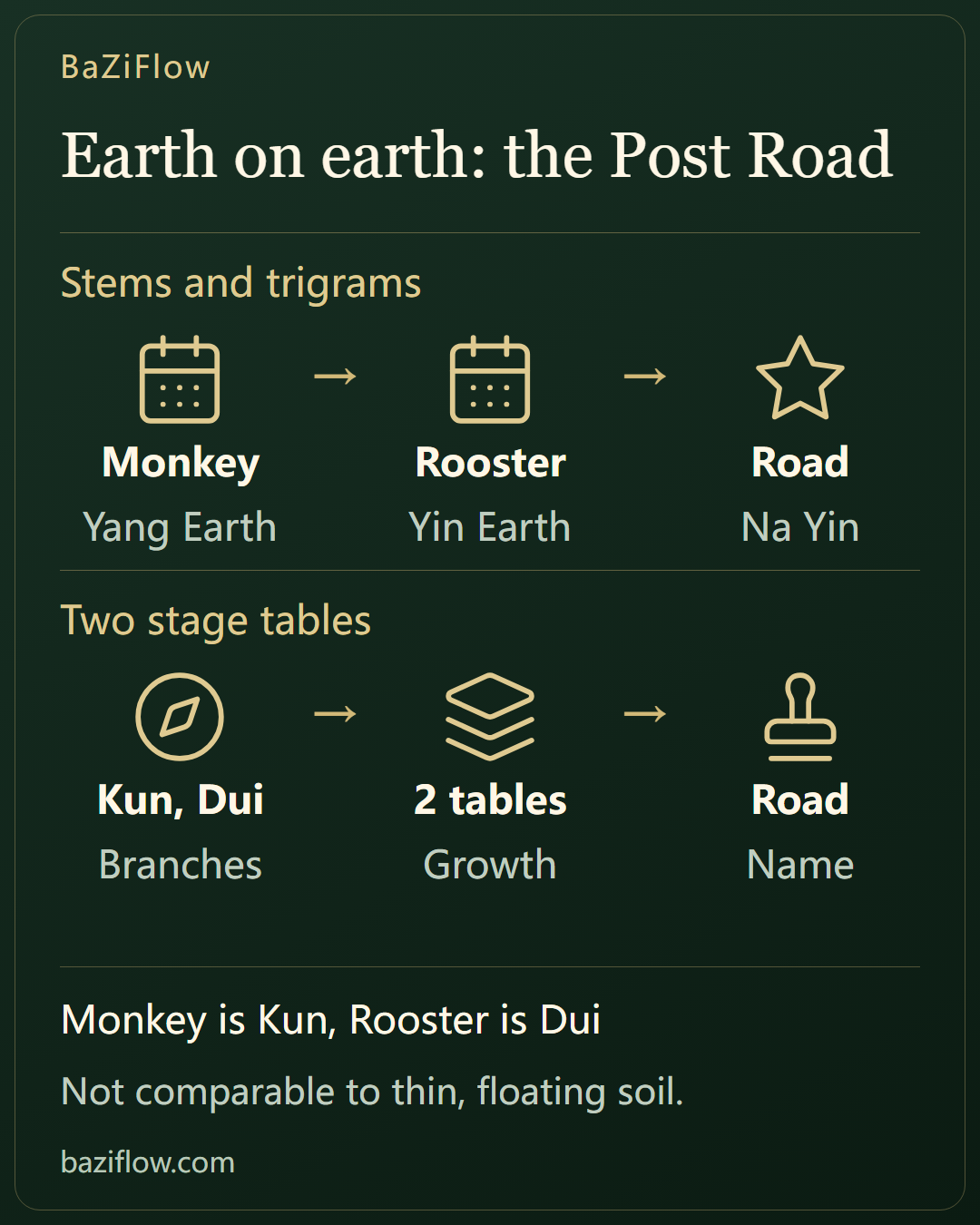
Yang Earth Monkey and Yin Earth Rooster share the twenty-third Na Yin name. The Sanming Tonghui reads Monkey as Kun and Rooster as Dui, then calls Yang Earth Monkey “earth at Growth”; two stage tables, pairings, years.
The short version10 min read
There is no metal in the name, yet each pillar is earth sitting on metal. Earth of the Great Post Road, the Na Yin of Yang Earth Monkey and Yin Earth Rooster, takes the Monkey as Kun, the ground, and the Rooster as Dui, the marsh, with the two Earth stems laid on top: a level highway to all nine provinces.
- Both stems are Earth and both branches are Metal, so Earth sits above Metal; the “road” is not any one character in the pillar but the picture the name borrows.
- The entry calls Yang Earth Monkey “earth at Growth” and Yin Earth Rooster “self-defeated”, on juan 1’s water-and-earth count for Na Yin earth; this site’s stem table follows juan 2, with Growth at the Tiger for Yang Earth and at the Rooster for Yin Earth.
- Four of the six pairings picked here carry a Punishment, Harm or Clash in the branch table, yet the book still rates them “also good”, “favorable in reverse”, “noble” or “fine alone”; it seems to rate Na Yin pairings.
Read first
What is Na Yin in BaZi? Why Yang Wood Rat Gold in the Sea does not replace Yang Wood ↗
Monkey and Rooster: the crossroads where things settle
The twenty-third Na Yin name, Earth of the Great Post Road (大驿土), is shared by Yang Earth Monkey (戊申) and Yin Earth Rooster (己酉). The stems, Yang Earth and Yin Earth, are both Earth, the branches Monkey and Rooster are Metal, so Earth sits above Metal. Yet the name has no metal in it; it describes a road.
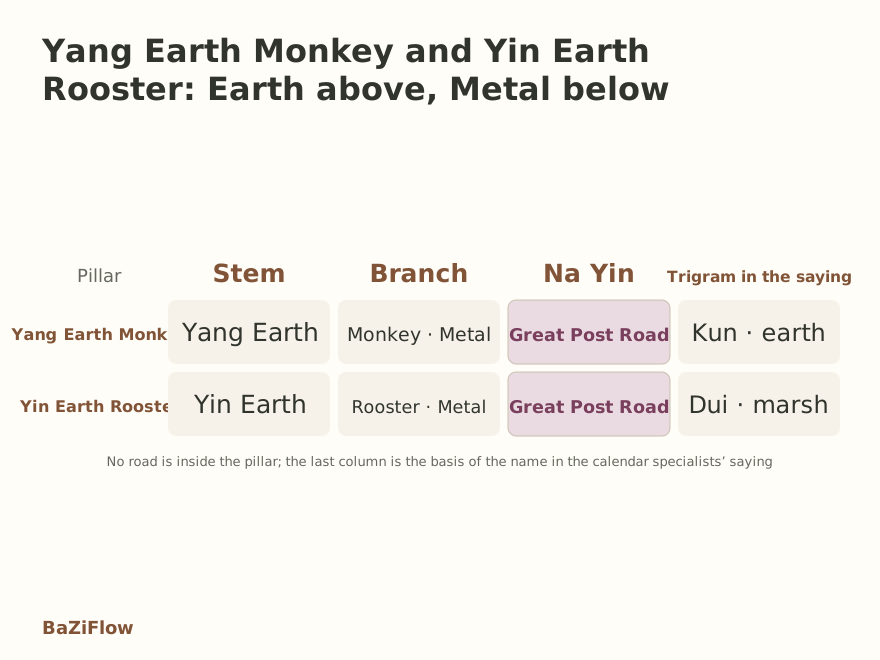
Comparison sketch: stem and branch attributes use the usual entry-level assignments, the Na Yin name follows the Sanming Tonghui, and the last column gives the trigrams used in the calendar specialists’ saying.
The last column of the picture holds the trigrams the calendar specialists (日家) used for the name. They pair the Monkey with Kun (坤), the ground, and the Rooster with Dui (兑), the marsh. Inside the Monkey sit Yang Metal, Yang Water and Yang Earth, inside the Rooster only Yin Metal, and that is where the branches take their Metal; Earth produces Metal, so the stem Earth feeds the branch Metal below it.
The first volume of the Sanming Tonghui (三命通会) sorts the twelve branches in pairs. Of the Monkey and the Rooster it says that yin and yang are in their withering phase, things are already harvested, and people have drawn in, each settled in stillness. For this pair of pillars it then writes:
Yang Earth Monkey and Yin Earth Rooster: the qi has gone home to rest, things are gathered in, drawn back and retired, beautiful and with nothing to do. So it is called Earth of the Great Post Road.
“Rest” and “gathered in” are the quiet after a harvest, and “nothing to do” means this earth has nothing left to hurry for. Yet the name is a post station, a big stop on a road, and the next passage puts that quiet onto the road.
Kun and Dui: setting earth on the ground and a marsh
A post station was a relay stop on an imperial road. The entry opens with a picture, then says where this earth lies and what it is like:
The great post road: a broad highway and a level road, with no province of the nine unreached and no state of the ten thousand not arrived at. Its place is on the side of Kun, and its virtue is to bear.
Kun is the earth among the trigrams: “on the side of Kun” puts it in that direction, and “its virtue is to bear” gives its character as carrying.
The second reason comes from the calendar specialists and switches to trigrams. The Monkey is Kun’s, and Kun is the ground; the Rooster is Dui’s, and Dui is the marsh. Yang Earth and Yin Earth are set on top of the two, so the book says it is “not comparable to any other thin, floating soil”. The Xieji Bianfang Shu (协纪辨方书), juan 1, carries the same saying.
Both accounts end on sturdy earth carried by ground and marsh. Later in the same section, appraising six kinds of earth, the book adds that the post road’s earth reaches every direction and that the Monkey and Rooster fit “finding friends, to profit and flourish”, a line to read beside the Kun hexagram’s “in the southwest, gain friends”.
Enlarge diagram · scroll sideways to read
“Earth at Growth”: a phrase in the book and a position in the table
After the name, the entry turns to what this earth should be paired with, and its first sentence already uses words from the twelve-stage table:
It brings forth the ten thousand things, with wood as its base. Yang Earth Monkey is earth at Growth, its virtue thick and without limit, and it is nourished by three or four woods; Yin Earth Rooster is self-defeated earth, and too much wood draws off its qi.
In older books Bath is also called “defeat”, so this sentence starts Earth’s Growth at the Monkey, with Bath on the Rooster. That is the water-and-earth count juan 1 uses for Na Yin earth; its pillar-by-pillar commentary likewise says Yang Earth Monkey “grows by itself”. This site’s table answers another question: it looks up a Day Master by stem and follows juan 2, where fire and earth go together, so Yang Earth begins Growth at the Tiger and Yin Earth at the Rooster. There Yang Earth on the Monkey is Weakening, while Yin Earth on the Rooster is Growth. Below, “Growth” and “self-defeated” in the entry and the commentary are read on the water-and-earth count.
Enlarge diagram · scroll sideways to read
Juan 2 takes up the difference in its section on the birth and death of the stems. It holds that Yang Earth is born at the Tiger and Yin Earth at the Rooster and calls the Monkey count “badly mistaken”; then it records the yin-yang school’s view that water and earth are born together at the Monkey, grants that this “also has its reason”, and calls earth “one thing with two births”. When a passage says “earth at Growth”, first ask which table it counts on. The full ring of twelve stages is drawn in the stage table and void branches.
Water and metal: six pairings against the table
After the stage words, the entry goes through wood, water, fire, earth and metal, naming what is welcome and what is not. Water and metal are named down to the pillar, so six of those pairings are picked out below and checked against the engine’s tables:
Enlarge diagram · scroll sideways to read
Row by row: Yang Earth and Yin Water combine as stems, so both Yin Water Snake and Yin Water Pig have that tie with Yang Earth Monkey. The Pig against the Monkey, in Yin Water Pig and Yin Metal Pig alike, is a Harm and the Tiger against the Monkey a Clash, yet the book downgrades neither and even writes the Yin Water Pig line as “favorable in reverse”. The entry seems to rate the pattern of the Na Yin pairing, not branch relations pillar by pillar.
4 February 1969: two year pillars either side of spring
1968 is a Yang Earth Monkey year and 1969 a Yin Earth Rooster year, as are 2028–2029 and 1908–1909. The pillar turns at the Start of Spring (立春), not on 1 January: 02:07 on 5 February 1968, 07:58 on 4 February 1969 and 13:45 on 4 February 1970 (Beijing time). On 4 February 1969, people born before and after 07:58 carry different year pillars.
Enlarge diagram · scroll sideways to read
Two exercises
Born at 6 a.m. on 4 February 1969: what is the year pillar?
6 a.m. comes ahead of the 07:58 Start of Spring, which leaves the year at Yang Earth Monkey; at 10 a.m. it is Yin Earth Rooster. Both carry Earth of the Great Post Road.
The day pillar is Yin Earth Rooster and the month pillar is Yin Wood Rabbit: what does the entry say of that pairing?
The entry only says that Yin Wood Rabbit of the great stream, “east, thunder, birth”, is fine alone; it does not mention Yin Earth Rooster. In the table the Rabbit and the Rooster clash, a layer that needs its own source and cannot be settled by “fine alone”.
Just before it in the sixty-cycle comes Water of the Heavenly River, just after it Hairpin and Bracelet Metal, and the book sets it against Earth on the City Wall half a circle away. How Na Yin divides the work with the plain elements is laid out in Na Yin versus the regular five elements.
Questions readers ask next
The book calls Yang Earth Monkey “earth at Growth”, but this site’s table puts Yang Earth on the Monkey at Weakening. Why?
The two tables answer different questions. The entry’s “earth at Growth” uses juan 1’s count for Na Yin earth, with water and earth together and Growth at the Monkey. This site’s table looks up a Day Master by stem and follows juan 2, where fire and earth go together: Yang Earth begins at the Tiger and Yin Earth at the Rooster, so Yang Earth on the Monkey is Weakening. Juan 2 discusses both, prefers fire with earth, and grants that earth with water “also has its reason”. Both are shown side by side and neither is rewritten into the other.
Someone born at 6 a.m. on 4 February 1969: is the year pillar Yang Earth Monkey or Yin Earth Rooster?
Yang Earth Monkey. The Start of Spring in 1969 fell at 07:58 Beijing time on 4 February, and 6 a.m. is before it, so the year pillar still belongs to the previous year. Someone born at 10 a.m. has Yin Earth Rooster. Both pillars carry the same Na Yin.
Why are the City Wall and the Great Post Road so often read as a pair?
Both have Earth stems, Yang Earth and Yin Earth, but their branches sit half a circle apart: the Tiger and Rabbit for the wall, which takes the image of Gen, a mountain, and the Monkey and Rooster for the road, which takes Kun and Dui. On the Images of Na Yin sets the two side by side with the words “east, south, west, north: the proper places of Kun and Gen”; Gen lies northeast and Kun southwest.
Was this article helpful?
Sources & references
Continue reading
Water of the Heavenly River (天河水): Why Yang Fire Horse and Yin Fire Goat Carry This Name ↗
Hairpin and Bracelet Metal (钗钏金): Yang Metal Dog, Yin Metal Pig, Last of Six Metals ↗
Five Elements cycles: learn the relationships, not just the order ↗