

Nurture: the cell before Growth, taking shape
Content version · · Sources & references
Nurture is the twelfth cell of the twelve life stages, between Conception and Growth. Where the ten Day Masters land, four shared storehouses, three passages on Conception and Nurture, and the book's luck-by-age scheme.
The short version8 min read
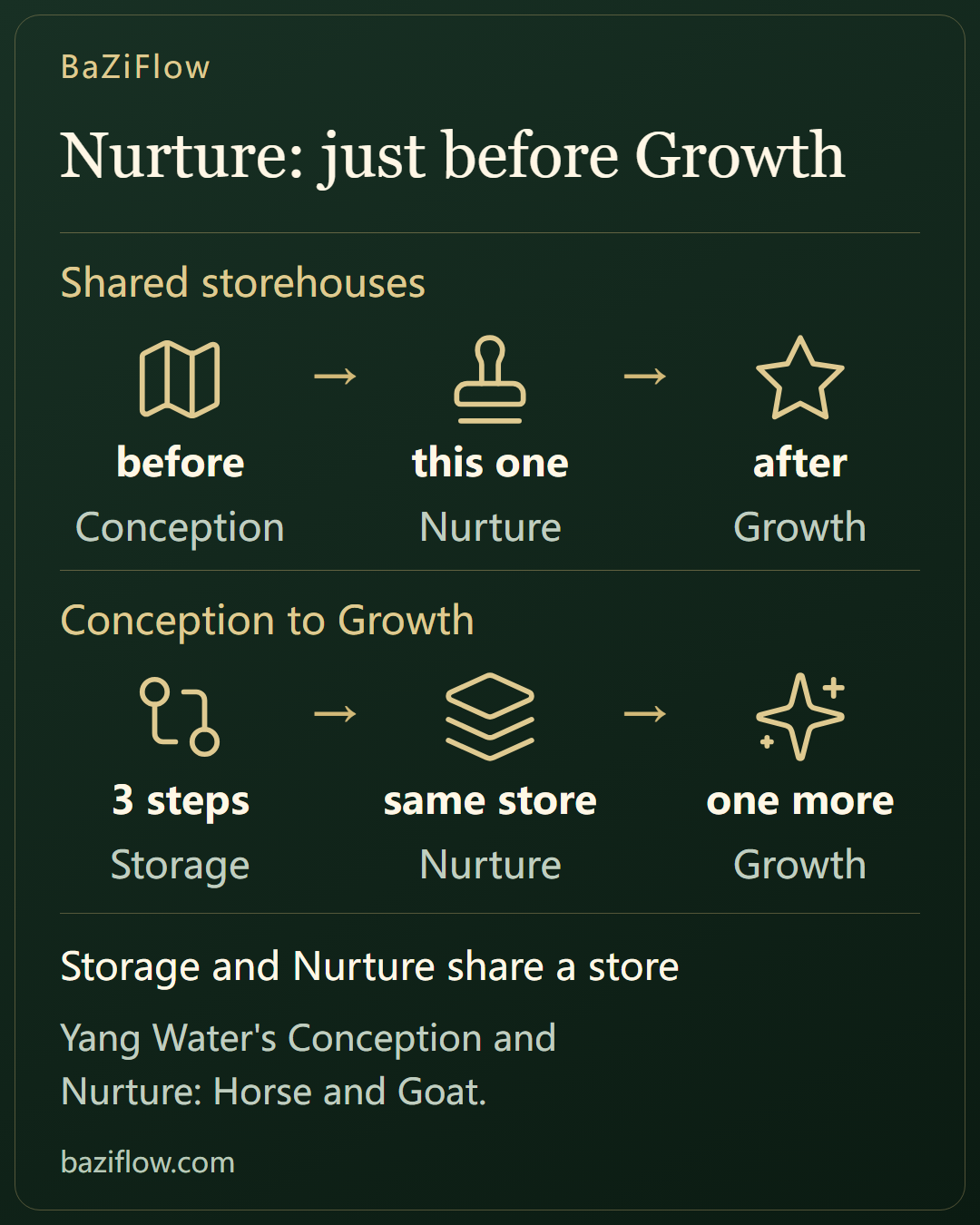
Nurture is the twelfth cell of the twelve life stages, between Conception and Growth: all ten Day Masters land on the four storehouses Dragon, Goat, Dog and Ox, and the Sanming Tiyao calls it "taking shape", the picture of things taking form in the earth as a person takes form in the womb.
- All ten Day Masters reach Nurture on a storehouse branch (Dragon, Goat, Dog or Ox), one step after Conception and one before Growth.
- One storehouse is Storage for some Day Masters and Nurture for others: Dragon is the Storage of Yin Metal and Yang Water and the Nurture of Yang Metal and Yin Water. From Storage to Nurture takes three steps, past Severance and Conception.
- The Sanming Tonghui says Yang Water takes "Goat and Horse as the place of conception and nurture" and the Yuanhai Ziping has "Goat and Horse", both matching the site table: Horse for Conception and Goat for Nurture.
Read first
Twelve Life Stages and Void Branches: Two Tables, Two References ↗
Strong and weak Day Masters: references, relationship directions and evidence ↗
Taking shape: the last cell before birth
Nurture is the twelfth and last cell before the ring starts again. Conception precedes it and Growth follows it. The third entry of the Sanming Tiyao (三命提要) gives it the name "taking shape":
Taking shape: things take shape in the earth, as a person takes shape in the mother's womb.
Read together, the three cells form a string: Severance is empty, Conception is qi appearing in the earth, and Nurture is a form appearing inside the qi. All three are still "in the earth" and unborn; the next entry is Growth, which the book describes as things sprouting and flourishing, "as a person begins to live and grows". The site calls this cell Nurture and the book calls it taking shape, and both mean the same position.
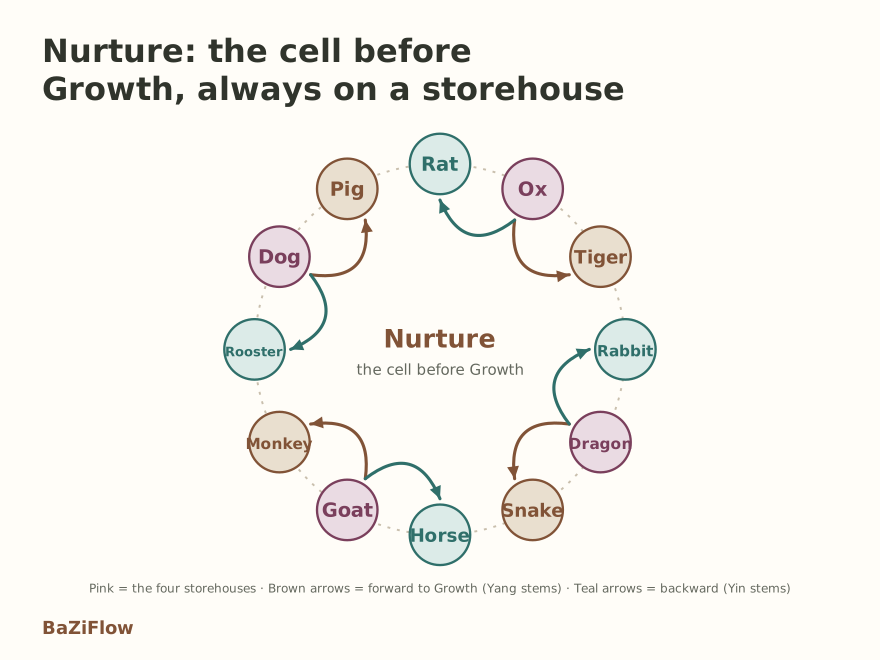
Landing sketch: positions come from the twelve-stage table of the site engine; Yang Fire and Yang Earth share the Ox, Yin Fire and Yin Earth share the Dog; the two arrows from each storehouse are the roads of the Yang and Yin stems to Growth.
Enlarge diagram · scroll sideways to read
Only four landing spots: one storehouse, two roles
The ten Day Masters land on just four branches, and these are Dragon, Goat, Dog and Ox, the four storehouses where Storage sits. The reason is mechanical. From Storage to Nurture takes three steps, past Severance and Conception, and each of the four storehouses is exactly three steps from the next, so three steps from a storehouse lead to another storehouse. One storehouse therefore plays two roles.
Enlarge diagram · scroll sideways to read
Take Dragon: Yang Metal reaches Dragon at Nurture, while Yin Metal reaches Dragon at Storage. The same branch asks first which Day Master is meant and only then which cell.
Of the sixty day pillars, four sit on the Nurture branch of their own stem: Jia Xu (甲戌), Yi Wei (乙未), Geng Chen (庚辰) and Xin Chou (辛丑). Yang Fire with the Ox, Yin Fire with the Dog, Yang Earth with the Ox, Yin Earth with the Dog, Yang Water with the Goat and Yin Water with the Dragon would join a Yang stem to a Yin branch or the reverse, which the sixty-cycle never does. Pillars other than the day can carry these branches too, and the judgment is always the Day Master set against that branch.
Conception and Nurture read together: three passages
The books often name the two cells together. In juan 2 the Sanming Tonghui says this about Yang Water going south:
Yang Water loves to go south: Horse and Goat are the place of conception and nurture, a land where wealth and emolument are warm and gentle.
The poem on Yang Water in the Yuanhai Ziping (渊海子平) is more compact:
To nurture and to conceive, it takes Goat and Horse; Growth and Emolument belong to Qian and Kun.
Against the site table: Yang Water runs forward, Horse is Conception, Goat is Nurture and Monkey is Growth, which is "Goat and Horse" plus Growth. Qian and Kun are the northwest and southwest trigram positions: the Emolument of Yang Water is on Pig, which faces Qian, and its Growth is on Monkey, which faces Kun. The third passage is in juan 1 of the Sanming Tonghui, in the paragraph on the Na Yin fire of Ji Chou (己丑), Thunderbolt Fire, where it quotes the Zhushen jing (烛神经):
The fire of the Ox, fire at Conception and Nurture, has a qi that grows stronger by degrees.
Fire is born at Tiger, and counting back from there Ox is Nurture and Rat is Conception (Wu Zi, the other Thunderbolt Fire pillar, sits on the Rat), which fits the "Conception and Nurture" of that sentence. The three passages speak of different things, the first two of Yang Water and the third of a Na Yin fire, yet each lands on a position that matches the twelve-stage table.
Enlarge diagram · scroll sideways to read
At what age the book places Conception and Nurture
Juan 2 of the Sanming Tonghui has another passage that sets the stages against ages of life:
A person goes from small to full strength between birth and old age. At ten one is just a youth, and luck should run only through the cells of Conception, Nurture, Growth, Bath and Coming of Age. At thirty or forty, with strong yang and sound teeth, luck may run through the peak cells.
The passage goes on to pair fifty and sixty with Decline, Ruin, Death and Severance. The "running" here means the luck pillar moving through a cell, which is a different question from the cell where the Day Master stands in the chart; the book's three age bands are one framework for reading luck.
Enlarge diagram · scroll sideways to read
Before looking anything up, sort out three things
Ask which storehouse
When Dragon, Goat, Dog or Ox appears, ask which Day Master is meant first: one branch can be Nurture for this Day Master and Storage for that one.
Then ask: in the chart, or in the luck
The place of the Day Master on the year, month, day and hour branches is one question, and the cells that luck pillars and years run through are another. The age bands of the book belong to the second.
Read Yang and Yin Water apart
The book's "Goat and Horse" belongs to Yang Water; Yin Water runs backward, with Conception on Snake and Nurture on Dragon, so the line cannot simply be carried over to it.
Look it up in the table
The Day Master is Yang Metal. Where is Nurture?
Yang Metal runs forward: Storage is on Ox, followed by Severance (Tiger), Conception (Rabbit) and Nurture (Dragon), so the answer is Dragon.
On the Goat, which Day Masters are at Nurture and which at Storage?
Yin Wood and Yang Water are at Nurture on the Goat; Yang Wood and Yin Water are at Storage there.
After Nurture comes Growth, and the ring of twelve cells joins up again.
Questions readers ask next
Does Nurture mean raising or adopting a child?
Not in the twelve stages. Nurture is the twelfth cell of the table. The Sanming Tiyao names it "taking shape", the picture of things slowly taking form in the earth as a child takes form in the womb. It comes after Conception and before Growth, so it describes a stage before birth.
Why does Nurture always land on Dragon, Goat, Dog or Ox?
Nurture is three steps after Storage: after Storage come Severance, Conception, then Nurture. Each of the four storehouses Dragon, Goat, Dog and Ox is three steps from the next, so counting three steps from one storehouse lands on another.
The book says luck around age ten should run through Conception and Nurture. Does every child's luck pillar reach Nurture?
That is the ideal order the book lays out by age: youth should pass through Conception, Nurture, Growth, Bath and Coming of Age, and the thirties and forties through the peak cells; a life that runs the other way the book calls "luck against the grain for a lifetime". Which cell a real luck pillar reaches is still looked up from the Day Master against the luck branch.
Was this article helpful?
Sources & references
Continue reading
Conception (胎): One Step After Severance, and the Stage Versus the Conception Origin ↗
What is Na Yin in BaZi? Why Jia-Zi Gold in the Sea does not replace Yang Wood ↗