

27 or 28 lunar mansions: what is the difference?
Content version · · Sources & references
Separate sky positions, month-table assignments and continuous calendar annotations. Compare the name lists, a 28-day counter and the missing anchor needed for a real date.
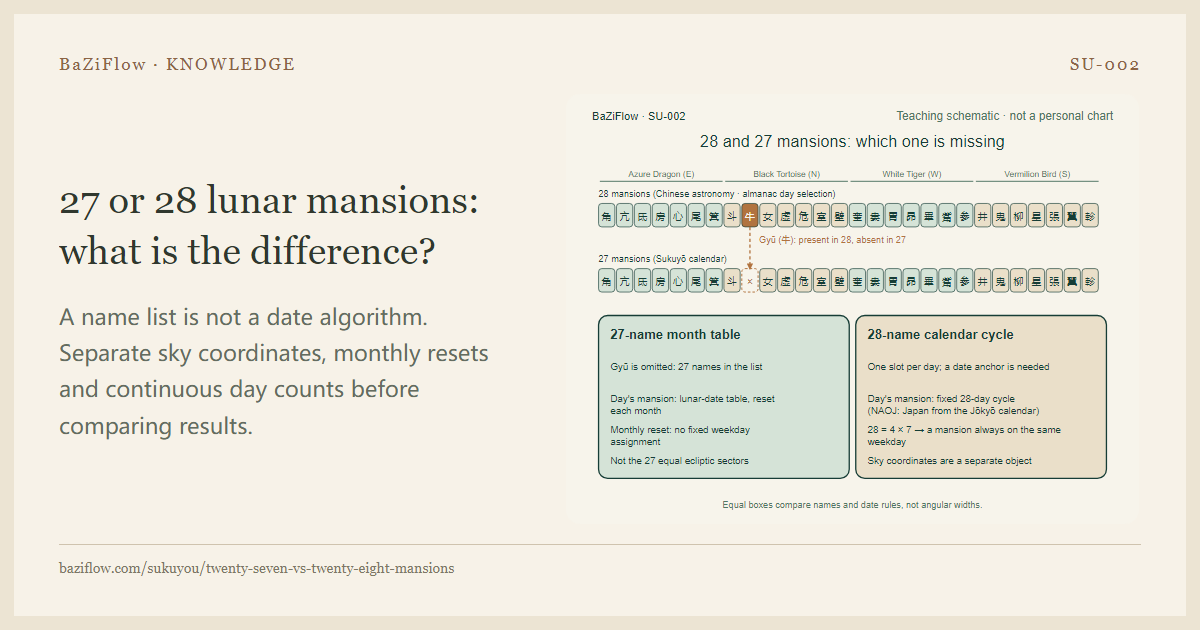
A name list is not a date algorithm. Separate sky coordinates, monthly resets and continuous day counts before comparing results.
Read first
Three columns belong in your comparison sheet
A spreadsheet headed only “27” and “28” can conceal what is being compared. Add a field called object before entering a mansion name. Is the source reporting a position in the sky, assigning a label to a calendar day, or deriving a birth label under a particular method? A number of names does not answer that question.
The National Astronomical Observatory of Japan describes astronomical Chinese mansions, a 27-name month-table assignment, and continuous 28-name calendar annotations. This article compares those named descriptions. It does not assume that every Chinese almanac or Japanese temple calendar implements one universal rule. The introduction to Sukuyō and birth mansions defines the birth-label question separately.
Test a counter with no birthday attached
Imagine a teaching counter that advances one slot per day through 28 slots. Choose an unspecified day zero and call its slot X. Days 28 and 56 return to X. Because 28 is four times seven, the returns also share a weekday in an uninterrupted seven-day week. No Moon position has been measured to establish this result.
Now shift the counter's starting point by one day. The cycle still has 28 slots and the same return interval, but its labels on actual dates change. “Repeats every 28 days” is therefore an incomplete specification. A real lookup also needs an anchor associating a date with a slot. We supply no historical anchor here and do not claim which named mansions belong to Sunday.
This counter illustrates the continuous daily assignment described for Japanese calendar annotations from the Jōkyō calendar onwards. It should not be read as the definition of astronomical Chinese mansions. A calendar annotation and a celestial coordinate can reuse a name while remaining different objects.
A month table breaks the continuous-counter assumption
In the 27-mansion assignment described by NAOJ, the lunar-calendar month selects the first day's name. Subsequent days advance through the list without Gyū (牛). The listed third month starts at I (胃): day two proceeds to Bō (昴), and day three to Hitsu (畢). This is a lookup exercise using that table, not a conversion of a Gregorian birth date or a rule for an intercalary month.
At the next month's beginning, return to the month-start table. A program that simply loops through 27 names forever has not thereby reproduced this procedure. To compare it with another result, record the calendar used for the date, its treatment of month boundaries and intercalation, and the stated version. A discrepancy may concern a method, an input, an implementation or a printed error; the labels alone do not settle which.
Locate the omitted name
The following rows align both sequences at Kaku (角). Chinese tradition groups the 28 names into four sets of seven. The shorter list omits Gyū between To (斗) and Jo (女). Several Japanese readings repeat, so retain the characters when comparing entries.
| Quarter | 28 mansions (Chinese astronomy) | 27 mansions (Sukuyō) |
|---|---|---|
| Azure Dragon of the East | Kaku (角), Kō (亢), Tei (氐), Bō (房), Shin (心), Bi (尾), Ki (箕) | the same seven |
| Black Tortoise of the North | To (斗), Gyū (牛), Jo (女), Kyo (虚), Ki (危), Shitsu (室), Heki (壁) | To, Jo, Kyo, Ki, Shitsu, Heki, with no Gyū |
| White Tiger of the West | Kei (奎), Rō (婁), I (胃), Bō (昴), Hitsu (畢), Shi (觜), Shin (参) | the same seven |
| Vermilion Bird of the South | Sei (井), Ki (鬼), Ryū (柳), Sei (星), Chō (張), Yoku (翼), Shin (軫) | the same seven |
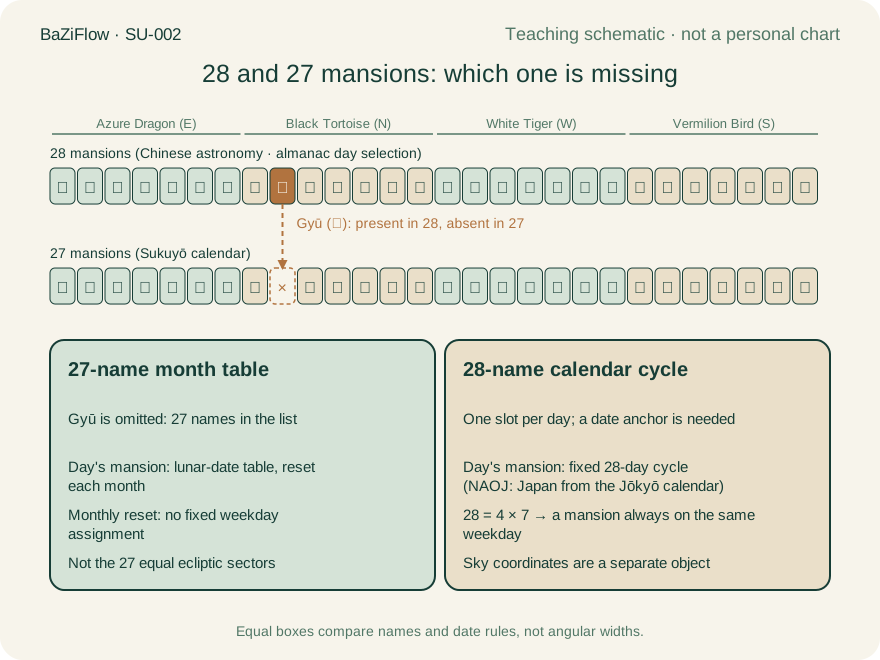
Original BaZiFlow diagram of names and specified calendar rules; equal boxes do not represent sky angles or a personal chart.
The equal-sized boxes are a layout device, not a map of angular widths. Starting the written sequence at a different name does not necessarily change its cyclic order. Align a common starting point first; then distinguish a rotation of the list from an omitted or added entry. Conversely, identical lists do not establish identical date algorithms.
Degrees require another reference frame
Astronomical Chinese mansions have unequal intervals and use an equatorial reference. The 27 equal divisions described for Nakṣatra use the ecliptic: 360 degrees divided by 27 gives 13 degrees 20 minutes. That equal width cannot be transferred to the Chinese astronomical scheme or interpreted as the Moon's measured travel for each step in a month-table assignment.
The Moon's average return relative to the stars is about 27.3 days. Rounding that average is not evidence establishing the history of either system. NAOJ discusses unresolved origin and transmission questions and cautions that translated names need not identify the same asterisms. Separate a documented rule from an explanation of how it may have originated.
For a useful comparison, keep names, day counts and angles in different fields. A Gyū-labelled date in one calendar does not disappear in the other: another method may assign a different name to that same date. Once the object and the rules are clear, checking a calendar's source becomes a reproducible task. Differences within birth-mansion methods are a further question; matching names alone does not validate the accompanying interpretation.
Part of a learning path
Sukuyō: from the birth mansion to relationship limits · Step 2 of 2 available