

Willow Wood: the Na Yin of Yang Water Horse and Yin Water Goat
Content version · · Sources & references
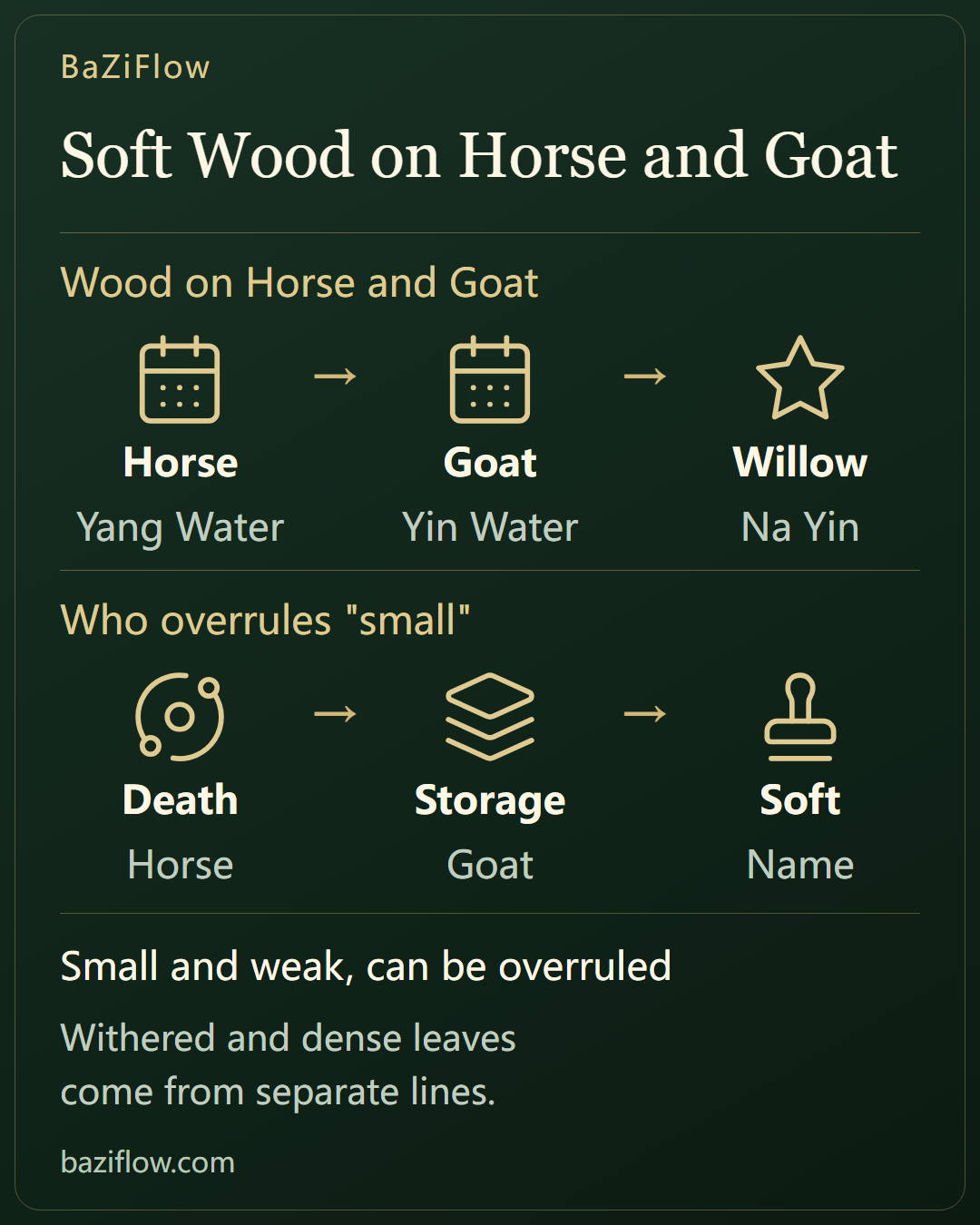
Yang Water Horse and Yin Water Goat share Willow Wood: Wood at Death and Storage, two opposite leaves in one book, the rule letting another pillar overrule "small and weak", and four Willow-trailing-gold pillars checked.
The short version10 min read
Willow Wood is the tenth Na Yin name, shared by Yang Water Horse and Yin Water Goat. It pictures Wood arriving at the Horse and Goat positions, which are Death and Storage, slight in limb and soft in nature, while the book also keeps a way for other pillars to overrule it.
- The stems are Yang and Yin Water and the branches are the Horse (Fire) and the Goat (Earth). Wood as an element is at Death on the Horse and Storage on the Goat, two neighboring cells of the twelve-stage table, and "soft" is read from them.
- From one premise the Sanming Tonghui writes two opposite leaves: its survey says withered in high summer, and the Yuxiao baojian it quotes says thick in high summer. The book sets both side by side.
- "Small and weak" is only a starting point: when the year pillar is Willow Wood and another pillar of the chart is Pine and Cypress or Wood of the Great Forest, the book says to drop the small and judge by the large.
Read first
What is Na Yin in BaZi? Why Yang Wood Rat Gold in the Sea does not replace Yang Wood ↗
A willow between the Horse and the Goat
The tenth Na Yin name is Willow Wood (杨柳木), shared by Yang Water Horse (壬午) and Yin Water Goat (癸未) in the sixty-cycle. One thing to settle first: this "Wood" is the name of the whole pillar, not the stem. The stems are Yang Water and Yin Water, both Water; the branches are the Horse, which is Fire, and the Goat, which is Earth.
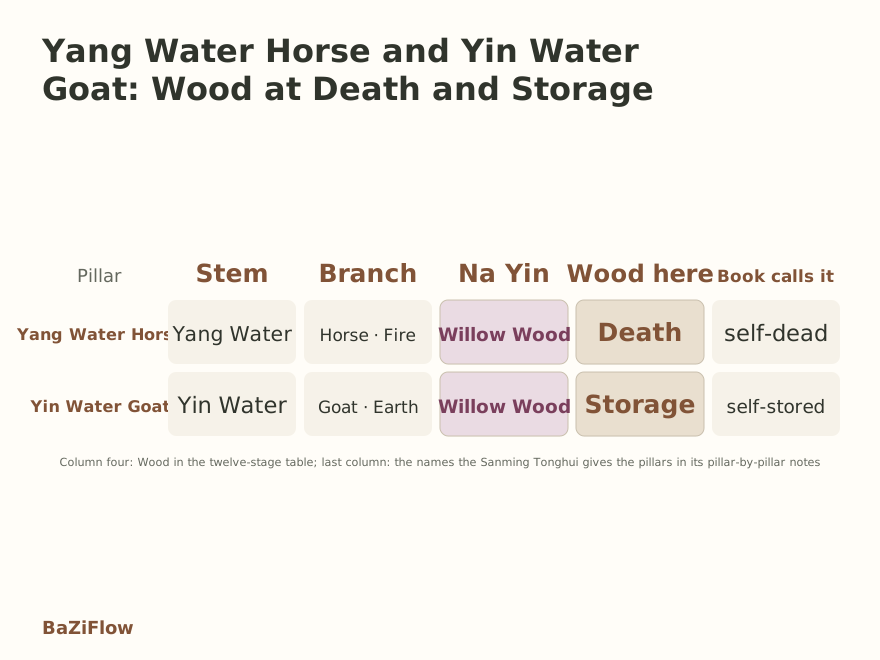
Reading aid: each row is one pillar. The stage of Wood on its branch is looked up in the twelve-stage table, and the last column gives the label the pillar-by-pillar notes attach to it.
Column four reads Wood's twelve stages: Death on the Horse and Storage on the Goat. Death and Storage are neighboring stage names, one a finish and one a vault, and the book borrows that position to picture something soft.
Each pillar also has its own notes in juan 1:
| Juan 1 source | Yang Water Horse (壬午) | Yin Water Goat (癸未) |
|---|---|---|
| Short note | willow trunk and joints; likes spring and summer | willow root; likes winter and Water, spring also suits |
| Pillar comment | self-dead Wood (quoting the Wuxing yaolun) | self-stored Wood, good at growth or strength stages |
| Willow entry: meeting Yang Fire Horse or Yin Fire Goat | very unlucky | nearly spared; no harm if other Water relieves it |
Withered or thick: two lines the book leaves side by side
The Ming-era Sanming Tonghui (三命通会) opens its imagery of the thirty names with a single layer of reasoning for this pair:
Yang Water Horse and Yin Water Goat: by the Horse the Wood has died, by the Goat it lies in the tomb. So the willow in high summer sheds its leaves and its limbs turn feeble, and the name takes its image from that softness.
Wood dead and entombed reads as a summer willow with thinned leaves and slight twigs, hence "soft". The calendar specialists (日家), quoted in the same chapter, put it as a small calculation: the Water of the two stems, Yang Water and Yin Water, does feed the Wood, and still it ends up "soft after all". The entry itself opens on both sides at once. First a picture, graceful along the Sui embankment and light in the Han gardens, ten thousand threads no silkworm spun and a thousand ribbons no needle sewed; then one line, "the Horse and Goat are Wood's death and tomb, Yang Water and Yin Water are its moisture".
In the pillar-by-pillar notes the same chapter also quotes a line from the Yuxiao baojian (玉霄宝鉴):
The pair Yang Water Horse and Yin Water Goat is named Willow Wood because the Wood has died by the Horse and lies in the tomb by the Goat, so in high summer the leaves are dense ...
The premise is word for word the same, and the conclusions are "withered" and "dense".
Enlarge diagram · scroll sideways to read
Tell the two leaves apart by the line each comes from. The book does not rule between them here. It also sets this pair opposite Mulberry Wood (Yang Water Rat and Yin Water Ox) and sums the two up in four words, "one bent, one soft"; that half is in Mulberry Wood.
"Small and weak" can be overruled by other Wood in the same chart
After the sixty entries, juan 1 has a passage on how "large" and "small" names land on a whole chart. Willow Wood is its second example:
Suppose someone is born under Yang Water Horse or Yin Water Goat: the Wood is plainly small and weak. If no other Wood shows in the month, day, hour or conception pillar, read it as Willow. If Pine and Cypress or Wood of the Great Forest shows, drop the small and judge by the large; it must not be read as Willow.
"Born under" means the birth year, that is, the year pillar; "month, day, hour and conception" are the month, day and hour pillars and the conception pillar. So: if the year pillar is Willow Wood and nothing else in the chart is Wood, read it as Willow, small and weak; if Pine and Cypress or Wood of the Great Forest shows elsewhere, read by the larger one. Just before it, the passage gives the mirror case: a year pillar of Yang Metal Tiger or Yin Metal Rabbit (Pine and Cypress, Wood at its largest) with Willow or Pomegranate Wood showing elsewhere is read by "taking the small".
Enlarge diagram · scroll sideways to read
The passage then carries the method over to other names. Fire in the Sky, Sword Edge Metal, Water of the Great Sea and Earth of the Great Post Road are its "large" names, and Lamp Cover Fire, Gold Foil Metal, Well-Spring Water (the book's name for the pair this site calls Water in the Spring) and Earth in the Sand are its "small and weak" ones. When the year pillar is one kind and the same element shows as the other kind elsewhere, the conclusion is again to follow what changed. The rule from the large side begins in Pine and Cypress Wood.
Willow trailing gold: four "finest" pillars on the emolument and nobility places of the two Water stems
At the end of the entry, among its "fine selections", is a pattern called "willow trailing gold":
There is the pattern of the willow trailing gold: this Wood is born in the three months of spring and the hour carries one Metal. Yin Metal Pig, Yang Wood Rat, Yin Water Rabbit and Yin Metal Snake are the finest, because they are the places of emolument and nobility for the two Water stems.
The "three months of spring" are the spring months, and "the hour carries one Metal" means the hour pillar is one whose Na Yin is Metal. The four pillars the book names all have a Metal Na Yin, and their branches sit on the "emolument" of the two Water stems (the Establishment stage of the twelve) or on their "nobility" (the Heavenly Nobleman).
Enlarge diagram · scroll sideways to read
The book's reason matches the tables: the Pig and the Rat are the Establishment cells of Yang Water and Yin Water, and the Rabbit and Snake are their Heavenly Noblemen. A few other pairings in the entry can be checked in passing. For Yang Water Horse meeting Yin Fire Pig (Earth on the Roof) the book says "Yin Fire and Yang Water combine and transform: auspicious"; on the table Yin Fire and Yang Water combine into Wood, which is exactly Willow's element. Yang Water Horse with Yin Earth Ox and Yin Water Goat with Yang Earth Rat (Thunderbolt Fire) are "yin and yang meeting", and the table does pair yang with yin there; the branches Horse and Ox, Goat and Rat are also in the relation of harm, which the book does not mention. The book also says "if Rat, Horse, Ox and Goat clash against one another it is not auspicious", and on the table Yang Water Horse with Yang Earth Rat is a Horse–Rat clash and Yin Water Goat with Yin Earth Ox an Ox–Goat clash.
Across two Starts of Spring: one year each for Yang Water Horse and Yin Water Goat
The Yang Water Horse year is 2002 and the Yin Water Goat year is 2003; the pair returns sixty years apart, in 1942 and 1943, then 2062 and 2063. The Start of Spring (立春) falls on 4 February at 08:24 in 2002, at 14:05 in 2003 and at 19:56 in 2004, all Beijing time.
Enlarge diagram · scroll sideways to read
The Na Yin stays the same across both years; watch the boundaries: someone born at noon on 4 February 2003 is already in 2003 on the calendar, yet the year pillar is still Yang Water Horse; someone born in January 2002 has the year pillar Yin Metal Snake and the Na Yin White Wax Metal, which has nothing to do with Willow Wood.
Work two cases
Born at 10 a.m. on 4 February 2003: which year pillar, and which Na Yin?
Spring begins at 14:05 that day, so at 10 a.m. the pillar is still Yang Water Horse, Willow Wood. Born at 6 p.m. it is Yin Water Goat, which is Willow Wood again.
The year pillar is Yang Water Horse and the day pillar is Yang Metal Tiger (Pine and Cypress). How does the book read the willow?
By this passage of juan 1, another Pine and Cypress Wood means dropping the small and judging by the large, so it is not read as Willow. The day pillar is among the month, day, hour and conception pillars the passage lists.
The previous pair is White Wax Metal and the next is Water in the Spring. How each of the two stage names, Death and Storage, is read is set out in the twelve life stages and void branches.
Questions readers ask next
I was born in 2002 or 2003. Is my Na Yin Willow Wood for certain?
It depends on the Start of Spring. Anyone born before 08:24 on 4 February 2002 still has last year's pillar, Yin Metal Snake, whose Na Yin is White Wax Metal; only from that moment until the 2004 Start of Spring is the year pillar Yang Water Horse or Yin Water Goat. Even on 4 February 2003, a noon birth and an evening birth get different year pillars.
Does "soft" in Willow Wood describe a soft person?
No. "Soft" is the book's image for Wood at the Horse and Goat, and what it describes is willow twigs: "ten thousand threads no silkworm spun, a thousand ribbons no needle sewed". Character cannot be derived from a Na Yin name, and the book's comments always hang on conditions such as "meeting this pillar" or "born in this month".
Yang Water Horse and Yin Water Goat get the same name. Why does the book rate them unevenly when they meet Yang Fire Horse or Yin Fire Goat?
The name is the same because both sit on the Death and Storage cells of Wood. Why the ratings differ the book does not say; it simply writes them apart. Those two pillars carry the Na Yin Water of the Heavenly River, yet the book calls their stems and branches "true fire"; Yang Water Horse meeting them is very unlucky, while Yin Water Goat is nearly spared and takes no harm if other Water relieves it. What the tables do show is that Yang Water Horse sits on the Horse (Fire) and Yin Water Goat on the Goat (Earth), and the Goat hides a Yin Wood.
Was this article helpful?
Sources & references
Continue reading
White Wax Metal (白蜡金): Why Yang Metal Dragon and Yin Metal Snake Carry This Na Yin Name ↗
Water in the Spring (泉中水), or Well-Spring Water: Yang Wood Monkey and Yin Wood Rooster ↗
Five Elements cycles: learn the relationships, not just the order ↗