

Twelve house topics
Content version · · Sources & references
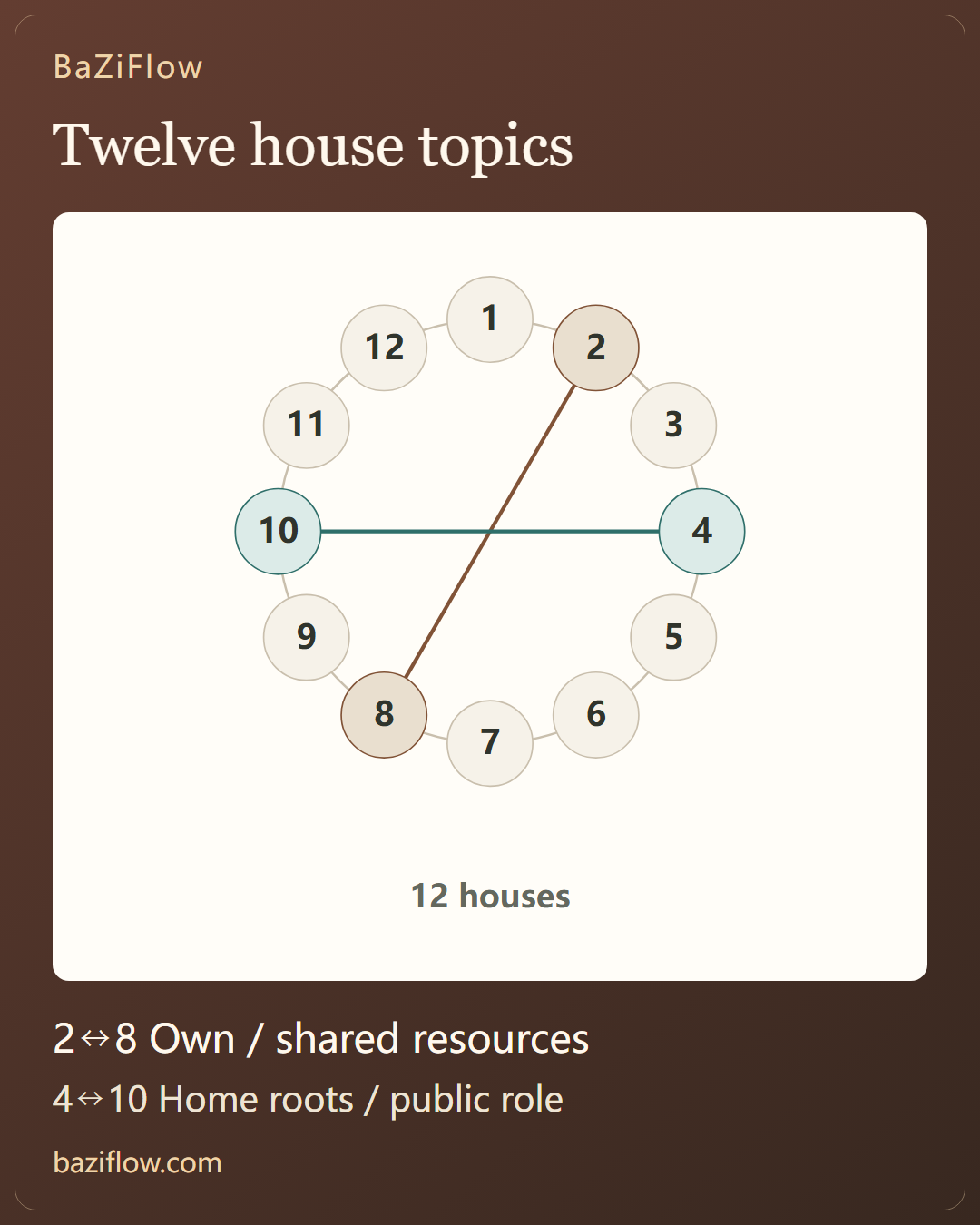
Distinguish the twelve house topics through six paired contrasts, while separating meanings from signs, calculated placements and real-world evidence.
The short version7 min read
The houses act as a directory of topics. Identify the question before choosing an entry; the directory cannot calculate a placement or decide the budget, agreement or outcome of a real project.
- Houses classify life topics and signs classify zodiac positions; their shared count of twelve does not make their numbers interchangeable.
- A course plan can involve resources in house two, duties in six, a partner in seven and a public role in ten; identify the part being discussed.
- Historical topics belong to authors and traditions. Actual house placement still requires time, location and a declared division method.
Read first
Four Chart Components: Read the Object, Position and Relationship ↗
Birth Time and Place: From the Clock Record to the Local Sky ↗
One project can contain several house topics
A community project involves supplies, daily tasks, collaborators, a public organiser and a network of supporters. Asking which single house “is the project” can hide the differences between those questions. Houses provide topic categories within astrological interpretation; they do not require an entire event to belong to only one category.
The six contrasts below introduce all twelve houses without treating them as twelve predictions. They combine historical topics with modern introductory language, and different traditions do not use every term identically. The diagram is an index, not a calculated chart for a person.
Before using it, separate a house from a sign. The first house need not contain Aries, and the tenth need not contain Capricorn. A chart's house calculation depends on its time, location and chosen system; the Swiss Ephemeris interface explicitly takes time, geographical coordinates and a house-method setting. Topic names cannot supply missing birth data.
Sign
- Zodiac sector
- Longitude
House
- Local division
- Time and place
All twelve topics in six useful contrasts
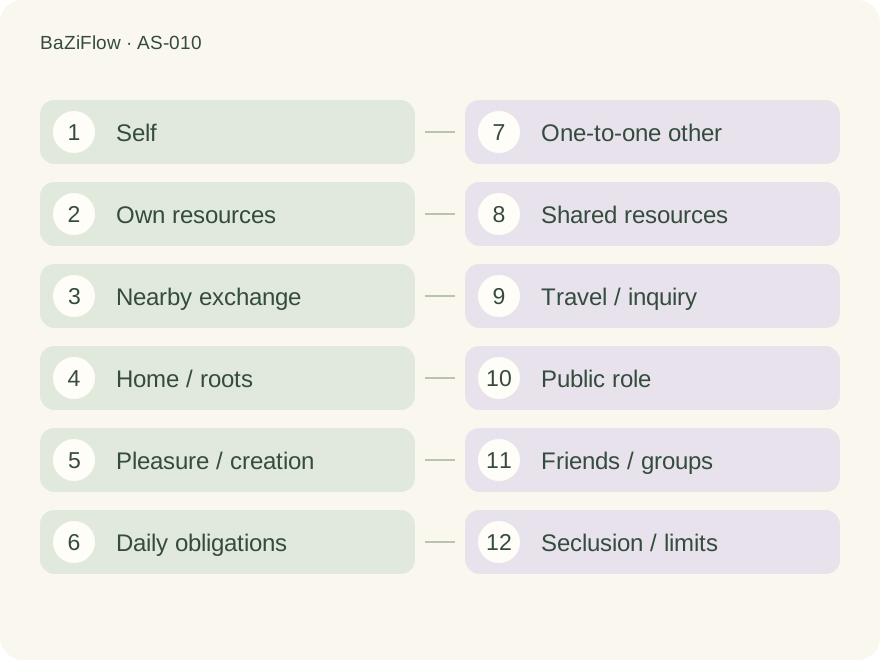
An original topic index. Pairing organises the lesson; it does not assert that the two topics must conflict.
| House | Topic range | Not established by the label |
|---|---|---|
| 1 | Self, body, approach | One fixed personality |
| 2 | Own goods, income, resources | Wealth or poverty |
| 3 | Siblings, neighbours, messages, basic learning | Every form of learning |
| 4 | Home, land, roots, family | One universal parental assignment |
| 5 | Children, pleasure, creative play | Fertility or number of children |
| 6 | Daily duties, service, bodily care | A medical diagnosis |
| 7 | Partners and distinct one-to-one others | Marriage or conflict |
| 8 | Shared or others’ resources, inheritance | Death dates, debt or profit |
| 9 | Distant travel, belief, higher learning | Travel or qualification guaranteed |
| 10 | Profession, standing, public role | Career success guaranteed |
| 11 | Friends, groups, support, hopes | Trustworthy friends guaranteed |
| 12 | Seclusion, retreat, restriction, private matters | Hidden enemies established |
Houses one and seven: whose side of the relationship?
In the community-project example, your role in presenting the idea and your agreement with one co-organiser are distinguishable subjects. Calling both “relationships” would lose the question of whose position is being discussed. Yet a placement in either house does not disclose the other person's consent or determine the success of the agreement.
The historical range of the seventh extends beyond marriage. Reducing it to a wedding forecast is therefore too narrow even as a description of traditional topics. In a reading, name the actual relationship under discussion instead of allowing the category to stand in for evidence about it.
Houses two and eight: which resources are involved?
For a project, distinguish supplies you personally own from resources another organisation may provide. The practical answer to whether those resources are available must come from an inventory or confirmation. The house label cannot certify a promise or create an entitlement.
Lilly's 1647 text includes death and inheritance among eighth-house topics. Historical inclusion is not a basis for announcing a death date or giving a legal conclusion. Learning what a tradition discussed should not be confused with demonstrating that the method can establish those facts.
Houses three and nine: nearby exchange and wider inquiry
A message coordinating a local meeting is not the same question as a programme of advanced study, even though both involve information. Likewise, travel is not sorted merely by counting kilometres without reference to the tradition and context. The point of the contrast is to ask what kind of movement or learning is being examined.
Houses four and ten: roots and public position
The fourth house concerns home, land and family roots; the tenth concerns profession, standing and public role. For the project, where the course is held and who prepares the venue raise a different question from who is publicly named as organiser. Neither label decides who is responsible, and Lilly's assignment of the father to the fourth house and the mother to the tenth is one convention among several, so name the source before using it.
Houses five and eleven: enjoyment and networks
A hobby can remain a pleasure without becoming a public network, and a helpful network can support work that is not your favourite pastime. Keeping the topics separate prevents a broad positive word such as “connection” from doing all the explanatory work.
Children as a topic do not permit a fertility judgement or a prediction of their number. Friends as a topic do not certify anyone's loyalty. In both cases, the actual people and circumstances matter more than a keyword assigned to a sector of a diagram.
Houses six and twelve: daily obligations and restriction
For the project, routine preparation and a period of stepping back from public activity can be different subjects. They are not automatically a conflict between productivity and failure. Avoid assigning moral worth to a house or treating every private activity as evidence of a hidden problem.
Split a course plan into questions you can answer
Suppose you are arranging a weekend course. Your own teaching supplies raise a resource question; daily preparation raises a task question; an agreement with another teacher raises a one-to-one question; your advertised teaching role raises a public-position question. These give distinct entries through houses two, six, seven and ten.
The practical answers come from an inventory, schedule, confirmed agreement and the actual responsibilities. If you later ask how a group of friends might introduce the course to participants, house eleven supplies another topic. Record the changed question rather than silently using a different topic to defend an earlier prediction.
Course plan
Supplies
- Specific issue
- What do I own?
- Topic
- 2: own resources
Routine
- Specific issue
- What must I do daily?
- Topic
- 6: daily duties
Partner
- Specific issue
- Who shares the work?
- Topic
- 7: one-to-one
Public role
- Specific issue
- How am I presented?
- Topic
- 10: public role
Preserve the author behind a historical assignment
Lilly’s 1647 discussion lists concrete topics for each house. His allocation of the father to house four and mother to house ten is one identifiable historical convention, not a compulsory division of roles in every family. This guide uses home and roots versus public position as a broad starting distinction.
Reid’s lesson distinguishes signs from houses. A resemblance between keywords is a teaching analogy, not a calculation rule. Keep the source and the task visible when a later textbook changes its emphasis.
Lilly, 1647
- 4: father
- 10: mother
This topic guide
- 4: home and roots
- 10: public role
Topic words cannot replace house calculation
The Swiss Ephemeris house interface needs a time, geographical latitude and longitude, and a house method. If the birth time is unknown, do not fill that gap with a preferred interpretation. A body near a boundary needs accurate position and settings; two methods may assign it differently.
An unoccupied house remains part of the framework; see empty houses. To connect the topic to another chart object, continue with sign, house and ruler together. Record the chosen method and actual positions before interpreting them.
Name the question
Separate resources, duties, other people and public roles within the larger event.
Check positions
Confirm time, place and house system; preserve reliable placements and unknowns.
Declare the reading method
Identify the topic tradition and interpret it separately from practical evidence.
Questions readers ask next
Is the first house simply another name for Aries?
No. Houses and zodiac signs are different divisions. Similar teaching keywords can aid memory, but they do not replace the calculation of the ascendant, cusps and longitude.
Why can one project involve several different houses?
A project contains separate questions about supplies, daily work, a collaborator and public responsibilities. Separating them shows which topic is actually being considered.
Must house four mean the father and house ten the mother?
Lilly uses those assignments, but later teaching can differ. This introduction uses home and roots versus public position without imposing one historical allocation on every family.
Was this article helpful?