

Read the route before comparing plate styles
Content version · · Sources & references
Compare an eight-position outer ring with numerical movement through nine palaces. A named implementation and a classical lodging variant show why chart style is only part of the setup.
The short version5 min read
The outer sequence 1–8–3–4–9–2–7–6 and the numerical sequence 1 through 9 use the same diagram but define different moves. Stars, doors, spirits and centre treatment need separate rules. A calculation passing through five does not establish how every final layer is placed.
- The two routes define different neighbours, even when their starting point and step count match.
- Distinguish a star’s merger at its home position from its destination after movement.
- Record placement style, time method and layer-specific blank slots as separate fields.
Read first
One step is not the same operation on both routes
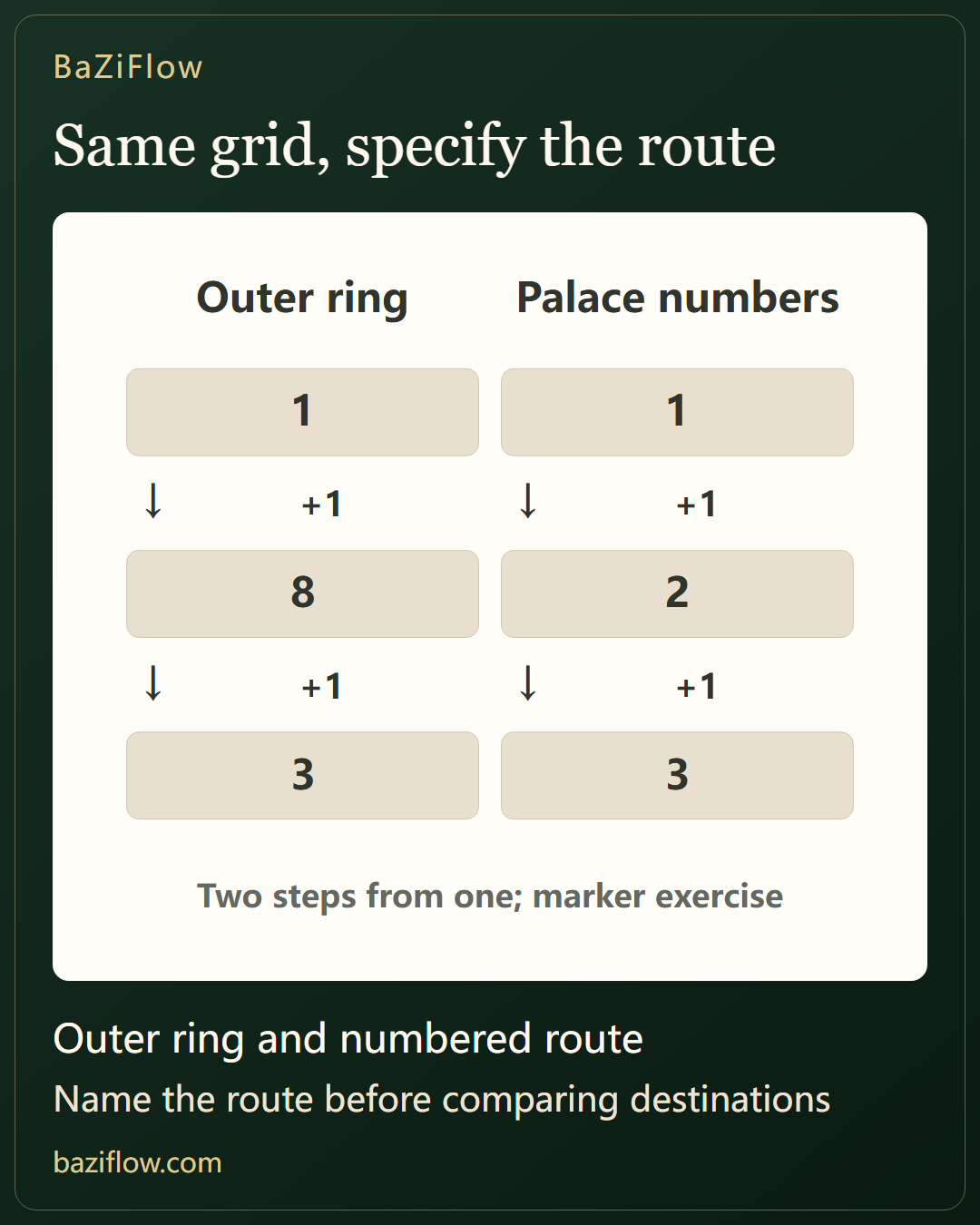
Put a neutral marker at palace one. On the outer ring used by the implementation cited here, the next position is eight. In ascending numerical palace order, the next is two. Before assigning any star or door, the two meanings of “one step” already differ.
| Route exercise | Sequence | Next after one | Includes centre five? |
|---|---|---|---|
| Eight-position outer ring | 1, 8, 3, 4, 9, 2, 7, 6 | 8 | No |
| Numerical palace order | 1, 2, 3, 4, 5, 6, 7, 8, 9 | 2 | Yes |
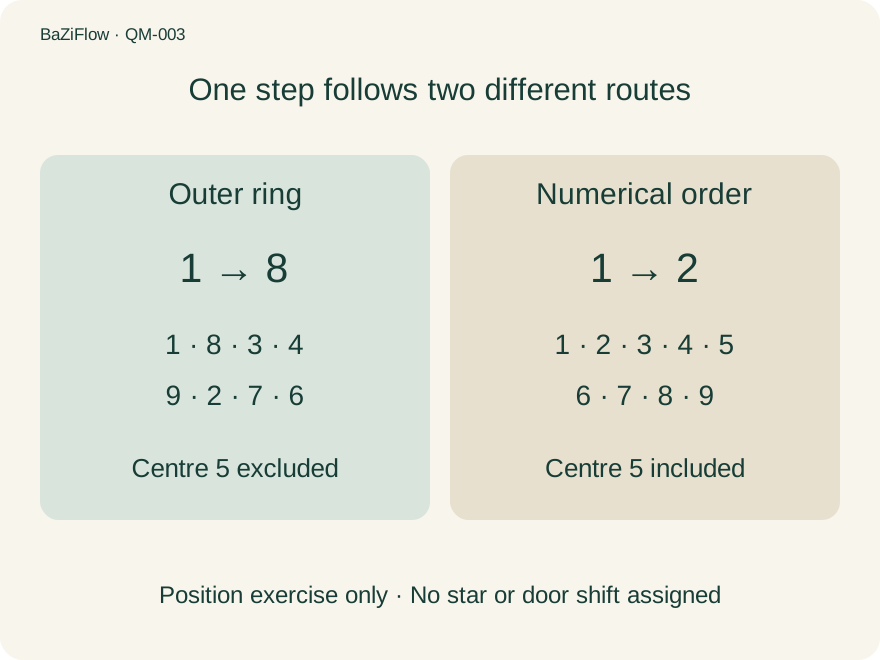
Original BaZiFlow route comparison checked against the cited implementation at a fixed revision. It illustrates placement structures, not a universal rulebook for every lineage.
This is a movement exercise, not an instruction to shift every chart layer one place. Actual stars, doors and other symbols still require their own starting conditions and placement rules. A shared grid does not imply a shared algorithm.
The modern example is the public atopx/qimen implementation at the fixed revision linked in the sources. It documents one concrete choice of rules. It is not being treated as historical authority or as a standard binding every school that uses the labels “rotating” or “flying.”
Outer ring
Palace numbers
Two steps from one; marker exercise
Separate the style from the time setup
A chart style concerns how elements are arranged. A ju-selection convention concerns how the time and cycle determine the setup. The cited implementation exposes these as separate choices. Selecting a flying plate therefore does not automatically tell you which solar-term or intercalation procedure is in use.
Before comparing two outputs, align the target time, time-zone interpretation, time-based or other method, Yin or Yang mode, yuan and ju number. Solar terms and ju numbers explains why the preceding time decision needs its own record. If the ju numbers already differ, not every later mismatch can be attributed to plate style.
Nor do a public library's defaults establish the settings of every product that might use it. The settings of a particular product must be read from that chart’s own configuration. Use the settings actually reported for the chart under examination.
Style
- Placement route
Time method
- Select yuan / ju
The centre question must name a layer
In the cited rotating star implementation, Tian Qin is combined with Tian Rui at the latter's palace-two home slot before the ring is rotated. This does not mean that the combined entry remains in palace two at every time. A lodging convention at the home stage and a final chart position are different things.
The cited flying star implementation instead places all nine stars through numerical palace order, allowing Tian Qin to participate independently. Its flying door layer still has eight doors and leaves one slot without a door. It does not invent a ninth door merely because the chart has nine palaces.
Its spirit layer also differs between styles: eight in the rotating case, nine including Tai Chang in the flying case. These are facts about this named implementation. They should not be expanded into claims that every flying school must use the same inventory.
The classical Tong Zong text makes the need for specificity especially clear. Its star section gives a Tian Qin lodging convention using Kun for both Yin and Yang, then preserves another version using Kun in Yang and Gen in Yin. A shared word such as “lodging” does not guarantee shared conditions.
A rotating chart can still use a numerical calculation
The simple route comparison can create a new misconception if taken too far. In the cited code, the duty door's destination is first calculated through numerical palace steps, including the possible centre. A centre result is then handled by its lodging rule, and the doors are arranged around the outer ring.
Thus “rotating” does not mean that every intermediate calculation ignores palace five. The final arrangement and the procedure used to locate its reference point must be distinguished. Similarly, a flying label is not enough to infer how every layer treats an empty slot.
When a description seems inconsistent, identify whether it is discussing the original position, a calculated destination, a centre adjustment or the final display. Those stages can contain different numbers without describing an error.
Compare fields, not the visual density of the pictures
Read the earth stems, heaven stems, stars, doors and spirits as separate layers. For a disputed entry, preserve its origin and destination as well as the rule connecting them. A blank field may mean that the convention leaves it unassigned, that the interface hides it, or that the supplied material is incomplete. Those possibilities need different explanations.
If Tian Qin appears beside another star in one display and in its own location in another, consult the lodging and display notes before counting labels. Return to the nine-palace coordinates, then reconstruct the affected layer under its stated rule. That is more informative than deciding which diagram looks more elaborate.
The structures can be compared and calculated. Their complexity does not establish predictive accuracy. A useful comparison identifies a named method, preserves its settings and leaves a documented disagreement intact where the rules genuinely differ. Missing details should remain open questions rather than being quietly borrowed from another school.
Earth stems
Heaven stems
Stars / doors / spirits
Questions readers ask next
Do matching endpoints identify matching methods?
Not without the intervening steps and rule. Two steps from one can reach three through either eight or two. That isolated agreement cannot identify the placement procedure.
Does Qin at seven prove that no lodging occurred?
Check the construction history. Under a rule that merges Qin with Rui before rotation, lodging belongs to the home arrangement and the merged marker can subsequently move elsewhere. The final coordinate alone does not settle this.
Should an empty flying-door slot receive a ninth door?
First check the layer’s defined count. The cited implementation shifts eight doors through nine positions and leaves one slot without a door. Adding a new name would alter that rule rather than repair missing data.
Was this article helpful?
Part of a learning path
Qimen: from the nine palaces to recording a chart · Step 2 of 2 available