

Yi (頤): yang at both ends, four yin between, who nourishes whom
Content version · · Sources & references
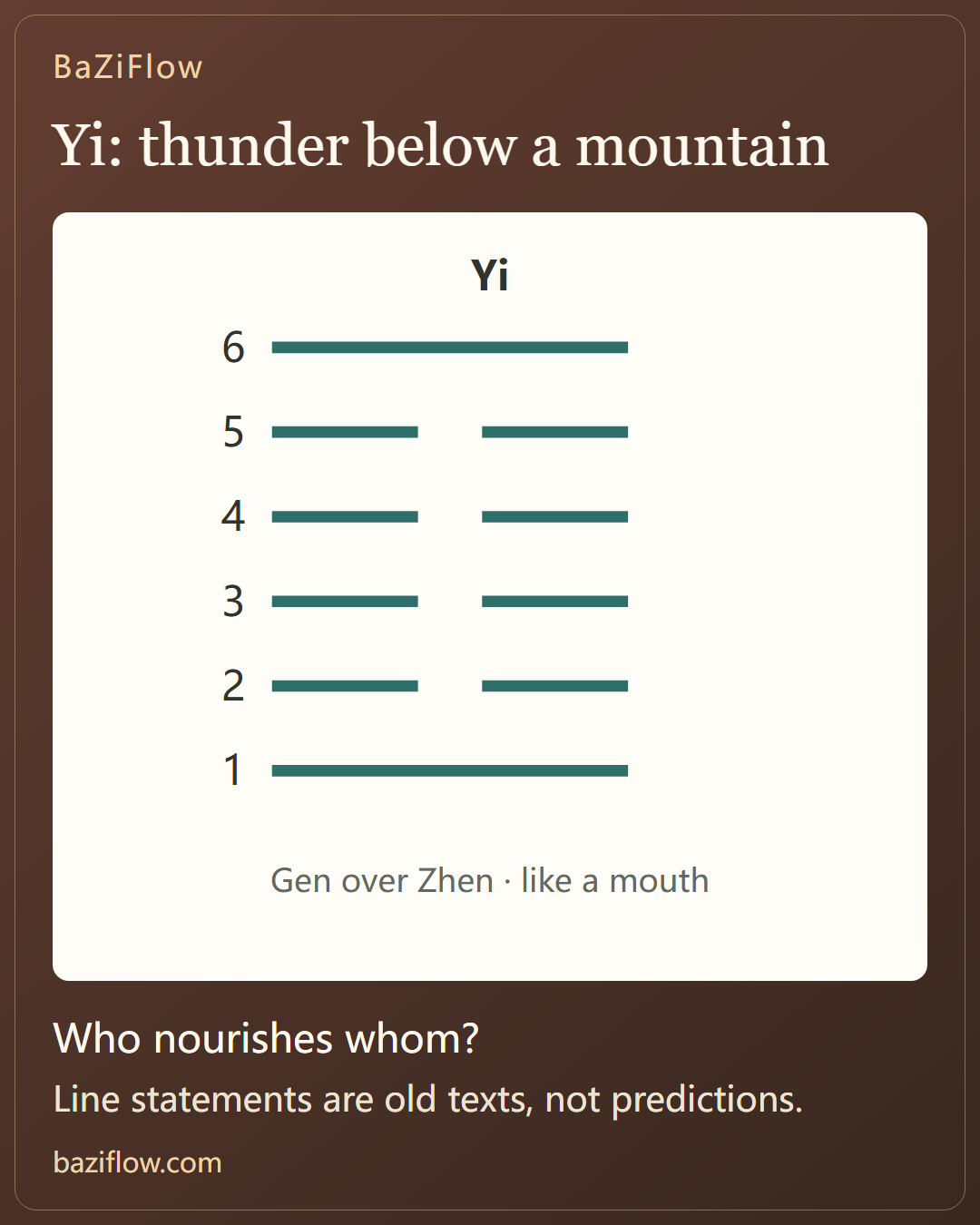
Yi is the 27th hexagram, Gen above Zhen, yang only at bottom and top, a shape often read as a mouth. Judgment, Image and six statements ask who nourishes whom, from "look at the jaws" to "from him comes nourishment".
The short version7 min read
Yi literally means the cheeks and jaw, and the Xu Gua explains the name as nourishing. One word, yi, is a thing to look at in the judgment, speech and food in the Image, and in the lines a direction of nourishing that keeps turning wrong.
- Yi (頤) is Gen (mountain) over Zhen (thunder); only the first and top lines are yang, the four between are yin. The figure is often read as a mouth, with Gen at rest above and Zhen moving below.
- The judgment says "look at the jaws; seek your own mouth-food". The Commentary on the Judgments reads it as looking at what one nourishes and how one nourishes oneself, and widens it to heaven and earth, the sage and the people.
- Of the six statements, "upside-down" appears in lines 2 and 4, "against" in lines 3 and 5, and only the top line says "from him nourishment comes"; lines 2 and 4 use the same two words and are judged opposite ways.
Read first
The Sixty-Four Hexagrams: How Upper and Lower Trigrams Form One Figure ↗
Judgment and Line Statements: Whole Hexagram or Single Line? ↗
A figure like a mouth: yang at both ends, four yin between
Yi (頤) is the 27th hexagram. In Chinese its name sounds much like the 42nd hexagram, Yi (益), but the characters differ and they are two separate hexagrams. The lower trigram is Zhen (thunder), the upper is Gen (mountain). Only the first line and the top line are yang; the four between are yin. Drawn out, there is a solid line at the bottom and another at the top, with four broken lines between, and later readers often take this shape for a mouth: two rows of jaw, empty in the middle.
The Shuo Gua gives each trigram one word: Zhen is moving and Gen is stopping. Some read chewing out of that: the lower jaw moves, which is Zhen below, and the upper jaw stays still, which is Gen above.
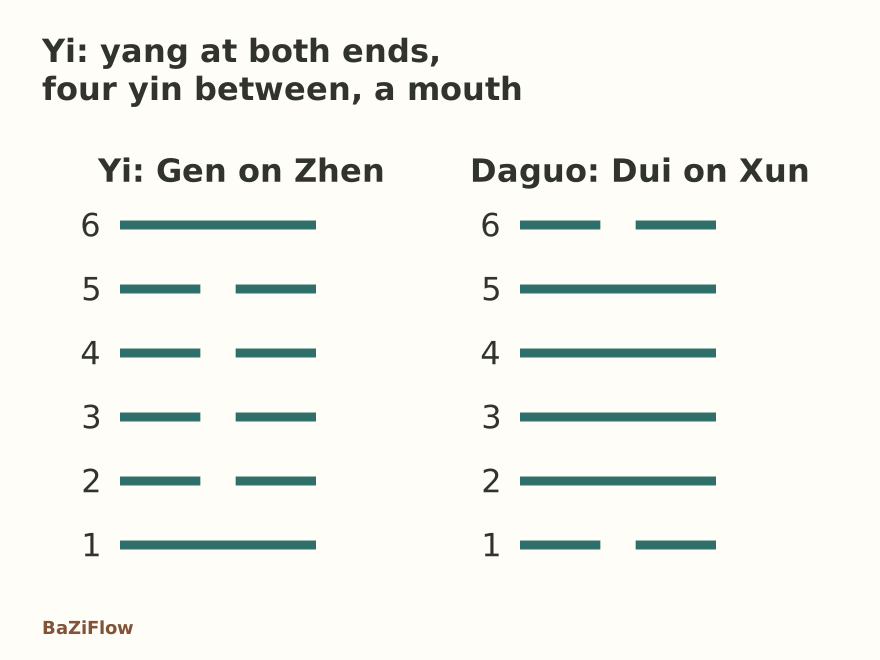
Yi and its inverse Daguo: the inverse changes every line, so the yang ends become yin and the yin middle becomes yang.
Enlarge diagram · scroll sideways to read
Words to know before reading Yi
- Yi
- Literally the cheeks and the jaw. The Xu Gua explains the name as nourishing: the mouth is the place where a person is fed.
- Drooping jaws
- A phrase from the first statement, "look at my drooping jaws": the cheeks hanging and moving as someone chews. The idiom for eating with relish comes from this line.
- Mouth-food
- The "mouth-food" of "seek your own mouth-food" is literally what goes into the mouth, the thing one uses to nourish oneself.
The judgment and the Commentary: what is there to look at
The judgment of Yi is short: "staying on course brings good fortune. Look at the jaws; seek your own mouth-food." The Commentary on the Judgments (彖传) first says "nourishing what is right brings good fortune" and then gives each of the next two clauses a "look".
Yi, "staying on course brings good fortune": nourishing what is right brings good fortune. "Look at the jaws": look at what is nourished. "Seek your own mouth-food": look at how one nourishes oneself. Heaven and earth nourish the ten thousand things; the sage nourishes the worthy and so reaches all the people. How great is the time of Yi!
Enlarge diagram · scroll sideways to read
The two clauses of the judgment sound like talk about food, and the Commentary turns them into two questions. "Look at the jaws": see what a person is nourishing. "Seek your own mouth-food": see how a person nourishes the self. By the end the word has grown by steps: heaven and earth feed the ten thousand things, the sage feeds the worthy, and the reach extends to everyone. A figure shaped like one mouth ends up speaking of more than a mouth.
The Image: words go out, food goes in
The Image starts from the figure, and lands on two things a mouth does.
Below the mountain there is thunder: Yi. The noble person is careful with words and moderate in drinking and eating.
Enlarge diagram · scroll sideways to read
What the noble person takes from this Image is simply about the mouth: speech going out and food going in, each governed by a word, "careful" for the one and "moderate" for the other. Read it with the Commentary on the Judgments. The Commentary asks what one nourishes and how; the Image brings the question down to its nearest place, the words said each day and the food eaten each day.
The six lines: the same two words, opposite verdicts
In the six statements the word before yi keeps changing: drooping, upside-down, against, upside-down, (against the constant), and "from".
Enlarge diagram · scroll sideways to read
Line 1 is lowest and speaks as if to someone else: "put aside your tortoise and look at my drooping jaws", that is, you leave your own spirit tortoise and watch me chew; ill. The Small Image says "also not worth prizing". The spirit tortoise has been read in two ways: a tortoise used for divination, or a tortoise that needs no food.
Line 2 says "nourishing upside down, against the constant, from the hill", and line 4 says "nourishing upside down: good". Two lines use the same two words, and the verdicts are opposite. Line 2: "setting out is ill", with the comment "his moves lose his own kind"; line 4 is "good", with "those above shed light". Line 3, "nourishing against the grain", is "staying on course brings misfortune; for ten years do not act; nothing is favorable", with "the Way is greatly at odds", a heavily worded line. Line 5 is "against the constant", yet "staying put on course brings good fortune", and the same statement adds "one must not cross the great river". The top line starts with only two words, "from him", then "danger, then good fortune; favorable for crossing the great river", and its Small Image is "great celebration". Two neighboring statements, one saying "must not cross the great river" and the next favoring the crossing, say opposite things.
Daguo, Kun and the Xu Gua: two joins
The inverse of Yi is Daguo (大過): every line changes polarity, the yang ends become yin, and the four yin lines become yang. Turn Yi upside down and it is still Yi, so its reversed hexagram is itself. Its nuclear hexagram is Kun (坤): lines two to four and lines three to five are each three yin lines, and together they give six yin lines.
Enlarge diagram · scroll sideways to read
The Xu Gua gives Yi a neighbor on each side. Before it stands Daxu, storing up; after it stands Daguo, and the stated link there is that without nourishment nothing can set itself in motion. Laid end to end the order reads: store up, nourish, move.
Questions readers ask next
Are Yi (頤) and Yi (益) the same hexagram?
No. The jaws hexagram is the 27th, Gen over Zhen; the other Yi is the 42nd, Xun over Zhen. The two names sound alike and share no character, so give the original character when you cite either one.
What did the idiom for eating heartily mean in the original?
It comes from line 1, "look at my drooping jaws". The jaws are those of someone chewing, and in the statement this line is judged misfortune, with the comment "not worth prizing". The idiom keeps only the picture of eating with relish, and its sense has turned.
Is this hexagram about diet and health?
Food is one layer. The Image says to be moderate in eating and drinking, but the judgment and Commentary on the Judgments move the idea to whom and what one nourishes, and end with heaven and earth feeding things and the sage feeding the worthy. Nourishing in this text is wider than a meal.
Was this article helpful?
Sources & references
Continue reading
Daxu: heaven inside a mountain, and the two meanings of one word, xu ↗
Daguo: the sagging and the arching ridgepole, two withered poplars, a ford over the head ↗
The Sixty-Four Hexagrams: How Upper and Lower Trigrams Form One Figure ↗
Judgment and Line Statements: Whole Hexagram or Single Line? ↗