

How luck pillars are ordered and when they begin
Content version · · Sources & references
Ordering luck pillars from the month pillar and calculating the starting age are separate tasks. Follow a Bing-Yin example and a hypothetical six-day solar-term interval.
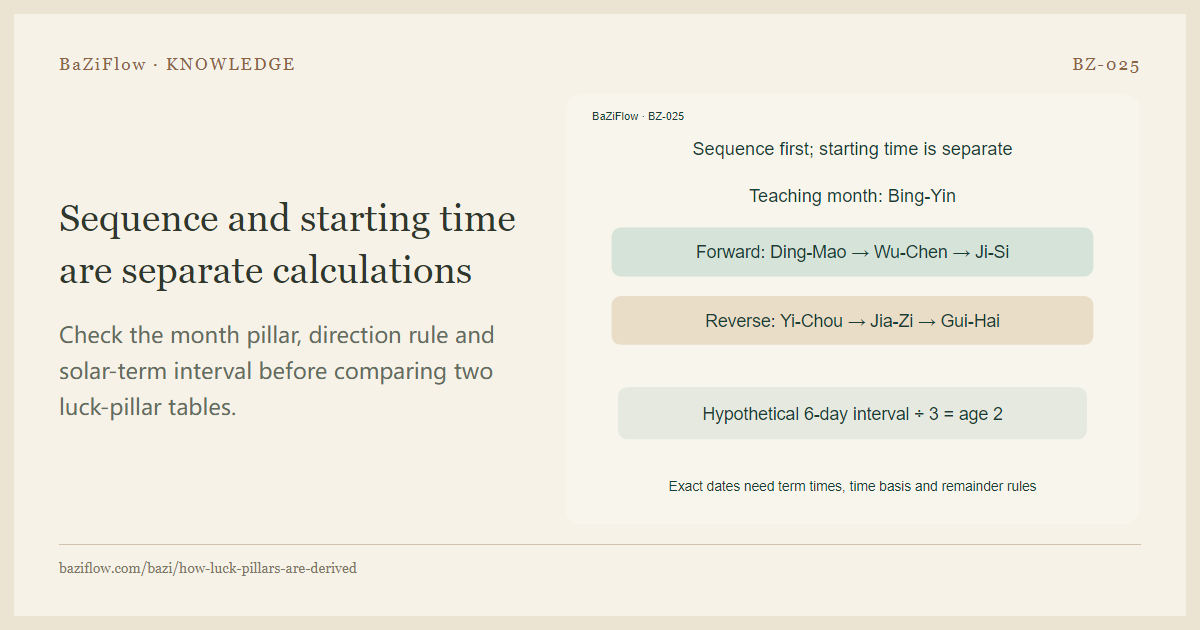
Check the month pillar, direction rule and solar-term interval before comparing two luck-pillar tables.
Read first
The same sequence can have a different starting date
Two charts can list the same first three luck pillars but disagree about when the first begins. That does not necessarily mean every part of one chart is wrong. Ordering the stem-branch sequence and calculating its starting time are separate operations. The month pillar and direction govern the sequence; the relevant birth-to-solar-term interval enters the starting-age calculation.
Luck pillars are commonly described as ten-year periods, but the first does not begin at birth for everyone. Nor are the periods simply universal blocks of ten calendar years. People who share a zodiac animal or even a birth-year pillar can have different month pillars, directions and starting times. A year label cannot supply a complete personal sequence.
A sequence exercise with Bing-Yin
Take Bing-Yin as a hypothetical month pillar. Moving forward through the sixty-pair cycle gives Ding-Mao, Wu-Chen and Ji-Si. Moving backward gives Yi-Chou, Jia-Zi and Gui-Hai. The month pillar supplies the starting reference; the adjacent pair is normally listed as the first luck pillar in this method.
| Reference month pillar | Direction | First | Second | Third |
|---|---|---|---|---|
| Bing-Yin | Forward | Ding-Mao | Wu-Chen | Ji-Si |
| Bing-Yin | Reverse | Yi-Chou | Jia-Zi | Gui-Hai |
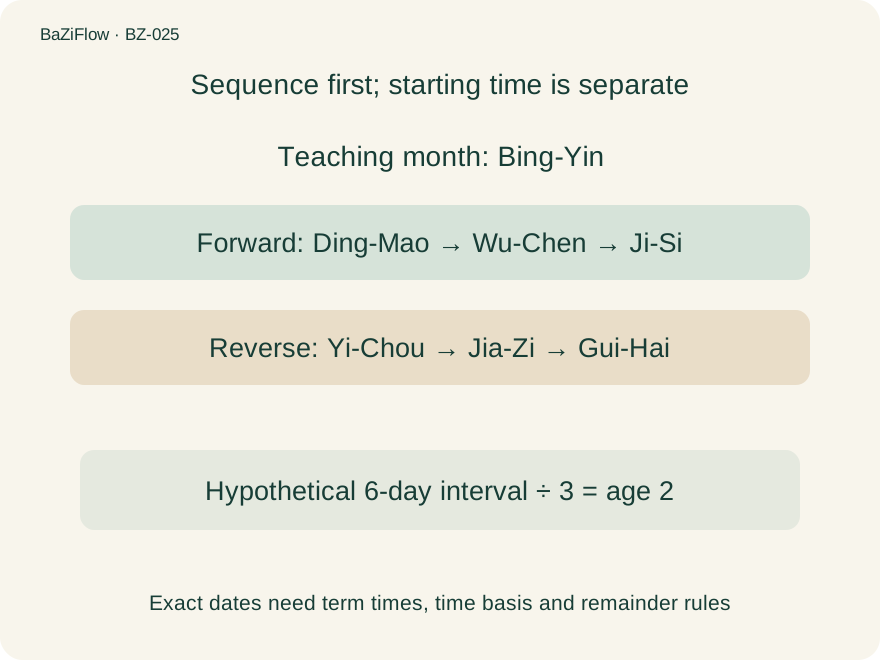
Original BaZiFlow calculation diagram. The interval is hypothetical, not a personal birth calculation.
Both stem and branch move together. Holding the stem fixed while changing only the branch would no longer follow the required cycle. The reverse step from Jia-Zi to Gui-Hai is a useful boundary check: the sequence wraps around rather than stopping at its first entry. The Hong Kong Observatory's sexagenary table verifies this order, not the predictive claims sometimes attached to luck pillars.
State the direction convention explicitly
In a common Zi Ping convention, birth-year stem polarity is combined with the traditional male/female input: Yang-year males and Yin-year females proceed forward; Yin-year males and Yang-year females proceed in reverse. Jia, Bing, Wu, Geng and Ren are Yang stems; Yi, Ding, Ji, Xin and Gui are Yin stems. This is a convention used by the algorithm, not a judgment about personality, ability or gender identity.
Historical discussions in Xing Xue Da Cheng and the commentary on Luo Lu Zi record the forward/reverse framework and its connection with the birth month. Modern implementations still need to specify the reference they actually use. A different school may apply different details, so a label such as Yang person is too vague without its definition.
Do not infer an unspecified input from someone's name or appearance. If the required direction information is missing, the two possible sequences can remain explicitly conditional. When comparing tools, inspect their direction settings before checking the month pillar and individual steps. This separates a convention mismatch from a sequence error.
Converting an interval into a starting age
Under the traditional conversion described here, forward calculation measures from birth to the next specified sectional solar term; reverse calculation measures from the preceding specified term to birth. The basic ratio is three days of interval to one year of starting age. The Xing Xue Da Cheng passage names the twelve sectional terms, such as Beginning of Spring and Awakening of Insects, and distinguishes them from the alternating principal terms.
Consequently, selecting whichever of the twenty-four terms is nearest can be wrong for this method. Rain Water, for example, cannot simply replace the required sectional boundary. The birth time and the chosen term must also be expressed on a consistent time basis before their interval is measured.
For a purely hypothetical interval of exactly six days, six divided by three gives two years. Nine days would give three years. Neither example asserts the starting age of a real person. Fractions of a day require the stated conversion convention rather than silent rounding to an integer age.
In the familiar traditional ratio, one day corresponds to four months and one double-hour corresponds to ten days of age. A double-hour is not one modern hour. Converting the resulting years, months and days into a civil start date introduces further choices about calendar units and rounding. A decimal age alone should not be presented as a fully verified timestamp.
Why a near-boundary birth needs careful input handling
A birth close to a sectional-term transition can raise two issues at once: which month pillar applies and how long the starting-age interval is. Time zone, historical daylight-saving rules and the precision of the recorded birth time can therefore affect more than the final displayed date. Keep the original input and the conversion convention visible before deciding that one output is preferable.
If a method applies true solar time, state that choice and apply it consistently. If the birth minute is unknown, preserve the uncertainty instead of filling in zero and claiming second-level precision. Differences between tools can also reflect age display conventions, rounding or the way converted calendar units are added back to the birth date.
A reproducible result retains the month pillar, direction rationale, ordered pairs, selected solar-term boundary, measured interval, conversion rule and final start time. Interpretation comes afterward. Natal, luck, year and month layers explains how the resulting pillar enters a broader reading, while luck-pillar transitions discusses changes around a boundary. Computing the framework does not guarantee that an entire decade will be favorable or unfavorable.