
Winnowing Basket: last of the eastern seven
Content version · · Sources & references
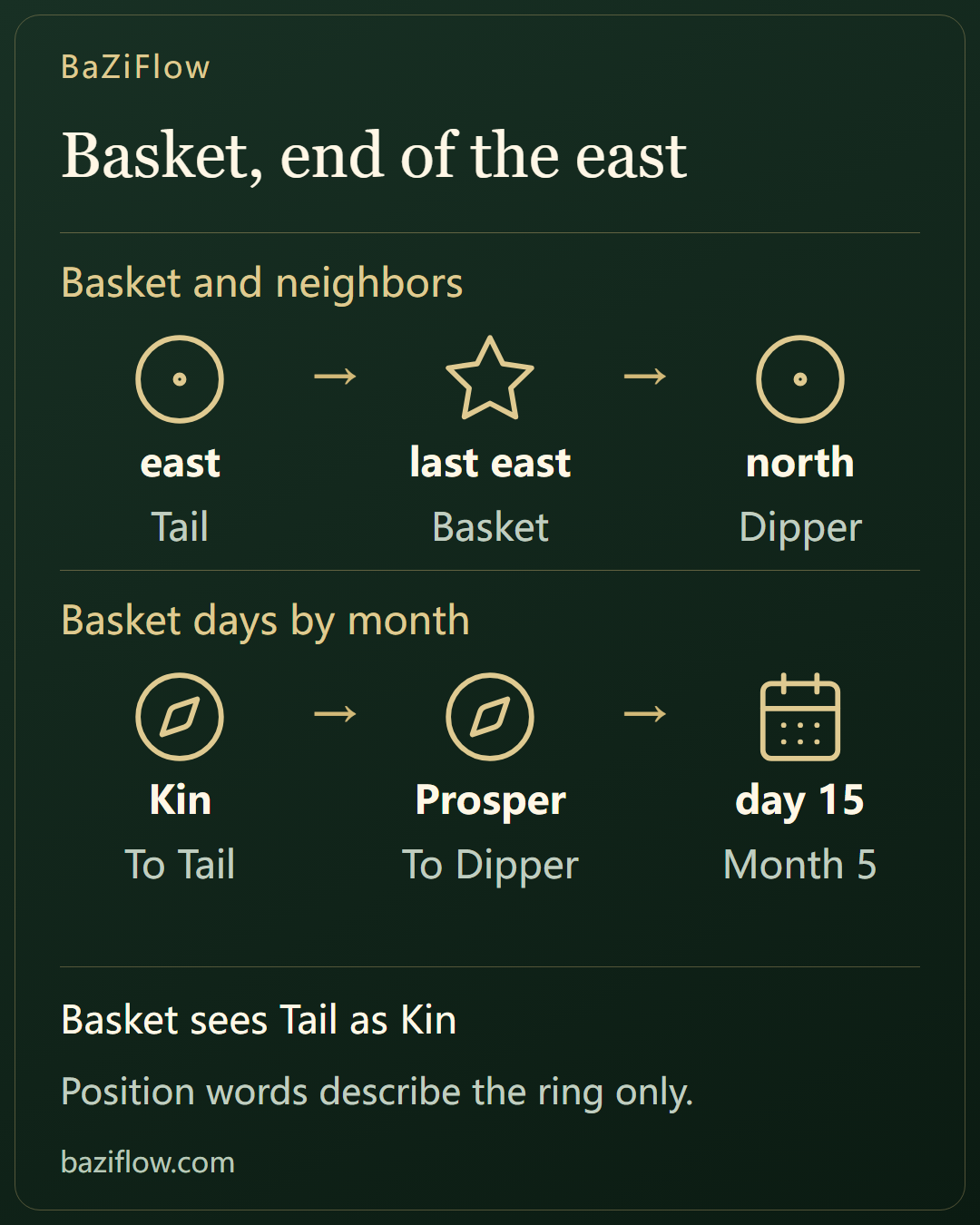
Winnowing Basket is mansion 18 of 27 and the last marked eastern; Dipper after it is northern. Its picture names only a water god. See how it and six neighbors view each other, and its day in month 5.
The short version6 min read
Winnowing Basket is the eighteenth of the twenty-seven mansions and the seventh and last that the annotator marks as a mansion of the east; the next one, Dipper, is a mansion of the north in the same notes.
- Seven notes, from Horn to Basket, close with "a mansion of the east" and Basket is the last; the note for Dipper says north, so the direction turns between the two.
- The Basket picture says "four stars, shaped like an ox's stride, a water god" with no name; five mansions, Hairy Head, Turtle Beak, Well, Neck and Basket, name their deity only as fire, moon, sun, wind or water.
- With Basket as origin, the three before it, Tail, Heart and Room, are Kin, Friend and Break, and the three after it, Dipper, Girl and Emptiness, are Prosper, Decline and Ease; in the site table (Japanese old calendar), day 15 of month 5 is Basket.
Read first
What is Sukuyō astrology? How a birth mansion is found ↗
Sukuyō 27 mansions vs the 28 lunar mansions: what is the difference? ↗
The last of the eastern seven
Counted from Hairy Head (昴), Winnowing Basket (箕) is number eighteen, with Tail (尾) before it and Dipper (斗) after it. Behind each picture the annotator put a Chinese-astronomy remark that ends with a direction. The remarks run east from Horn through Basket (角, 亢, 氐, 房, 心, 尾, 箕), seven in all, and Basket is the last of them; the next mansion, Dipper, gets this one:
In Chinese astronomy Dipper has six stars, governs the rivers and lakes, and is a mansion of the north.
So the step from Basket to Dipper is more than two neighbors; it is where the direction changes.
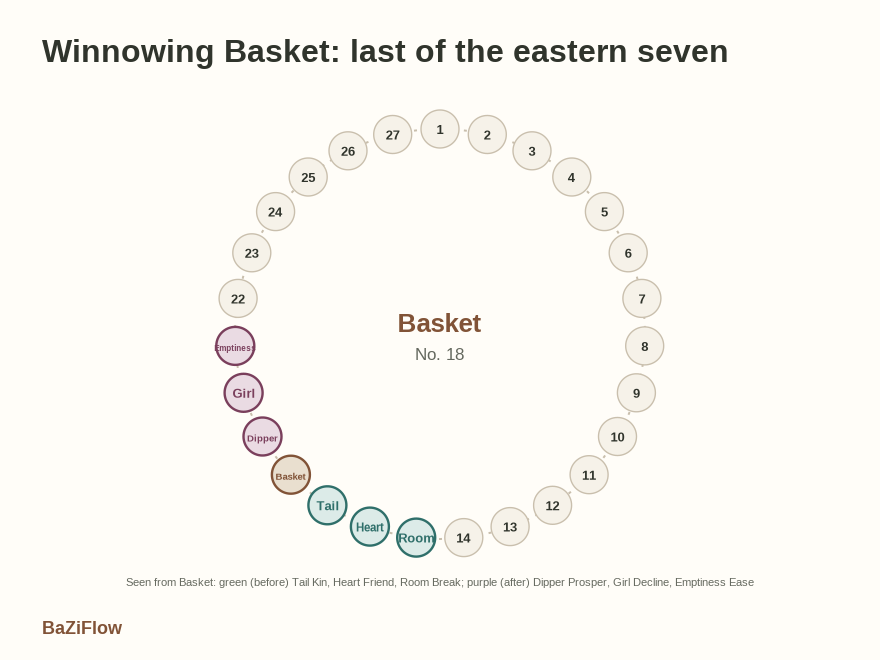
Position sketch: the twenty-seven names are spaced evenly in their order, with Hairy Head as No. 1; the note gives the three-nine words for the view from Basket, and even spacing is typography, not sky width.
In the picture Basket is gold, Room, Heart and Tail before it are green, and Dipper, Girl and Emptiness (斗, 女, 虚) after it are purple. The note under the ring gives the three-nine position words seen from Basket as origin, taken up in the third section.
The picture of Basket: only "a water god"
The Basket entry begins:
Basket has four stars, shaped like an ox's stride. A water god. Its clan name is La-po-ye-ni (刺婆耶尼).
At the end the annotator notes "in Chinese astronomy Basket has four stars, governs the consorts of the court, a mansion of the east", so the star count matches the picture, four and four. What stands out is the deity. The pictures of Room and Heart give a transcribed deity name, whereas Basket says only "a water god". Compare the deities across the sutra’s twenty-eight pictures (Ox included) and just five are described this way:
Enlarge diagram · scroll sideways to read
Fire, moon, sun, wind and water here are descriptions of a deity. They are not the mansion's element, and they are not the same thing as the Sun, Moon, Mars and Mercury of the luminary tables. When quoting Basket's deity, write "the picture calls it a water god", and the sentence will not be read as something else.
In the three-nine order: how Basket and the three on each side see each other
The three-nine method works in both directions: first see which place the other mansion takes in your own sequence, then turn round and see where yours falls in theirs. Three steps do it:
Fix the origin
Here Basket is the origin, the first place, Fate.
Count the steps
Go forward round the ring and count the steps to the other mansion; a full lap round counts too.
Look up the word
One step is Prosper, two Decline, three Ease, twenty-six Kin, twenty-five Friend, twenty-four Break.
Each mansion takes itself as origin and counts where the other falls. With Basket as origin, Tail, Heart and Room before it fall 26, 25 and 24 places on, with position words Kin (親), Friend (友) and Break (壞); Dipper, Girl and Emptiness after it fall 1, 2 and 3 places on, which are Prosper (榮), Decline (衰) and Ease (安). Turn it round and take each of the six as origin to look at Basket, and you get the other set:
Enlarge diagram · scroll sideways to read
Across the six neighbors the two views always pair up: Prosper with Kin, Decline with Friend, Ease with Break, which agrees with the pairs worked out in where the six relationship types come from. All the offsets lie between 1 and 3, so each falls in the near band of the near, middle and far convention. These words name positions. They are not a verdict on the mansions, still less on any two people, and the book goes on to say something about each position, which should be checked against the text before it is quoted.
The Basket month: the fifteenth of month 5
The sutra's month names call month 5 the "Basket month" and the note glosses it as the Tang fifth month; the name comes from the mansion the Moon occupies on that month's fifteenth night. The site's table does the same: month 5 starts at Three Stars (参, No. 4), and fourteen steps on, day 15 is Basket (No. 18). Here are the dates of the first Basket day in each of the twelve months:
Enlarge diagram · scroll sideways to read
The Basket day comes two or three days earlier each month, because the starting mansion of each month moves on two or three places; by month 10 it is down to day 3 and in month 11 it wraps to day 27. On the Gregorian calendar day 15 of month 5 was 29 June in 2026 and is 19 June in 2027, and the day mansion is Basket both times. Basket never appears in the three luminary tables, as the page on Tail shows.
Two counting puzzles
Which mansion is month 7, day 10 of the old calendar?
Month seven opens on Extended Net (No. 9). Nine steps on, 9 + 9 = 18, lands on Basket.
Does day 30 of month 10 fall on Basket too?
The ring of month ten begins at Heart (No. 16). Twenty-nine steps give 45, one lap of 27 off leaves 18, so yes, and month ten holds two Basket days, the 3rd and the 30th.
One step on is Dipper.
Questions readers ask next
Why does the direction suddenly change to north after Basket?
The annotator's Chinese-astronomy notes give a direction after each picture: Horn through Basket are east and Dipper onward is north. That follows the four-quarter grouping of the twenty-eight mansions. Basket closes the seven of the Azure Dragon in the east and Dipper opens the north, so the direction changes between them.
Does "water god" mean the deity of Basket is called Water God?
The picture says only "a water god" and does not give a transcribed deity name the way Room and Heart do. Across the twenty-eight pictures (Ox included) five, for Hairy Head, Turtle Beak, Well, Neck and Basket, call the deity by a natural thing: fire, moon, sun, wind and water. Those few words are all that is certain, so it is better not to supply a name.
Basket sees Tail as Kin; does that say two people are close?
No. Kin is a position word in the three-nine order: from Basket, Tail lies 26 places on, and from Tail, Basket lies one place on, which is Prosper. The words describe where two mansions sit on the ring and say nothing about how any two people get on.
Was this article helpful?
Sources & references
Continue reading
Tail (尾), Mansion No. 17: Two Luminary Tables, Two Stars or Nine, Two Month Charts ↗
Dipper (斗), Mansion No. 19: Ox or Girl Next, and Where the Sutra Counts 28 or 27 ↗