
TWELVE EARTHLY BRANCHES
Branch 7 of 12
- Yang Fire
- Horse
- High Noon
- 11:00–13:00
- Zodiac animal
- Horse
- Month
- Grain in Ear
- Hour
- 11:00–13:00
baziflow.com
Wu — Fire at the Turning Noon
Wu is the seventh Earthly Branch, the centre of summer and the two hours around noon. Its branch is Yang Fire, yet its hidden stems are Yin Fire and Yin Earth: maximum outward light contains an inward turn and the first work of settling heat into form. Wu therefore marks both a peak and the instant after which direction changes.
At a glance
- Element
- Yang Fire
- Zodiac animal
- Horse
- Hidden stems
- Yin Fire · Yin Earth
- Month
- Grain in Ear · 06/06–07/06
- Hour
- 11:00–13:00
- Direction
- Due south
- Seasonal frame
- Summer · 巳午未
- Three Harmony frame
- 寅 · 午 · 戌 → Fire
The public signal
At noon, little remains hidden by shadow. Wu makes a priority legible, gathers attention quickly and shortens the time a group can pretend that no choice has been made.
A shared flame
Its reach comes from transmission: one clear standard, demonstration or invitation can mobilise many people at once. The spotlight is most useful when it points beyond the person holding it.
Budget the descent
The day begins declining immediately after its brightest point. Set the end time, recovery block and minimum reserve before launch; capacity planned at the peak is usually capacity borrowed from later.
What is hidden inside
- Yin Fire60%Primary qi · Fire
- Yin Earth40%Middle qi · Earth
Wu is not a pure branch. Beneath Yang Fire it holds Yin Fire as main qi and Yin Earth as middle qi, shown here as the engine's 3:2 root weights: 60% and 40%. The graphic explains this calculation model, not a physical or universal elemental percentage.
Is the Horse branch in your chart, and in which pillar? Enter your birthday to check.
Where it falls in the year and in the day
- 寅
- 卯
- 辰
- 巳
- 午
- 未
- 申
- 酉
- 戌
- 亥
- 子
- 丑
- 子
- 丑
- 寅
- 卯
- 辰
- 巳
- 午
- 未
- 申
- 酉
- 戌
- 亥
The Wu month runs from Grain in Ear to Minor Heat (about Jun 6–Jul 6) and contains the summer solstice, the year's longest daylight. Wu hour is 11:00–13:00 and straddles noon. In both cycles, brightness reaches a maximum while the next direction has already begun.
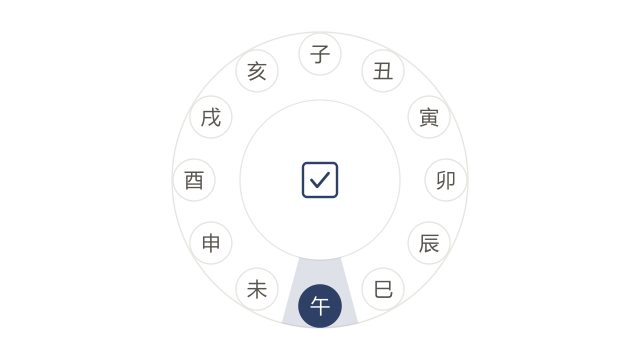
午 and the other eleven
Wu–Wei are a Six Harmony pair assigned to Earth. Peak Fire hands its output to late-summer Earth, but actual transformation depends on season and the rest of the chart; adjacency alone does not guarantee Earth takes command.
- 午 · 未Earth
午 in each of the four pillars
Year branch
Wu in the year branch may place visibility, performance or openly declared standards near the centre of the early environment. Praise and pressure can arrive through the same spotlight, so they should not be treated as the same signal.
Month branch
Wu in the month branch gives Fire its strongest seasonal command. The chart must account for heat and circulation: Water may regulate, Earth can receive output, while vulnerable Metal and dry Wood need more than a simple count of elements.
Day branch — spouse palace
Wu in the day branch places Yin Fire and Yin Earth in the spouse palace beneath a Yang Fire exterior. Warmth may be direct while care appears through practical follow-through; disagreement works better in private than in front of an audience.
Hour branch
Wu in the hour branch can make later work public-facing—teaching, leading, demonstrating or convening. A maintenance calendar matters as much as the launch, because repeated visibility consumes a reserve that applause does not refill.
The five 午 day pillars
Each stem that can sit on this branch makes a different pillar. Open one for the full profile.
- Yang Wood HorseYang Wood feeding peak Fire: a vision becomes visible fast, and its continuity depends on replenishing the source rather than admiring the flame.
- Yang Fire HorseBroad Fire seated at summer's centre: maximum reach and immediate response, disciplined by a boundary that is set before attention arrives.
- Yang Earth HorseYang Earth over peak Fire: heat can become structure and delivery, provided the result is not baked so hard that it cannot adjust.
- Yang Metal HorseYang Metal above a hot branch: public pressure can forge decisive form when tolerances are explicit and cooling is part of the process.
- Yang Water HorseMoving Water over noon Fire: contrast produces circulation and range, but both forces need a channel to avoid cancelling the task.
A classical note
At Wu, Yin and Yang meet; therefore it is called Wu.Records of the Grand Historian, Treatise on Pitch Pipes
The classical line treats noon as a crossover, not a permanent state of maximum Yang. Light peaks, then the cycle turns and Yin begins to return. That is why Wu carries exposure and reversal in the same image; it does not mean every Horse year or Wu branch produces an extroverted person.
Frequently asked questions
What does Wu mean in a BaZi chart?
Wu is a Yang Fire branch and the Horse sign. It marks 11:00–13:00, the month from Grain in Ear to Minor Heat and the south. Its hidden stems are Yin Fire and Yin Earth.
Why does a Yang Fire branch hide Yin stems?
Branch polarity and hidden stems describe different layers. Wu is outwardly Yang Fire, while its interior contains Yin Fire and Yin Earth. This fits its position around noon and the summer solstice: visible Yang is at its height as the inward turn begins.
Is a Zi–Wu clash always bad?
No. It opposes midnight Water and noon Fire, so it may change sleep, schedules, location, public exposure or emotional pacing. The clash can force a needed allocation between competing rhythms, or intensify instability when neither side has containment.
Does one Wu branch create self-punishment?
No. Self-punishment requires repetition, so at least two Wu branches must meet in the relevant natal or timing layers. Even then, it is a structural relation to evaluate with the full chart, not a guaranteed event or a personality diagnosis.
Was this article helpful?
Is the Horse branch in your chart, and in which pillar? Enter your birthday to check.
See your four branches
Calculate your full BaZi chart free — with longitude correction — and see which branches sit under your year, month, day and hour.
Calculate my chart free